
L. T. Stuurman 1*
1 Utrecht University, The Netherlands
* l.t.stuurman@students.uu.nl
Introduction
The long-term growth and maintenance of dunes depend strongly on aeolian transport (Rostal, 2024). Wind mobilizes grains, feeding the dunes and enabling adaptation to sea-level rise and storm impacts. Along the Dutch coasts, sediment availability is often the limiting factor, which has led to a policy of preserving the coastline through extensive nourishments (B.M. Hoonhout, 2017; Brand et al., 2022). Nourished sediment commonly differs in grain size distribution and shell content, which can strongly influence transport rates (van der Wal, 2000).
Despite the importance of aeolian beach-to-dune transport for long-term coastal safety, sediment transport models used in coastal planning typically rely on simplified representations of sand flux and uniform sediment properties that do not resolve small-scale processes well (Van IJzendoorn et al., 2023). Model calibration is therefore essential; however, field measurements often target large-scale processes, while laboratory experiments contain approximations of unknown variables. As a result, small-scale aeolian processes under controlled yet real field conditions remain underexplored. Bridging this gap requires novel experimental approaches that combine the benefits of controlled laboratory wind conditions, with the realism of in-situ field characteristics.
Objective and Methods
This study aims to quantify aeolian sediment transport of nourished beach sand under controlled laboratory conditions and to evaluate the applicability of co-registered Structure-from-Motion (SfM) photogrammetry for measuring small-scale morphological change. By conducting experiments in a mobile wind flume, the research seeks to bridge the gap between field observations and controlled laboratory measurements, providing a “laboratory on the beach” approach to coastal aeolian processes.
Aeolian transport rates were determined by collecting transported sediment during each run and converting the measured mass to volumetric flux using bulk density estimates. Simultaneously, high-resolution surface models were generated using SfM from imagery acquired before and after each experiment. Photogrammetric processing produced digital elevation models, which are referenced and scaled to the flume’s internal geometry and differenced to quantify spatial patterns of erosion and deposition. Precision and reliability were assessed through repeated surface reconstructions and a comparison with reference volume differences.
Finally, a series of controlled flume experiments was conducted using sediment that mimics nourishment properties (i.e., mixtures were prepared to represent fine and coarser fractions, as well as different proportions of shell fragments). The morphological patterns and differences in transport volumes were analysed to determine trends between bed properties and realised aeolian transport.
Results
This study demonstrates that a combination of a mobile wind flume with high-resolution Structure-from-Motion (SfM) photogrammetry provides an effective approach to investigating small-scale aeolian processes under controlled field conditions. The method is able to resolve sub-millimetre surface changes, allowing ripple formation, scour development, and subtle redistribution patterns to be interpreted spatially, in addition to quantitative measurements of volume flux variations.
The achieved level of detail was shown to be valuable for understanding small-scale processes on nourished beaches. Experiments show that poorly sorted nourished sediments rapidly form armouring layers that suppress downwind transport beyond the initial coarse patches, and that increasing shell surface cover leads to a strong, nonlinear reduction in transport. Furthermore, the detailed SfM-derived pointclouds were shown to reliably detect changes in surface roughness within the flume through an analysis of the intra-cell standard deviation. All of the found trends and results show varying degrees of compatibility with results from prior research.
The combined experimental and SfM-based approach provides new insights into small-scale aeolian processes on nourished beaches, demonstrate the value of mobile flume experiments for improving process understanding, and thereby contributes to improved methods for calibration of variables in coastal aeolian transport modelling.
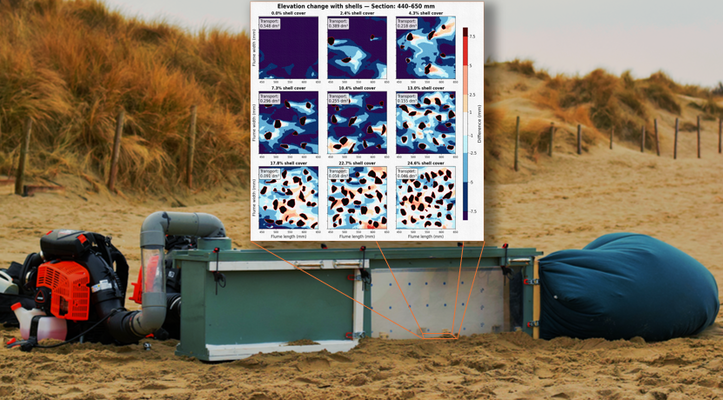
Figure 1: The flume in action at the Zandmotor! Including a Dem of Difference (DoD) with polygon overlay showing individual shell fragments.
References
Rostal, E. (2024). Dynamic Interactions of Coastal Dunes: Processes, Patterns, and Responses to Climate Change.
B.M. Hoonhout. (2017). Aeolian Sediment Availability and Transport [Delft University of Technology]. https://doi.org/10.4233/UUID:E84894D6-87D2-4006-A8C2-D9FBFACABDDC
Brand, E., Ramaekers, G., & Lodder, Q. (202a). Dutch experience with sand nourishments for dynamic coastline conservation – An operational overview. Ocean & Coastal Management, 217, 106008. https://doi.org/10.1016/j.ocecoaman.2021.106008
Van IJzendoorn, C. O., Hallin, C., Reniers, A. J. H. M., & De Vries, S. (2023). Modeling Multi‐Fraction Coastal Aeolian Sediment Transport With Horizontal and Vertical Grain‐Size Variability. Journal of Geophysical Research: Earth Surface, 128(7), e2023JF007155. https://doi.org/10.1029/2023JF007155
