
Cem Sevindik1*, Marrion Tissier1, Bas Hofland1, Ad J.H.M. Reniers1, Afshar Adeli Soleimandarabi2, Vincent Gruwez3, Peter Troch2
1 Department of Hydraulic Engineering, Delft University of Technology, the Netherlands; 2 Department of Civil Engineering, Ghent University, Belgium; 3 Flanders Hydraulics, Belgium
* Cem Sevindik: C.Sevindik@tudelft.nl
Introduction
To protect the coastal areas and prevent or minimize property damage and loss of life during extreme storms, hard and soft coastal protection structures, such as dikes and dunes, have been designed. However, climate change-induced rising sea levels and more extreme storms pose greater threats to these areas, particularly to low-lying countries like the Netherlands. Therefore, these coastal defences need to be modified to provide safety against more extreme conditions. One way to achieve this goal is to create dune-dike hybrid nature-based solutions (DD-hybrid NbS), which combine hard and soft defences (see Figure 1a). Although this innovation enables the creation of more conveniently integrated coastal protections with nature, existing knowledge on these structures is insufficient to describe their hydraulic response, such as mean wave overtopping discharge, which is an important design and safety criterion for coastal structures, under extreme storm conditions. In particular, it is unclear how the eroding dune and associated changes in the beach profile during the storm influence wave transformation and ultimately wave interaction with the dike. In this work, the mean wave overtopping discharge evolution of a representative dike-in-dune type DD-hybrid NbS is numerically studied under extreme storm conditions, as a part of the DuneFront project.
Objective and Methods
For dike safety assessment, it is typically assumed that the most critical conditions occur when wave heights and water levels (storm surge + tide) reach their maxima simultaneously. In this study, three different schematizations of a 35-hour-long extreme storm (Boers and Wouters, 2014) are considered. The classic storm schematization, in which the maximum water level and maximum wave height are in phase (Scenario 1), is compared to two additional scenarios in which the maximum water level is set to occur 5 hours before and after the maximum wave height (Scenarios 2 and 3, respectively). This is done to investigate how the time lag influences the morphological response of the hybrid structure and the resulting mean overtopping discharge.
This study is conducted in two parts. Firstly, for each storm scenario, the structure's morphological response is calculated using XBeach (Roelvink et al., 2009) in Surfbeat mode. For each scenario, bed profiles are collected to capture eroded profiles representing different phases of the storm. Secondly, simulations are performed in XBeach’s non-hydrostatic mode using the collected bed profiles. Hydrodynamic simulations are run for each profile for 2 hours to collect reliable statistics for the mean overtopping discharge over the dike’s seaward crest line.
Results
The geometry of the hybrid structure, applied offshore boundary conditions, and the simulation results for the mean overtopping discharges during the storm are shown in Figure 1. In Scenario 1, the maximum mean overtopping discharge occurs when the maximum water level and wave height coincide at t=0. Furthermore, results show that time steps around the peak of the storm with identical water level and wave conditions (e.g., blue lines at t=+/- 30 min in Fig.1b-c) experience different overtopping discharges. This is due to differences in bed profile (not shown), with more eroded bed profiles facing higher discharges.
Moreover, the maximum overtopping discharge reached during the storm depends on the storm scenario (Fig.1c). The highest and lowest maximum discharges occur in Scenarios 3 and 2, respectively. The bed profiles corresponding to these maximum discharges are shown in Fig 1a (coloured lines). The main difference is the horizontal length of the berm that develops in front of the dike following dune erosion. Scenario 2, with the lowest maximum discharge, corresponds to the profile with the longest berm, suggesting a protective role of this feature. To better understand the feedback between morphological evolution and overtopping, further numerical and physical modelling studies are underway.
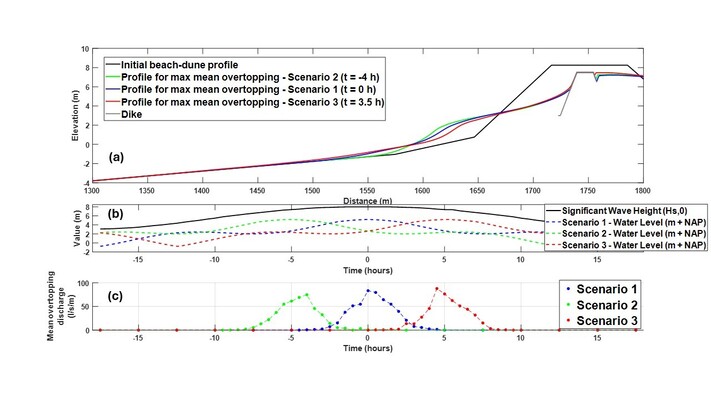
Figure 1 – Cross-section of the hybrid structure geometry (a), boundary conditions (b), and mean wave overtopping discharges for all three scenarios, during the 35-hour storm (c).
References
- Boer, S., & Wouters, J. (2014). Kustwerk Katwijk; verification dune body. Kustwerk Katwijk, Verificatie duinlichaam. Document number: Kwk-04vo-11100180-001. Revision 3 – final. 8-12-2014. (In Dutch).
- Roelvink, D., Reniers, A., Van Dongeren, A. P., De Vries, J. V. T., McCall, R., & Lescinski, J. (2009). Modelling storm impacts on beaches, dunes, and barrier islands. Coastal engineering, 56(11-12), 1133-1152.
