
O.E. Neshamar1*, B.E. Larsen1 , A. Petridis1
1 Technical University of Denmark
* Corresponding author: oeine@dtu.dk
Introduction
To model coastal sediment movement over large timescales and spatial scales, it is necessary to employ simplified ways of representing the wave hydrodynamics. One key simplification is to replace the irregular wave signal with an equivalent, regular representative wave. The application of such representative wave formulations has been shown to perform relatively well when modelling longshore-directed (parallel to the shoreline) sediment movement (Plecha et al. 2017, Roelvink et al. 2009). Cross-shore directed (perpendicular to the shoreline) sediment movement, on the other hand, is less well-understood and carries very high uncertainties, partly due to the increased significance of unsteady, intra-wave phase-lag effects (van der A et al, 2013). A fundamental question in this regard is whether the "representative wave" approach is valid for predicting cross-shore directed sediment movement under irregular waves. This work aims to investigate this question by way of numerical simulations. For a given representative regular wave, the parameters which describe the near-bed oscillatory velocities are the velocity amplitude U, flow period T, and the skewness S and asymmetry A of the timeseries (Abreu et al. 2010).
Objective and Methods
As part of a larger project aiming to develop an improved understanding of cross-shore sediment movement, a conceptual investigation is conducted investigating the practical viability of various representative wave formulations. This is done in three steps:
- Large-scale 2D RANS simulations are conducted in OpenFoam, modelling nearshore hydrodynamics on various beach profiles exposed to realistic irregular waves.
- Irregular velocity timeseries extracted from the OpenFoam simulations are used to drive a 1-D RANS model (MatRANS, Fuhrman et al. 2013), capable of modelling time-varying sediment movement. A series of simulations are conducted for each flow condition involving a wide range of sediment characteristics in order to obtain a large representative dataset.
- For each case, a number of different MatRANS simulations are performed using periodic representative wave conditions selected to match the irregular wave conditions.
Various definitions of representative U are tested, including (a) RMS flow amplitude URMS, and (b) significant flow amplitude US, defined as the highest 1/3rd of individual wave amplitudes. T is defined based on (a) the zero-crossing period TZC and (b) the peak spectral period Tp. The flow shape is selected to match the skewness and asymmetry of the signal, applying the formulation of Abreu et al. (2010).
Results
The figure shows preliminary results, showing predicted bedload (qB) and suspended load (qS) from simulations performed using a full irregular timeseries, as well as various representative wave formulations, on three sandbeds (d50 = 0.15, 0.30 and 0.45 mm). The presence of low-frequency “bound” waves in the timeseries results in large waves being correlated with offshore-directed mean velocities in the infragravity wave trough (Deigaard et al., 1999); as a result, the raw velocity signal has negative skewness, whereas if infragravity waves are filtered out, the signal has positive skewness. Representative waves generated from both "filtered" and "unfiltered" signals are included in the figure. Overall, none of the parameterisations tested appear to accurately predict the sediment transport. The filtered signal tends to overpredict onshore-directed transport, while the unfiltered signal often underpredicts transport. If using the filtered signal, URMS generally performs better than Us, while the opposite is often the case for the unfiltered signal.
The presentation will present results obtained for the full range of conditions, as well as a discussion on the best path forward for irregular wave parameterisation based on present observations.
Financial support is acknowledged from the European Research Council, Horizon 2020 Research and Innovation Program (Grant Agreement No. 101163534).
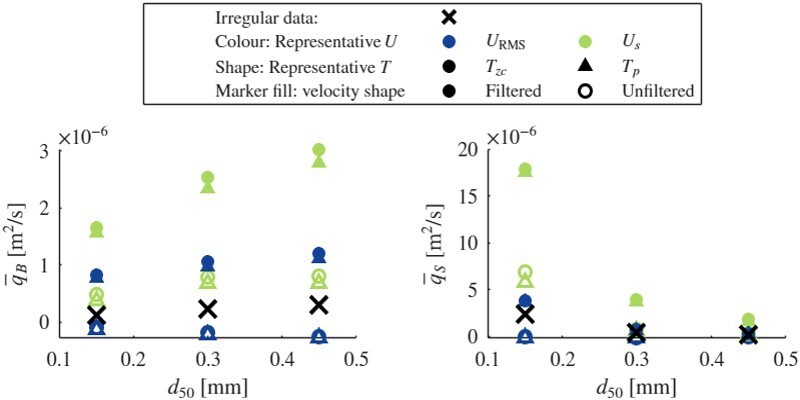
Net sediment transport under irregular velocity signals and corresponding representative wave cases.
References
Abreu, T., Silva, P. A., Sancho, F., & Temperville, A. (2010). Analytical approximate wave form for asymmetric waves. Coastal Engineering, 57(7), 656–667.
Deigaard, R., Jakobsen, J. B., & Fredsøe, J. (1999). Net sediment transport under wave groups and bound long waves. Journal of Geophysical Research: Oceans, 104(C6), 13559–13575.
Fuhrman, D. R., Schløer, S., & Sterner, J. (2013). RANS-based simulation of turbulent wave boundary layer and sheet-flow sediment transport processes. Coastal Engineering, 73, 151–166.
Plecha, S., Sancho, F., Silva, P., & Dias, J. M. (2007). Representative Waves for Morphological Simulations. Journal of Coastal Research, 50(sp1).
Roelvink, D., Reniers, A., Van Dongeren, A., Van Thiel De Vries, J., McCall, R., & Lescinski, J. (2009). Modelling storm impacts on beaches, dunes and barrier islands. Coastal Engineering, 56(11–12), 1133–1152.
van der A, D. A., Ribberink, J. S., van der Werf, J. J., O’Donoghue, T., Buijsrogge, R. H., & Kranenburg, W. M. (2013). Practical sand transport formula for non-breaking waves and currents. Coastal Engineering, 76, 26–42.
