
M. Daugharty1*, S. Kamminga1, J. Valk1, R. van Dorp1, O.López2
1 Nortek, Netherlands; 2 INNOVA oceanografía litoral SL, Spain
* Corresponding author: maeve.daugharty@nortekgroup.com
Introduction
In September 2025, Nortek Netherlands deployed a Nortek Vessel Mounted Ocean Signature100 in the Strait of Gibraltar (SoG) region to sample currents and quantify instrument capabilities in a dynamic environment. The Signature100 has four beams for currents and bottom track and a fifth beam echosounder. The echosounder can be used to sample water column content such as fish, zooplankton, phytoplankton, and suspended sediment.
Flow in the SoG consists of an eastward, approximately 125 meter (m) thick Atlantic Ocean surface layer and an underlying westward, Mediterranean Sea layer (Sverdrup et al., 1942). Currents in the SoG are rapid, bathymetry is complex, and mixing is rigorous (Sverdrup et al., 1942). Barotropic forcing includes the Levanter winds Poniente winds, atmospheric pressure gradients, and tides. Westward tidal currents through the SoG reduce Atlantic inflow, while eastward tidal currents enhance it (Sverdrup et al., 1942). The build up and release of tidal energy at Camarinal Sill into an eastward train of internal solitary waves (solitons) is well studied (Bolado-Penagos et al., 2023).
With a dynamic environment to explore, we asked: What oceanographic features can be detected? Is the Signature100 range-limited by the boundary between the Atlantic Ocean and Mediterranean Sea layers?
Objective and Methods
A Signature100 was pole-mounted from the side of the AS ONE vessel to replicate the setup and challenges of many of our users. The AS ONE is a 22.85 m long vessel fabricated from naval steel with two propulsion engines (339 kW) located on either side of the vessel about 7 meters (m) from the rear. Two ANSI316 mounting brackets were welded to the starboard (right) side of the vessel about 8 to 10 m from propulsion engines and safely away from fuel tanks.
Track timing incorporated soliton travel times from Camarinal Sill presented in Bolado-Penagos et al., 2023 in conjunction with spring high tide to increase the chance of intercepting internal waves. Currents, amplitudes, and echosounder output were analyzed to identify physical features.
Results
Figure 1 displays features of a track sailed roughly parallel to the SoG exit. An eastward layer several tens to 160 m thick and an underlying layer of westward outflow are acoustically resolved. Current speeds approach 2.0 m/s in the upper layer, are 0.2 to 1.0 m/s in the lower layer, and < 0.2 m/s in the thin, intermediate layer. In the first 10 km of track, the upper regions of the echogram and Beam 1 amplitude show oscillatory, high intensity structure containing plumes that extend beyond the upper layer observed in currents. The profiling range, which extends to a range of 200 to 320 m, appears to have been enhanced by scatterers in this structure.
Wave structure in the along-channel velocity field and its horizontal shear (∂u/∂x) is symmetric; leading and trailing edges of waves have similar magnitudes and slopes. The dominant fronts characteristic of solitons are not observed. The upper, eastward layer of the across-channel velocity field is negative, and the lower, westward layer is positive, indicating Coriolis effects. Mirrored, phase-shifted structure in the across-channel velocity further illustrates Ekman circulation within the internal wave. Although soliton-asymmetry is absent, the Signature100 resolved a tidally-generated internal wave and the vertical structure of the Coriolis response in a stratified fluid.
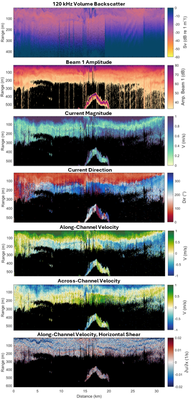
Figure 1 ~ Signature100 track. Top to bottom: Relative volume backscatter (Sv); Beam 1 amplitude; Current magnitude; Current direction; Along-channel velocity. Across-channel velocity. Along-channel horizontal velocity shear. Black values are below the quality threshold (-110 dB for the echosounder, 35 dB amplitude + 50% correlation for currents).
References
Bruno, M., Van Haren, H., 2023. Analysis of internal soliton signals and their eastward propagation in the Alboran Sea: exploring the effect of subinertial forcing and fortnightly variability. Progress in Oceanography 217, 103077. https://doi.org/10.1016/j.pocean.2023.103077
Sverdrup, H.U., Johnson, M.W., Fleming, R.H., 1942. The Oceans: Their Physics, Chemistry, and General Biology. Prentice-Hall, Inc., New York.
