

T. Leijnse*1, D. Eilander1,2 , R. de Goede1, N. Fraehr3
1 Deltares, NL; 2 Vrije Universiteit Amsterdam, NL; 3 The University of Melbourne, Australia
* Corresponding author: Tim.Leijnse@deltares.nl
Introduction
Probabilistic flood risk assessments and flood early warning systems are essential tools for managing and responding to disastrous flood events, particularly in coastal deltas where flooding is often compound. Compound floods arise from interacting drivers such as rainfall, river discharge, and coastal surge, posing challenges for risk assessment due to their stochastic nature (Wahl et al., 2015). Traditional hydrodynamic models (e.g., Delft3D-FM (Kernkamp et al., 2011), ADCIRC (Luettich et al., 1992)), while accurate, are computationally expensive for ensemble forecasting and probabilistic analysis. While efficient hydrodynamic models for compound flooding have been developed, such as SFINCS (Leijnse et al., 2021), still trade-offs in the model resolution, model extent and/or number of simulations have to be made. Surrogate models using Machine Learning offer a promising alternative to further speed up computations, but most existing approaches focus on single drivers or static flood conditions, limiting their applicability to compound events.
Objective and Methods
The hybrid SFINCS-LSG surrogate model addresses these gaps by integrating low-resolution SFINCS simulations with Empirical Orthogonal Function (EOF) decomposition and Sparse Gaussian Process learning (Fraehr et al., 2023, 2022) to emulate high-resolution flood dynamics. For new events to simulate, the approach combines a simulation of the low-resolution hydrodynamic model with the trained surrogate model, to predict high-resolution water depths at low computational costs. While this hybrid model setup has successfully been applied for riverine flooding, it has not yet been used to predict compound flooding from multiple drivers.
Besides the need for predictions with an uncertainty sufficient for decision-making, models ideally also need to be ‘actionable’ with the ability to incorporate flood mitigation and prevention scenarios (e.g., adding a dike), and computational speed compatible with operational forecast cycles (<10 min) and large spatial scales (>1000 km).
Two case studies, Charleston, USA, and Brisbane, Australia, were selected to evaluate model performance under diverse flood conditions. Training datasets were generated by scaling historical events decomposed to individual flood drivers to ensure coverage of diverse flood conditions. Model skill was assessed against high-fidelity SFINCS simulations using Critical Success Index (CSI) for flood extent and Root Mean Square Error (RMSE) for flood depth.
Results
Our results showed that SFINCS-LSG achieved speed-ups of 50–150× compared to high-fidelity SFINCS simulations with good accuracy. The median RMSE for flood depth was 0.06 m for the Charleston and 0.36 m for Brisbane cases, with a CSI of 0.96 and 0.91 respectively. However, performance varied by flood type due to large variability in extent between coastal and compound or pluvial-fluvial events.
The compression of spatial information through EOF analysis introduced noise, which constrained the model’s ability to reproduce dominant flood driver zones. Very large coastal domains and the inclusion of flood mitigation and prevention strategies will be evaluated in future work. However, because in the presented hybrid model setup still numerical SFINCS models are run – that can include these flood prevention measures – there is potential for the SFINCS-LSG to also be actionable in this regard.
The presented approach demonstrates potential for real-time forecasting and probabilistic risk analysis where many simulations are required. This research advances state-of-the art surrogate models by capturing dynamic spatiotemporal flood evolution under multi-driver conditions rather than static peak inundation. Overall, the SFINCS-LSG framework offers a scalable solution for accelerating coastal compound flood modelling at a limited loss of accuracy.
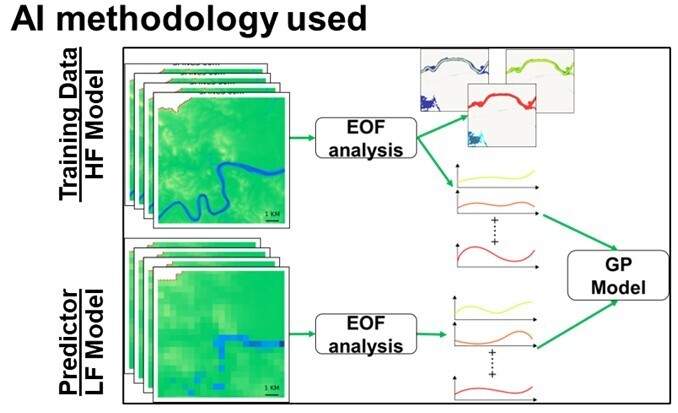
Overview of modelling approach with High Fidelity (HF) and Low Fidelity (LF) flood maps generated by SFINCS for training data and initial prediction, with link through Empirical Orthogonal Function ( EOF) analysis and Gaussian Processes (GP) model to upscale LF flood maps in surrogate model setup.
References
Fraehr, N., Wang, Q.J., Wu, W., Nathan, R., 2023. Development of a Fast and Accurate Hybrid Model for Floodplain Inundation Simulations. Water Resources Research 59, e2022WR033836. https://doi.org/10.1029/2022WR033836
Fraehr, N., Wang, Q.J., Wu, W., Nathan, R., 2022. Upskilling Low‐Fidelity Hydrodynamic Models of Flood Inundation Through Spatial Analysis and Gaussian Process Learning. Water Resources Research 58, e2022WR032248. https://doi.org/10.1029/2022WR032248
Kernkamp, H.W.J., Van Dam, A., Stelling, G.S., De Goede, E.D., 2011. Efficient scheme for the shallow water equations on unstructured grids with application to the Continental Shelf. Ocean Dynamics 61, 1175–1188. https://doi.org/10.1007/s10236-011-0423-6
Leijnse, T., van Ormondt, M., Nederhoff, K., van Dongeren, A., 2021. Modeling compound flooding in coastal systems using a computationally efficient reduced-physics solver: Including fluvial, pluvial, tidal, wind- and wave-driven processes. Coastal Engineering 163, 103796. https://doi.org/10.1016/j.coastaleng.2020.103796
Luettich, R.A.J., Westerink, J.J., Scheffner, N.W., 1992. ADCIRC: An Advanced Three-Dimensional Circulation Model for Shelves, Coasts, and Estuaries. Report 1. Theory and Methodology of ADCIRC-2DDI and ADCIRC-3DL. Coastal Engineering Research Center Vicksburg MS.
Wahl, T., Jain, S., Bender, J., Meyers, S.D., Luther, M.E., 2015. Increasing risk of compound flooding from storm surge and rainfall for major US cities. Nature Clim Change 5, 1093–1097. https://doi.org/10.1038/nclimate2736
