
Laura Brakenhoff1*, Edwin Elias2, Harry de Looff1, Carola van Gelder-Maas1, Ad van der Spek2
1 Rijkswaterstaat, The Netherlands; 2 Deltares, The Netherlands
* Corresponding author: laura.brakenhoff@rws.nl
Introduction
Since 1990, the Dutch coastal safety is successfully preserved by applying nourishments to keep the coastline in place. Structural coastline retreat has been halted, and on average the coastline has even moved seaward since the introduction of regular nourishments (Brand et al., 2021). The long-term effectiveness of the policy in the Wadden area is uncertain, as the system may become increasingly sediment-limited under accelerated sea-level rise.
As part of the Kustgenese 2.0 research program, a pilot nourishment of 5.45 million m³ of sand was executed on the ebb-tidal delta of Ameland inlet in 2018-2019. The nourishment was placed on the ebb shield, that plays a key role in wave-driven sediment redistribution and longshore transport. The primary objective was not directly related to shoreline stabilization, but to investigate whether ebb-tidal deltas can function as effective sediment buffers that supply sand to adjacent islands and the coastal system (Rijkswaterstaat, 2020; Elias et al., 2020). The nourishment was accompanied by an extensive field measurement program to quantify hydrodynamics, sediment transport, morphological change, and ecological effects. Bathymetric surveys continued till today, creating a unique dataset of 22 maps between 2018 and 2025, to investigate the evolution of the nourishment and the ebb-delta morphodynamics.
Objective and Methods
The objective of our study is to analyse how the nourishment evolves in space and time and how the sand is redistributed by waves and tidal currents within the ebb-delta system. We investigate the extent to which the nourishment interacts with the natural dynamics of the ebb-tidal delta, including shoal migration and sediment pathways toward the adjacent island s.
The bathymetric surveys were used to construct an “active sediment budget” of the nourishment and the larger scale ebb-tidal delta. The “active sediment” concept shifts sediment budgeting away from net bed-level change alone toward identifying which sediment volumes actually participate in coastal morphodynamics (Taal et al., 2023; Elias et al., 2024). This enables more realistic estimates of sediment exchange and improves interpretation of nourishment effects. This provides a stronger basis for developing coastal management strategies under (accelerated) sea-level rise. Active sediment volumes are computed using the minimum depth principle (Pearson et al., 2022). In addition, the net volumetric change was calculated. Through this method we can obtain estimates of the volumes of sediment that are contained on the ebb-tidal delta, its shoals and the nourishment.
Results
The nourishment was placed on the north-northwestern flank of the Kofmansbult (Figure 1). Construction took place between March 2018 and February 2019, and in total 5.45 million m³ of sediment was deposited (van Rhijn, 2016; Ebbens, 2019). Immediately after completion, the nourishment experienced an adjustment phase, particularly during the first winter storm season, during which substantial erosion occurred (erosion rates of 7800 m3/day). After the first year, the nourishment volume reduced to 3.5 million m3. By 2025, the nourishment is no longer visible in the ebb-delta topography and in the sediment budget. Over the entire time frame the erosion rate equaled 0.90 million m3/year. A detailed analysis of the nourishment development shows that most of the sediment moved to the north and merged with the northern ebb shields and shoal areas. Although over 5 million m3 of sediment was added to the system, the outbuilding and eastward migration of the ebb-shields continued.
Therefore, the pilot demonstrated that a nourishment of this magnitude can be constructed on the ebb-tidal delta without significantly altering the natural morphodynamic behaviour of the system, while providing valuable insight into sediment redistribution pathways and the long-term role of ebb-tidal delta nourishments in coastal sediment management.
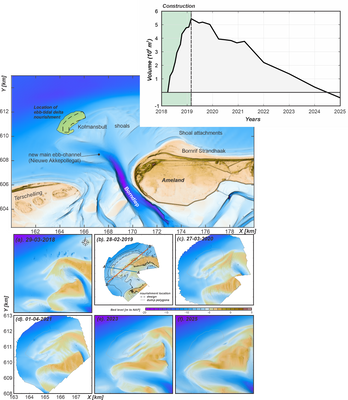
Figure 1: Overview of the location and morphodynamic evolution of the Ameland ebb-tidal delta nourishment. The upper right panel displays the volume development of the nourishment between start of construction in March 2018 and present-day (2025).
References
Brand, E., Ramaekers, G., Lodder, Q. (2021). Dutch experience with sand nourishments for dynamic coastline conservation – An operational overview. Ocean & Coastal Management 217: 106008 https://doi.org/10.1016/j.ocecoaman.2021.106008
Ebbens, E. (2019). Tussenrapportage pilotsuppletie buitendelta Amelander Zeegat. Rijkswaterstaat.
Elias, E., Grasmeijer, B., Nolte, A., Oeveren-Theeuwes, C. van, Oost, A., Spek, A.J.F. van der, Tonnon, P.K., Wang, Z., Werf, J. van der. (2020). Kustgenese 2.0 – Integrale synthese: Belangrijkste conclusies uit drie jaar onderzoek naar de langetermijnkustontwikkeling (2017–2020). Deltares rapport 1220339-009-ZKS-0008.
Elias E.P.L., Quataert, E., Taal, M., Vermeer, N, (2024). Sedimentbalans Nederlandse kust, Deltares rapport 11207897-002-ZKS-0007
Pearson, S.G., Elias, E.P.L., van Prooijen, B.C., van der Vegt, H., van der Spek, A.J.F., Wang, Z.B., (2022). A novel approach to mapping ebb-tidal delta morphodynamics and stratigraphy. Geomorphology 405: 108185 https://doi.org/10.1016/j.geomorph.2022.108185
Rijkswaterstaat. (2020). Kustgenese 2.0: Kennis voor een veilige kust. Rapport WVL1220ZB001.
Taal M., Quataert, E., van der Spek, A., Huisman, B., Elias, E. Wang, Z., Vermeer, N. (2023). Sedimentbehoefte Nederlands kustsysteem bij toegenomen zeespiegelstijging. Deltares rapport 11207897-002-ZKS-0004, 115 p.
van Rhijn, M.W., (2019). Sediment transport during the execution of the pilot nourishment Ameland Inlet. MSc. Thesis, Delft University of Technology, Delft,197 pp.
