

C. Fan1*, L. Harris2 , K. Beasley-Polko2, C. Hodgkins2, J. Testa2
1 Yale School of the Environment, United States of America; 2 University of Maryland Center for Environmental Science, United States of America
* Corresponding author: christopher.fan@yale.edu
Introduction
Water flow impacts many oyster reef processes, such as food availability and the transport and composition of particulate matter. The three-dimensional structure of the reef in turn creates feedback on local hydrodynamics and particle transport processes, generating drag on current velocities that slows down particles in the water column. This drag allows for more concentrated particle settling and increased filtration rates (Styles 2015; Wright et al., 1990). Here we describe an effort to deploy tilt meters to document hydrodynamic conditions on oyster reefs alongside water quality measurements of chlorophyll and turbidity. Typically, current velocity is measured using Acoustic Doppler Current Profilers (ADCP) which utilize sound waves. For our study, we explored tilt meters as a low-cost alternative. Previous studies have suggested that tilt meters and ADCP can yield similar water velocity readings in saltwater systems (Lowell et al., 2015). However, there is not much prior work done utilizing tilt meters in mesohaline systems such as the Chesapeake Bay.
Objective and Methods
First, we evaluated the accuracy of tilt meters in a mesohaline setting. Tilt meter and ADCP water velocity data were collected at the University of Maryland Center for Environmental Science's Chesapeake Biological Laboratory research pier. Time series and regression models were then created to observe patterns and correlations of the two sensors. Second, we deployed the tilt meters and analyzed the relationship between water quality and water velocity in a restored oyster reef in the St. Mary’s River in Maryland, USA. Three tilt meters and a water quality sonde were deployed at various locations around the reef. Time series and regression models were created to observe trends and relationships between water quality parameters, specifically turbidity and chlorophyll-a concentrations, and water velocity.
Second, we deployed the tilt meters and analyzed the relationship between water quality and water velocity in a restored oyster reef in the St. Mary’s River. Three tilt meters and a water quality sonde were deployed at various locations around the reef. Timeseries and regression models were created to examine trends and relationships among water quality parameters, such as turbidity and chlorophyll-a concentrations, and water velocity.
Results
Water velocity measurements from both the tilt meter and the ADCP showed strong temporal agreement, with consistent patterns of increasing and decreasing speeds over time. This temporal consistency suggests that tilt meters can feasibly identify distinct tidal phases. Despite the alignment in timing, the actual velocity values recorded by each device differed. Tilt meters were found to overestimate ADCP readings by an average of 0.56 cm/s. Although tilt meter values were often higher than those recorded by the ADCP, the two instruments exhibited a moderately strong correlation.
Analysis of turbidity and chlorophyll-a in relation to current speed revealed no significant relationship between water quality and velocity at the St. Mary’s River site. This weak relationship suggests that factors other than water velocity may play a more influential role in determining turbidity and chlorophyll-a concentrations. To better understand these dynamics, additional data from multiple oyster reef sites are needed to evaluate whether this pattern is consistent across different locations and environmental conditions.
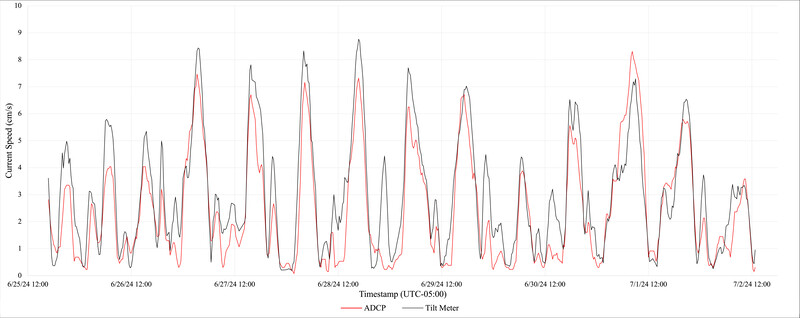
Timeseries of Tilt Meter and ADCP current velocity measurements.
References
Lowell, N. S., D. R. Walsh, and J. W. Pohlman. 2015. A comparison of tilt current meters and an acoustic doppler current meter in vineyard sound, Massachusetts. In 2015 IEEE/OES Eleveth Current, Waves and Turbulence Measurement (CWTM), 1–7. St. Petersburg, FL: IEEE. https://doi.org/10.1109/CWTM.2015.7098135.
Styles, R. 2015. Flow and Turbulence over an Oyster Reef. Journal of Coastal Research 314:
978–985. https://doi.org/10.2112/JCOASTRES-D-14-00115.1.
Wright, L. D., R. A. Gammisch, and R. J. Byrne. 1990. Hydraulic Roughness and Mobility of
Three Oyster-Bed. Journal of Coastal Research 6.
