
M.A. Wassink1*, D.S. van Maren1,2 , Y. Huismans1,2, Z.B. Wang1,2
1 Delft University of Technology, The Netherlands; 2 Deltares, The Netherlands
* Corresponding author: m.wassink-2@tudelft.nl
Introduction
Accelerated sea level rise (SLR) is threatening many coastal systems around the world. One example is the Wadden Sea, a UNESCO world heritage site because of its extensive channel-shoal system. The intertidal area of the Wadden Sea provides a feeding ground for migratory birds, and plays an important role in wave attenuation. Without sufficient sediment accretion, the intertidal area may shrink, impacting the ecosystem and coastal safety. The observed accretion rates of intertidal area in the German Wadden Sea are much higher than current SLR rates whereas accretion rates in the Dutch Wadden Sea are much lower than in German basins and also likely lower than current SLR rates.
Understanding the present-day (and predicting the future) response of the tidal flats in the Dutch-German Wadden Sea requires differentiation between sand and mud, especially given potential limitations in availability of fine-grained sediments (Colina Alonso et al., 2024).
Objective and Methods
This study aims to understand the long-term evolution of tidal flats to improve predictions of their response to SLR. Therefore, this study investigates different methods and variables to describe whether the Wadden Sea, and especially its tidal flats, can keep pace with SLR. Based on the works of Pineda Levia (2025), Colina Alonso (2024) and Elias (2012), different approaches of calculating sediment budgets are compared. Bathymetric data from 1996-2022 is used, to determine the accretion and erosion of sand and mud across the Dutch and German Wadden Sea. The variables considered include the basin-wide budget, and for intertidal area specifically the extent, volume and height development are calculated. Furthermore, the effect of the changing mean high water and mean low water values on these budgets are considered.
Results
Preliminary results indicate that German basins are accreting more sediment than Dutch basins. Both total basin budgets, and intertidal area budgets specifically, have higher values in the German basins, especially in the German bight. The Dutch basins are accreting, and on the basin-wide scale the sediment volume is enough to keep pace with SLR. However accretion rates on intertidal area is insufficient to keep pace with present-day rates of SLR, and as a result the intertidal area extent and volume is declining over time. However, not only the degree of this decline is sensitive to methodological aspects such as the evaluated time period and definition of reference water levels, but also the definition of tidal flat accretion (e.g. using height or volume). A systematic analysis of the relative importance of these aspects identifies a range of morphological responses of intertidal flats in the Dutch-German Wadden Sea to human interventions and sea level rise, and provides explanations for the apparently contrasting conclusions drawn as part of earlier studies.
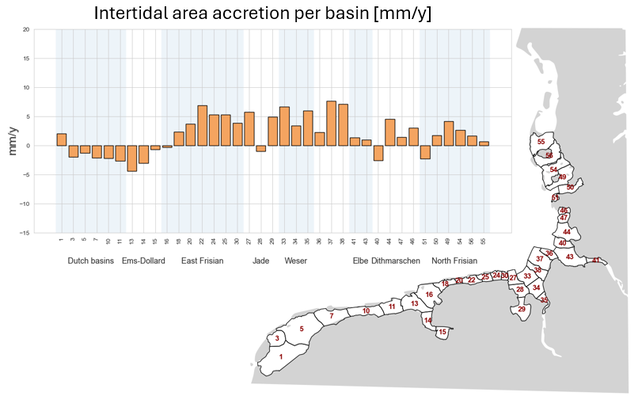
Intertidal area accretion in mm/year per tidal basin, based on a calculation using changing water levels over time. The numbers on the x axis correspond to basin numbers, indicated on the map. Geographical regions are grouped and named, indicated by light blue or white shading.
References
Colina Alonso, A., van Maren, D. S., Oost, A. P., Esselink, P., Lepper, R., Kösters, F., Bartholdy, J., Bijleveld, A. I., & Wang, Z. B. (2024). A mud budget of the Wadden Sea and its implications for sediment management. Communications Earth & Environment, 5(1), 1–9.
Elias, E. P. L., Van Der Spek, A. J. F., Wang, Z. B. & De Ronde, J. (2012) Morphodynamic development and sediment budget of the Dutch Wadden Sea over the last century. Neth. J. Geosci. - Geol. En Mijnb. 293–310,
Pineda Leiva, D., Lorenz, M., Kösters, F., Winter, C., & Lepper, R. (2025). Asymmetric morphodynamics of the Wadden Sea. Communications Earth & Environment, 6(1), 1–13.
