T.J. van Veelen1,2*, P.C. Roos1, V.R.M. Van Lancker2,3, D. Van den Eynde2, S.J.M.H. Hulscher1
1 University of Twente, The Netherlands; 2 Royal Belgian Institute of Natural Sciences, Belgium; 3 Ghent University, Belgium
* Corresponding author: t.j.vanveelen@utwente.nl
Introduction
Marine sand extraction demands for coastal nourishments, land reclamation, and the construction industry are rising rapidly on the Netherlands and Belgium Continental Shelves (NCS & BCS), also driven by increasing needs for nourishments due to sea level rise. Extraction from the NCS currently amounts to 25 Mm3 per year and is expected to double by the second half of this century, whereas extraction from the BCS was around 3 Mm3 in 2025 (Figure 1).
Sandbanks are an attractive location for extraction due to the large volume of sand contained within them and the shallow depth of their crests. However, intensifying extractions from these bedforms may alter the natural sediment composition (Wyns et al., 2021), as well as bank morphodynamics due to increasing scarcity (van Veelen et al., 2024). This poses a severe threat to ecosystem services provided by tidal sandbanks, such as coastal protection and as a foundation for offshore windfarms, but indirectly also for protected habitats and species that are further away.
Objective and Methods
Considering the intensifying pressures on sandbanks caused by extractions, our aim is to support users with the knowledge and tools to minimize the morphodynamic impacts of extraction in the form of a sand extraction toolbox, developed through a co-creation process.
A key component of our co-creation process carried out in the BANX project is understanding the contrasting settings of the NCS and the BCS, which is essential to incorporate the perspectives of users working on both parts of the North Sea and to ensure that the toolbox is applicable to these unique settings. Through an interactive workshop, user interviews, and policy review an understanding of both environments has been obtained.
Results
The NCS is a large continental shelf (~57,000 km2), partially covered by sandbanks (Dutch Banks, Zeeland Banks), with large sand budget available of approximately 26 billion m3 in the current reservation zone (Deltares, 2023). Pits are normally permitted up to 6 m deep, although exceptions have been made up to 20 m deep. Despite the large sand budget, the co-creation process has identified scarcity of specific grain sizes and potentially lasting impacts on the Zeeland Banks.
In contrast, the BCS is a small continental shelf (3,457 km2), which is almost fully covered by sandbanks, but is otherwise scarce in sediment (~600 Mm3, Degrendele et al., 2017) with non-erodible layers occurring in between the sandbanks. Extraction on sandbanks is only permitted up to a reference level, which is set based on the thickness of the quaternary layer and criteria related to the European Marine Strategy Framework Directive (Degrendele et al., 2017). The co-creation process has identified threats to future sediment supply and opportunities for smart monitoring of bedforms.
These outcomes provide essential input to the development of the sand extraction toolbox.
Acknowledgements
This publication is part of the project BANX with file number 20622 of the Open Technology Program, which is (partly) financed by the Dutch Research Council (NWO).
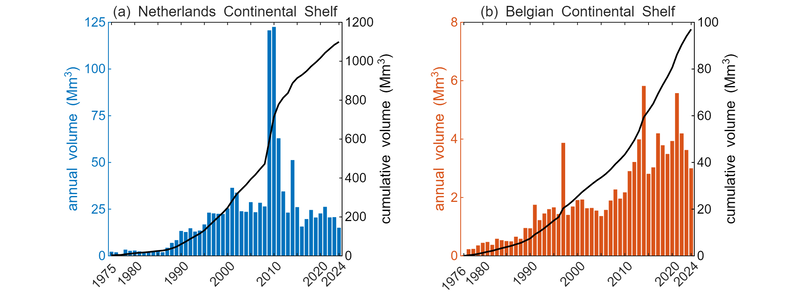
Trend in annual sand extraction volumes: (a) NCS, (b) BCS. Solid lines show the cumulative volumes. Data NCS: ICES (2019, 2026). Data BCS: ICES (2006, 2026), Roche et al. (2017). Note the different scales on the vertical axes in both figures.
References
Degrendele, K., Roche, M. & Vandenreyken, H., (2017), New limits for the sand extraction on the Belgian part of the North Sea? In: Degrendele et al. (Eds.), Belgian Marine Sand: A Scarce Resource? Proceedings of the Study Day (9 June 2017).
Deltares, (2023), Oplossingsrichtingen ten behoeve van de beschikbare zandvoorraad.
ICES, (2006, 2019), Reports of the Working Group on the Effects of Extraction of Marine Sediments on the Marine Ecosystem (WGEXT).
ICES, (2026). North Atlantic Marine Aggregates Application (NAMAAP). Retrieved 20 February 2026 from https://rconnect.cefas.co.uk/wgext_dash/.
Roche, M., Degrendele, K., Vandenreyken, H. & Schotte, P., (2017), Multi time and space scale monitoring of the sand extraction and its impact on the seabed by coupling EMS data and MBES measurements. In: Degrendele et al. (Eds.), Belgian Marine Sand: A Scarce Resource? Proceedings of the Study Day (9 June 2017).
van Veelen, T.J., Roos, P.C. & Hulscher, S.J.M.H., (2024), Modelling the cross-sectional dynamics of tidal sandbanks in sediment-scarce conditions. Journal of Geophysical Research: Earth Surface, 129(4), e2023JF007308.
Wyns, L., Roche, M., Barette, F., Van Lancker, V.R.M., Degrendele, K., Hostens, K., & De Backer, A., (2021), Near-field changes in the seabed and associated macrobenthic communities due to marine aggregate extraction on tidal sandbanks: A spatially explicit bio-physical approach considering geological context and extraction regimes. Continental shelf Research, 229, 104546.
