

L. van Asselt1*, P.M. Bayle1, R.D. Mills-Williams2, A.J.H.M. Reniers1, B. Hofland1, T.S. van den Bremer1
1 Delft University of Technology, Netherlands; 2 Edinburgh Designs Ltd., United Kingdom
* Corresponding author: L.vanAsselt@tudelft.nl
Introduction
Waves play an important role in coastal science (e.g. sediment and pollutant transport) and in the design of hydraulic structures (e.g. loads, overtopping, runup). One way to study the effects of waves is using scaled physical modelling in a laboratory, where waves are generated by a wavemaker. For the generated waves to be as close as possible to realistic waves, it requires the generation to be accurate up to second order. This means that besides the first order harmonic, the second order super-harmonic (double the frequency) and sub-harmonic (long bound wave) also have to be generated correctly.
The control signal of a wavemaker prescribes the paddle position in time so that the desired waves are generated. There are multiple theories that can be used to calculate the control signal up to second order, of which two will be discussed here: the broad-band and the narrow-band theory. The broad-band theory makes no assumptions about the type of wave spectrum and is described in Schäffer (1996). The narrow-band theory (van Leeuwen & Klopman, 1996) assumes a narrow wave spectrum, which results in simpler and faster calculations, but leads to inaccuracies for a broad spectrum.
Objective and Methods
The first objective of this study is to compare the two theories and make sure they agree with each other. With a sufficiently narrow wave spectrum, both theories are valid and can therefore be verified against each other. The second objective is to quantify the error associated with a broad spectrum when using the narrow-band theory.
To achieve these objectives, the theoretical paddle position is calculated with both theories for varying relative water depths varying from shallow to deep water (kh=0.28, 0.58, 1.0, 1.6, 3.1, with k the wavenumber and h the water depth). The broad-band theory is calculated with a MATLAB code from Edinburgh Designs Ltd. and the narrow-band theory is implemented in a separate code. A Gaussian wave spectrum for a focussed wave group is used. The spectral width is indicated by the variable ν, taken as ν=0.02 for a narrow spectrum and ν=0.10 for a broad spectrum.
To quantify the difference between the narrow-band (nb) and broad-band (bb) theory, the relative error of the maximum paddle position is used. The relative error is defined as (nbmax - bbmax)/bbmax.
Results
In Figure 1, the relative error for the first order, super-harmonic and sub-harmonic are shown as a function of kh for both a narrow and a broad spectrum. Considering the results for a narrow spectrum, the relative error of the first order is very low. Through this study, a shallow water assumption was found in van Leeuwen & Klopman (1996), leading to an incorrect super-harmonic signal in intermediate and deep water (dashed line). This study also derives a novel, general super-harmonic equation (not shown), for which the relative error is very low (plain line). The sub-harmonic has a larger relative error but this is reduced to below 1.5% when the accuracy is increased by increasing the repeat time and including more evanescent modes. This means that for a sufficiently narrow spectrum, the two theories do agree with each other. For the broader spectrum, the relative error increases for all harmonics, with a maximum increase of 8 percentage points for the super-harmonic signal.
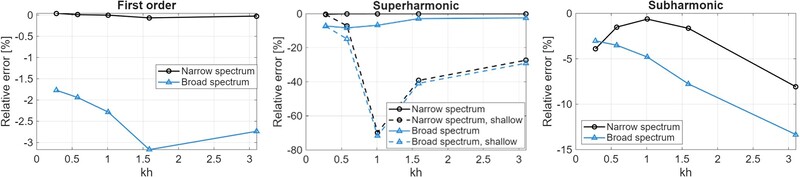
Figure 1: The relative error of the paddle position between the narrow-band and broad-band theory for the first order (left), super-harmonic (middle) and sub-harmonic (right). For the super-harmonic, the dashed line represents the incomplete formulation in van Leeuwen & Klopman (1996), while the plain line represents the new equation developed in this study. The black lines are for the narrow spectrum, the blue lines for the broad spectrum.
References
Schäffer, H. A. (1996). Second-order wavemaker theory for irregular waves. Ocean Engineering, 23 (1), 47-88.
van Leeuwen, P. J., & Klopman, G. (1996). A new method for the generation of second-order random waves. Ocean Engineering, 23 (2), 167-192.
