
R.L. Hulskamp1*, D.C. Hulskemper1, M. Pregnolato1, S. de Vries1
1 Delft University of Technology, Netherlands
* Corresponding author: r.l.hulskamp@tudelft.nl
Introduction
Coastal dunes are dynamic landforms shaped by interactions between wind, waves, sediment availability and vegetation. Short-term variations in external forcing drive alternating events of dune accretion and erosion. Despite these highly variable short-term events (hours to days), dune volumes often exhibit a gradual increase over longer timescales (years to decades). Current understanding on how short-term variability develops cumulatively over time is limited (Ruessink et al., 2022).
Recent advances in Unoccupied Aerial Vehicles (UAV) and UAV Laser Scanning (ULS) enable high-resolution monitoring of three-dimensional dune morphology at sub-seasonal temporal resolution and sub-metre spatial scales. These technologies offer new opportunities to measure short-term variability in addition to long-term trends.
In this study, we analyse one year of frequent high-resolution ULS measurements of an embryonic dune system at the Zandmotor (The Netherlands). Our aim is to quantify intra-annual morphological changes of the dune area and investigate how short-term sediment redistribution relates to the development of gradual dune volume growth at annual timescales.
Objective and Methods
This study uses a new data-driven framework to quantify intra-annual spatiotemporal variations in dune development. The framework enables automated extraction of dune morphology, volumetric change, vegetation presence, and relationship with wind forcing. We apply this framework to an embryonic dune system at the Zandmotor to evaluate whether and how previously observed gradual and spatially homogeneous annual dune growth (De Vries et al., 2012; Hulskamp et al., 2025) relates to intra-annual sediment redistribution processes.
The analysis consists of four steps:
- Sediment budgets are quantified using volumetric difference maps.
- Spatiotemporal patterns of sediment redistributions are identified by applying cluster analysis.
- The influence of vegetation on sediment capture and stabilisation is assessed by employing vegetation classification.
- Variability in sand storage and dune geometry across the system is examined using crest line analysis.
These steps provide a systematic approach to quantify and interpret dynamic dune evolution from high-frequency ULS datasets in both space and time.
Results
Our results demonstrate that the magnitude of short-term morphological changes in an embryonic dune system can substantially exceed long-term trends. Intra-annual sediment redistribution rates were measured up to six times larger than the annual net volume increase. Episodic redistribution reached 226 m3/day (equivalent to 82,490 m3/year), while the annual net gain equals 12,050 m3/year.
Despite the large magnitude of measured short-term morphological changes, the system displays a coherent growth trajectory in the long-term. We propose two complementary mechanisms to explain how larger short-term changes may result in smaller long-term gradual behaviour.
First, vegetation facilitates sedimentation up to a finite capacity. This sedimentation is likely limited by physical and biological constraints related to vegetation traits that remain relatively constant over time. This sedimentation (or capture) capacity may enable the gradual accumulation over longer timescales.
Second, some deposited sediment remains mobile, for instance in the lee side of a vegetation patch. Sediment can be remobilised, until it encounters stabilising conditions (again). This persistent redistribution of mobile sediment can generate substantial short-term variability within a relatively coherent long-term growth signal at the system scale.
Our findings suggest that, despite local complexity and short-term variability, long-term dune development can exhibit more predictable patterns.
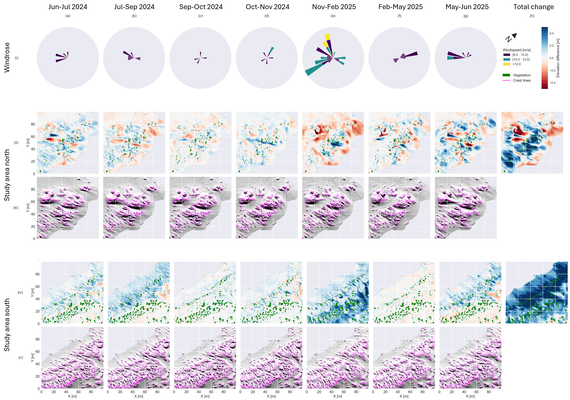
Short-term and long-term difference maps of two areas in the embryonic dunes of the Zandmotor. Columns represent intra-annual (a-g) and annual (h) change. Rows show windroses (i), difference maps (ii) and crest lines (iii) of study area north, and difference maps (iv) and crest lines (v) of study area south.
References
Ruessink, G., Sterk, G., Smit, Y., De Winter, W., Hage, P., Donker, J.J., Arens, S.M., (2022), Predicting monthly to multi-annual foredune growth at a narrow beach. Earth Surface Processes and Landforms, 47, 1845–1859.
de Vries, S., Southgate, H.N., Kanning, W., Ranasinghe, R., (2012), Dune behavior and aeolian transport on decadal timescales. Coastal Engineering, 67, 41–53.
Hulskamp, R.L., Pregnolato, M., De Vries, S., (2025), Dynamics of engineered coastal dune landscapes at the Zandmotor. Discover Geoscience, 3, 244.
