
Vallen1*, L.P.H. Van der Vegt1 , M. Veerman1 , T.H.
1 Utrecht University, Department of Physical Geography
* L.p.h.vallen@students.uu.nl
Introduction
The Wadden Sea is commonly described as a chain of semi-independent tidal basins separated by tidal divides. However, recent studies indicate that substantial water exchange can occur across these divides through wind-driven flow, particularly during wind set-up and storm conditions, suggesting a more dynamic and interconnected system than traditionally assumed (Colosimo et al., 2020; Van Weerdenburg et al., 2021). In tidal inlet systems, strong empirical relationships exist between inlet cross-sectional area (CSA) and tidal prism (Stive & Rakhorst, 2008), demonstrating that inlet morphology adjusts to the tidal forcing and wave climate. Similarly, tidal divides may show a long-term balance between deposition during calm weather conditions and erosion during wind-event, resulting in an equilibrium depth of the tidal divide.
Understanding the morphological and hydraulic role of tidal divides is particularly relevant in the context of sea-level rise, increasing sediment demand, and coastal management. If tidal divides influence how water and sediment are exchanged between adjacent basins, they may play a key role in the long-term morphological stability and resilience of the Wadden Sea as an interconnected system.
Objective and Methods
The objective of this study is to quantify the relationship between inlet cross-sectional area, tidal divide cross-sectional area, and gross tidal water transport in the Dutch and German Wadden Sea. Specifically this study investigates:
- The relationship between inlet CSA and adjacent tidal divide CSA
- The relation between tidal divide CSA and peak discharge across the divide
Long-term bathymetric datasets (~50 years) from the Dutch (Vaklodingen; Rijkswaterstaat) and German Wadden Sea (Sievers et al., 2021) were used to derive CSAs of the inlets and tidal divides. The CSA depends on the choice of reference water level and transect that is chosen. This is especially true for the tidal divides, which are very shallow and do not have large bathymetric variations. Three methods were tested: straight-line, segmented, and shortest-path transects based on bathymetric grids. Cross-sections were defined to minimize CSA, using spring tide HW level to calculated the depth. The segmented method provided the most realistic bathymetric representation and smallest CSA estimates.
Hydrodynamic model output (Donatelli et al., 2022) was used to extract the upper 5 % of flow velocities at inlets and divides. Peak discharges were calculated from the flow velocities across the selected transects and related to their CSA for five Dutch Wadden Sea basins.
Results
A clear positive linear relationship can be observed between the inlet CSA and the summed CSA of the connecting tidal divides. Larger inlet systems generally correspond to larger divides in both the Dutch and German Wadden Sea, indicating that divides scale with basin and inlet size and adjust to change (Wang et al., 2013).
Furthermore, tidal divide CSA scales linearly with peak discharge, and so do the inlets (fig. 1), suggesting divides evolve toward equilibrium heights balancing deposition during calm conditions and erosion during wind events. It has to be noted that even when inlets and tidal divides have comparable CSA, peak discharges differ substantially. Inlet channels are deeper and characterized by higher tide-induced flow velocities resulting in significantly larger peak discharges. Tidal divides by contrast are shallow and exhibit lower, wind-induced flow velocities limiting the flow between adjacent basins.
These results align with earlier findings (e.g. Van Weerdenburg et al.,2021) that tidal divides act as semi-boundaries within the Wadden Sea, constraining but not fully blocking exchange of water and potentially sediments between adjacent basins. This highlights their importance for long-term water and sediment exchange.
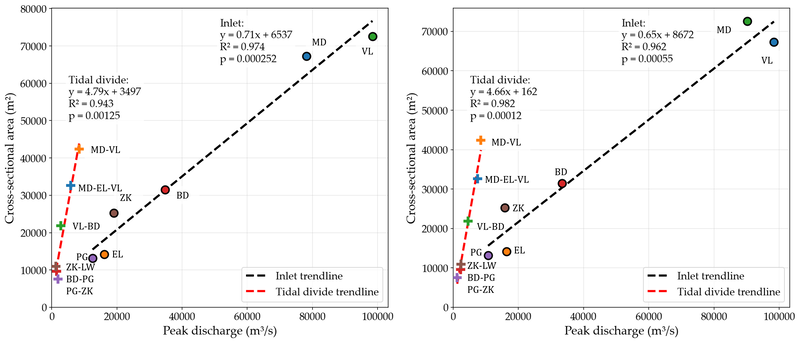
Figure 1: Relationship between cross-sectional area (CSA) and peak discharge for tidal divides and inlets in 2009. The left panel shows peak discharge in the dominant westward direction across the tidal divides and ebb discharge through the inlets. The right panel shows peak discharge in the eastward direction across the tidal divides and flood discharge through the inlets.
References
Colosimo, I., De Vet, P. L. M., Van Maren, D. S., Reniers, A. J. H. M., Winterwerp, J. C., & Van Prooijen, B. C. (2020). The Impact of Wind on Flow and Sediment Transport over Intertidal Flats. Journal of Marine Science and Engineering, 8(11), 910.
Donatelli, C., Duran-Matute, M., Gräwe, U., & Gerkema, T. (2022). Residual circulation and freshwater retention within an event-driven system of intertidal basins. Journal of Sea Research, 186, 102242.
Sievers, J., Milbradt, P., Ihde, R., Valerius, J., Hagen, R., & Plüß, A. (2021). An integrated marine data collection for the German Bight – Part 1: Subaqueous geomorphology and surface sedimentology (1996–2016). Earth System Science Data, 13(8), 4053–4065.
Stive, M. J. F., & Rakhorst, R. D. (2008). Review of empirical relationships between inlet cross-section and tidal prism. (23).
Van Weerdenburg, R., Pearson, S., Van Prooijen, B., Laan, S., Elias, E., Tonnon, P. K., & Wang, Z. B. (2021). Field measurements and numerical modelling of wind-driven exchange flows in a tidal inlet system in the Dutch Wadden Sea. Ocean & Coastal Management, 215, 105941.
Wang, Z. B., Vroom, J., Van Prooijen, B. C., Labeur, R. J., & Stive, M. J. F. (2013). Movement of tidal watersheds in the Wadden Sea and its consequences on the morphological development. International Journal of Sediment Research, 28(2), 162–171.
