
S. Kampman1
1 Utrecht University, Netherlands
s.j.kampman@students.uu.nl
Introduction
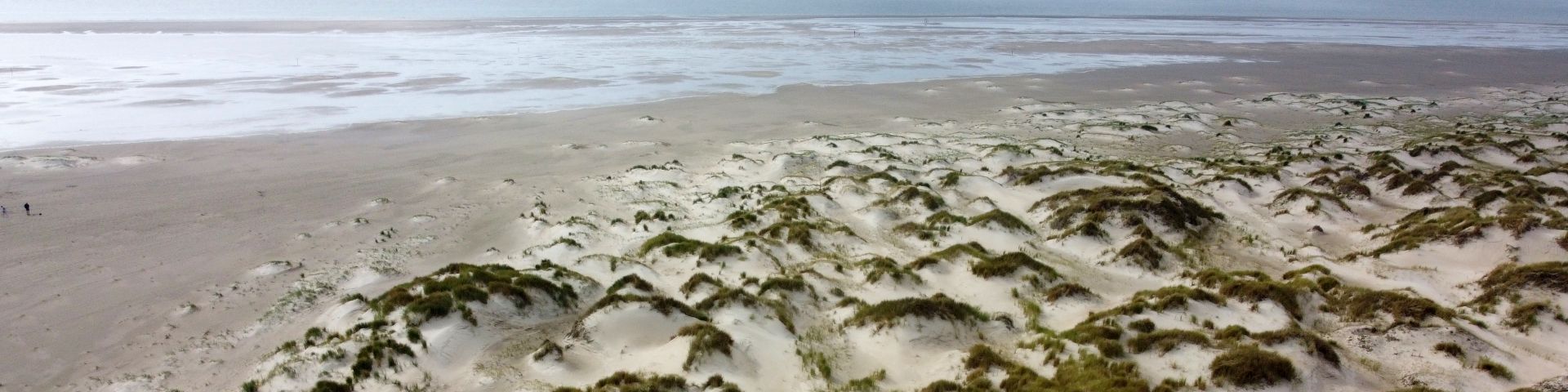
The protection of Dutch coast requires a comprehensive understanding of the processes that shape and reshape this coastal landscape. Sediment transport by water and wind plays a major role in the formation of characteristic coastal morphological features like dunes or tidal channels and vegetation influences this sediment transport by their capability to trap and hold sediment, both above ground and below the water surface (Chen et al., 2018; Work et al., 2021). This research focusses on aeolian sediment transport and the sediment-trapping capabilities of dune grass species in the Netherlands. For this study, a portable windtunnel was developed and will be applied to relate plant trait expression and their effects on sediment transport under controlled conditions.
Objective and Methods
The research contributes ongoing work to help further parameterize the existing numerical coastal dune model AeoLiS. In the AeoLiS model, vegetation is still in its early stages of integration, and the wind tunnel may provide valuable new insights. The wind tunnel can also be operated in situ; however, in this study it was primarily used under laboratory conditions. Multiple 15-minute runs were conducted under laminar flow conditions at a constant wind velocity across different experimental scenarios. The results are used to create a small-scale AeoLiS model and determine which vegetation approach—Raupach or Okin—performs better.
Results
Raupach tends to be the best approach when it comes to modelling the effect of vegetation on sediment transport in this relatively small scale in AeoLiS. Among the variables -number of plants, vegetation density and location- the location of the plant(s) exerts the strongest effect. Meaning, when a single plant is placed at a downwind position inside the windtunnel, it traps the most sediment. This agrees with reported studies, as a short wind-fetch could act as a limiting factor in terms of sediment transport (Mir-Gual et al., 2023). Vegetation density appears to have minimal influence, contrary to expectations. This may result from the relatively simple calculation methods in AeoLiS, indicating that methodological improvements—and input from the wind tunnel—could yield better results. Next to this study, the newly developed portable wind tunnel also has the potential to expand possibilities for other research applications, which is a promising prospect.
* Please note that this is an ongoing project (Master Thesis) and results therefore are preliminary.
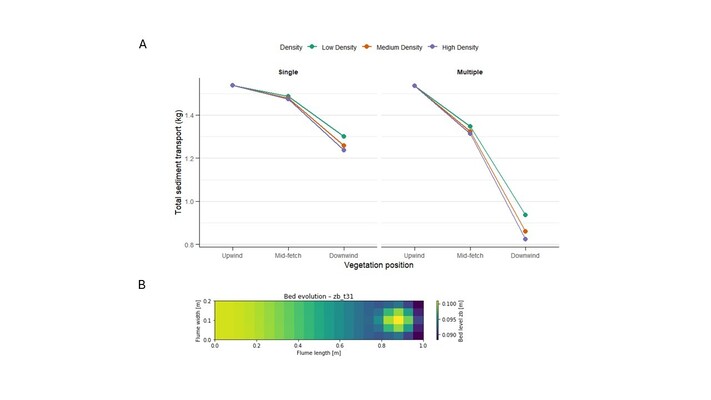
A) Plot illustrating the total sediment transported (in kilograms) after a 15-minute run, using a small-scale AeoLiS model, showing that plant position has a greater influence on sediment transport than vegetation density. B) Example of multiple plants placed downwind, resulting in a distinct sediment hummock near the outlet of the wind tunnel.
References
Chen, Y., Li, Y., Thompson, C., Wang, X., Cai, T., & Chang, Y. (2018). Differential sediment trapping abilities of mangrove and saltmarsh vegetation in a subtropical estuary. Geomorphology, 318, 270–282. https://doi.org/10.1016/j.geomorph.2018.06.018
Mir-Gual, M., Pons, G. X., Delgado-Fernández, I., & Smyth, T. A. G. (2023). Field-Measurement of Surface Wind and Sediment Transport Patterns in a Coastal Dune Environment, Case Study of Cala Tirant (Menorca, Spain). Journal of Marine Science and Engineering, 11(12), 2361. https://doi.org/10.3390/jmse11122361
Work, P. A., Downing-Kunz, M., & Drexler, J. Z. (2021). Trapping of Suspended Sediment by Submerged Aquatic Vegetation in a Tidal Freshwater Region: Field Observations and Long-
