
R. van Weerdenburg1,2*, D.S. van Maren1,2, T. van Kessel2, I. Myouri1, B.C. van Prooijen1
1 Delft University of Technology, the Netherlands; 2 Deltares, the Netherlands
* Corresponding author: r.j.a.vanweerdenburg@tudelft.nl
Introduction
Intertidal mudflats in estuaries and tidal basins provide unique habitats for birds and benthic communities and deliver a range of ecosystem services, including attenuation of wave impacts. Large volumes of fine sediment are (temporarily) stored in mudflat beds. After erosion this sediment influences e.g., turbidity levels and tidal channel siltation, thereby affecting the sediment balance of the wider coastal system. Understanding the stability of mudflat beds is therefore important for coastal sediment management, as reflected in numerous studies on the properties and erodibility of mudflat sediments. Several recent studies (e.g., Nguyen et al., 2019; 2020; Fivash et al., 2024, Dong et al., 2025; Van Rees, Hanssen et al., 2024) have observed reduced mudflat erodibility after periods of aerial exposure. In this study, we aim to quantify the mechanisms behind these observations.
Objective and Methods
The objectives of this study are (1) to quantify the occurrence of drying of intertidal mudflat beds during periods of aerial exposure, and (2) to estimate its effect on sediment erodibility. The first part of the study is based on field measurements of pore-water pressures in the sediment bed of a mudflat in the Dutch Wadden Sea over a period of three months, which reveal whether, and under what conditions, drying of the sediment bed occurs. The second part of the study is based on Gust Erosion Microchamber Systems (GEMS) erosion experiments using sediment samples collected from different elevations on the same mudflat. In addition, a (two-phase flow) consolidation model is used to upscale the measurement results to a larger area.
Results
Drying of the top layer of the mudflat sediment bed occurs as a result of evaporation rather than drainage via groundwater flows. The amount of drying increases with the total potential evaporation over the duration of aerial exposure, which may be extended due to set-down of the water level. Drying does not occur during low-water periods at night or when potential evaporation is low (cloudy and/or cold weather). The resulting stresses in the soil, and hence the strength of the sediment bed, are an order of magnitude larger than those induced by self-weight consolidation, leaving the mudflat bed in an over-consolidated state. At both small (ridges and runnels) and larger spatial scales along the elevation profile of a mudflat, drying stabilizes the sediment bed in elevated areas, making it more resistant to erosion during subsequent flooding. These dynamics during periods of aerial exposure are considered an important reason why high intertidal mudflat beds are less dynamic than subtidal or low intertidal beds.
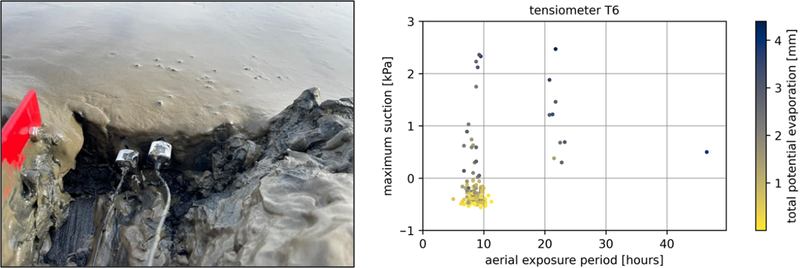
Caption: Left: Installation of tensiometers in the sediment bed of an intertidal mudflat during low water. Right: Measured suction in the bed (i.e., pore-pressure below atmospheric pressure) at one of the instruments in relation to the duration of the aerial exposure period and the total potential evaporation over that period.
References
Dong, C., Chen, Y., Townend, I., Wu, Y., Guo, Z., Jiang, Q., . . . Zhou, Z. (2025). The role of exposure on the vertical variation of mudflat sediment erodibility. Marine Geology, 487, 107579. doi: 10.1016/j.margeo.2025.107579
Fivash, G. S., Stoorvogel, M. M., De Smit, J. C., Van Rees, F., Van Dalen, J., Grandjean, T. J., . . . Van Belzen, J. (2024). Abiotic origins of self-organized ridge-runnel patterns on tidal flats. Limnology and Oceanography, 69(6), 1378-1389. doi: 10.1002/lno.12581
Nguyen, H. M., Bryan, K. R., Pilditch, C. A., & Moon, V. G. (2019). Influence of ambient temperature on erosion properties of exposed cohesive sediment from an intertidal mudflat. Geo-Marine Letters, 39 (4), 337–347. doi: 10.1007/s00367-019-00579-x
Nguyen, H. M., Bryan, K. R., & Pilditch, C. A. (2020). The effect of long-term aerial exposure on intertidal mudflat erodibility. Earth Surface Processes and Landforms, 45 (14), 3623–3638. doi: 10.1002/esp.4990
Van Rees, F. F., Hanssen, J., Gamberoni, S., Talmon, A. M., & Van Kessel, T. (2024). Effect of air exposure time on erodibility of intertidal mudflats. Frontiers in Marine Science, 11, 1393262. doi: 10.3389/fmars.2024.1393262
