
A. Nnafie1*, H.E. de Swart1 , T. Verwaest2, S. Dan2
1 Utrecht University (IMAU), Netherlands 2 Flanders Hydraulics Research, Antwerp, Belgium
* Corresponding author: a.nnafie@uu.nl; abnnafie@gmail.com
Introduction
Shoreline erosion threatens many coastal areas. Addressing this issue requires a thorough understanding of the underlying processes for effective mitigation. Field and modelling studies show that large-scale sand ridges on continental shelves strongly influence shoreline evolution on decadal timescales (Hequette & Aernouts, 2010, Safak et al., 2017, Nnafie et al., 2024). These ridges, known as shoreface-connected sand ridges (sfcr) and tidal sand ridges (tsr), are spaced 2–15 km apart, have lengths of 10–50 km, widths of 1–10 km, heights of 5-25 m, and evolve over centuries (Dyer & Huntley, 1999).
Many modelling studies assume a constant mean sea level, although sea level rise (SLR) is known to affect ridge evolution and shoreline dynamics (Schwab et al., 2013). SLR is also considered a key driver of the onshore migration of sfcr observed on several shelves, including the Northern French and Belgian coasts (Hequette & Aernouts, 2010). With climate change expected to accelerate global SLR, its impact on shoreline behaviour is likely to increase. In addition, human interventions such as sand nourishments and port construction can significantly influence coastal evolution (Del Rio et al., 2013).
Objective and Methods
The objective of this study is to quantify the effects of SLR and sand nourishment on decadal shoreline evolution in an idealised coastal system. The Belgian coast serves as a representative test case because it features both sfcr and tsr (Fig. 1a), exhibits shoreward ridge migration, and has an extensive nourishment programme.
To address this objective, historical bathymetric data of the Belgian coast covering the period 1800–2022 are analysed and an idealised model is applied. Large-scale morphological changes over this period are quantified, with the analysis focusing on the “Stroombank” ridge (black rectangle in Fig. 1a). Alongshore-averaged profiles are extracted for the years 1804, 1866, 1938, 1962, and 2022. The observed evolution is used to extend an existing idealised coupled shelf–nearshore model (Delft3D + SWAN + Q2Dmorfo; Nnafie et al., 2024), which simulates nearshore and shoreline morphodynamics. The extension incorporates SLR, onshore ridge migration, and a fixed shoreline position (the so-called “hold-the-line” strategy).
The model is validated by comparing the simulated annual nourishment volumes required to maintain the “hold-the-line” strategy with observed nourishment volumes. Subsequently, the model is used to compute the annual nourishment volumes over the next 50 years under two SLR-based IPCC scenarios (5 mm/yr and 8 mm/yr).
Results
Results of the analysis of historical bathymetric data from the Belgian coast between 1800 and 2022 (Fig. 1b), reveal major changes in the shelf and nearshore morphology over the past two centuries. The ridge crest, adjacent channel and lower shoreface migrated shoreward at rates of about 1 m/yr during the 19th century, increasing to about 4 m/yr over the past 100 years (see the inset in panel b). This onshore migration was accompanied by erosion of the lower shoreface and a landward retreat of the offshore nearshore profile at comparable rates. Together with the hold-the-line strategy that maintains a fixed shoreline position through groynes and nourishments, this process has reduced the width of the nearshore zone and steepened its profile, a phenomenon referred to in this study as coastal squeeze.
Model results using sea-level rise rates from the IPCC scenarios for the next 50 years (5 mm/yr and 8 mm/yr), combined with a hold-the-line strategy to maintain shoreline position and the associated coastal squeeze, indicate that future annual nourishment volumes in areas where coastline erosion is determined by the channel-ridge morphology may need to be about 2–5 times larger than those under the sea-level rise rates over the past century (≈1.5 mm/yr).
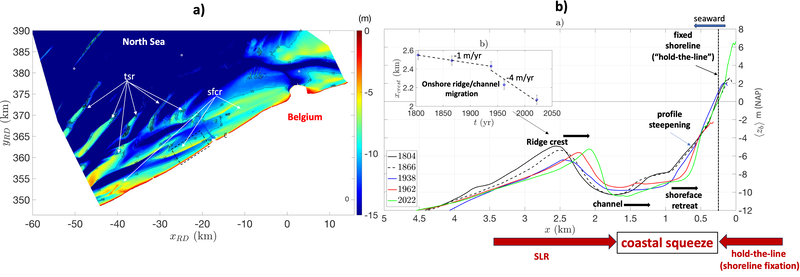
a) Bathymetric map of the Belgian shelf, showing a field of shoreface-connected sand ridges (sfcr) and tidal sand ridges (tsr). b) a) Historical evolution of alongshore-averaged cross-shore profiles in the coastal region of the "Stroombank" ridge (indicated by the black rectangle in panel a). The inset shows ridge crest location (x_crest) versus time.
References
Del Río, Laura, F. Javier Gracia, and Javier Benavente. (2013). “Shoreline change patterns in sandy coasts. A case study in SW Spain.” Geomorphology 196: 252–66. https://doi.org/10.1016/j.geomorph.2012.07.027.
Dyer, Keith R., and David A. Huntley. (1999). “The Origin, Classification and Modelling of Sand Banks and Ridges.” Continental Shelf Research 19 (10): 1285–1330.
Héquette, Arnaud, and David Aernouts. (2010). “The influence of nearshore sand bank dynamics on shoreline evolution in a macrotidal coastal environment, Calais, northern France.” Continental Shelf Research 30 (12): 1349–61.
Nnafie, A., H. E. de Swart, J. M. Boersma, T. Verwaest, A. Falqués, and D. Calvete. (2024). “Presence and Position of Sand Ridges on the Shelf Strongly Impact Decadal Evolution of Adjacent Shorelines: A Model Study.” Journal of Geophysical Research: Earth Surface 129 (12): e2024JF007814. https://doi.org/10.1029/2024JF007814.
Safak, Ilgar, Jeffrey H. List, John C. Warner, and William C. Schwab. (2017). “Persistent shoreline shape induced from offshore geologic framework: Effects of shoreface connected ridges.” Journal of Geophysical Research: Oceans 122 (11): 8721–38. https://doi.org/10.1002/2017JC012808.
Schwab, William C, Wayne E Baldwin, Cheryl J Hapke, Erika E Lentz, Paul T Gayes, Jane F Denny, Jeffrey H List, and John C Warner. (2013). “Geologic Evidence for Onshore Sediment Transport from the Inner Continental Shelf: Fire Island, New York.” Journal of Coastal Research 29 (3): 526–44. https://doi.org/10.2112/JCOASTRES-D-12-00160.1.
