
Y. Li1*, E. W. Nota1, S. Gargari1, M. G. Kleinhans1
1 Utrecht University, Netherlands
*Corresponding author: y.li47@students.uu.nl
Introduction
Estuaries are systems of dynamic networks of channels and bars, showing a unique and complex morphology influenced by river flow, tides and storm waves. We study estuarine dynamics through geomorphological experiments in the Metronome, a laboratory flume that is used for emulating tidal systems (Kleinhans et al., 2017). We have conducted experiments to study the hydrodynamic differences between symmetric and asymmetric tides (Figure 1a). In previous studies, we implemented the numerical model XBeach to simulate the hydrodynamic behaviour of experiments in the Metronome. This model was developed specifically to simulate the impact of extreme storms on sandy coastal areas, incorporating wave propagation, long waves, mean flow and morphological changes.
Objective and Methods
The aim of this study is to find out how tidal asymmetry influences estuarine hydrodynamics within the Metronome. We have a version of XBeach that is modified to suit and simulate the Metronome condition for both asymmetrical (flood-dominant) and symmetrical (ebb-dominant) tides (Figure 1a), and various morphologies are tested. First, we conducted experiments in the Metronome. Then, we simulated specific tidal cycles of these experiments in XBeach, from which we compared modelled and measured values for water depth (from acoustic sensors or optical depth measurements) and flow velocity (from Particle Image Velocimetry, PIV). Based on these comparisons, we calibrated the input parameters of Xbeach to optimize model performance.
Results
The precision of simulation is improved by calibrating input parameters and modifying boundary conditions through numerous model test runs. Based on the calibrated model and experimental results, both ebb-dominant and flood-dominant estuaries could be successfully simulated. The results show that the model can effectively capture the main hydrodynamic features of the estuarine system, especially flow patterns. The modelled velocity and water level are in agreement with the measured velocity and water depth (Figure 1c and 1d). Additionally, the model successfully accounts for dry cells under varying morphological conditions. Despite these strengths, some uncertainty persists regarding the river boundary conditions.
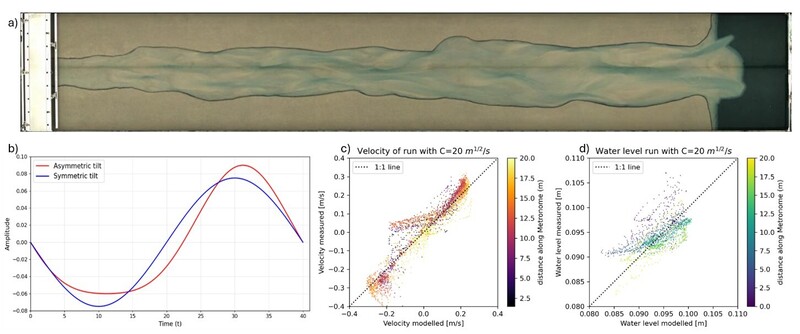
Figure 1 a) Orthophoto of the Metronome. b) Tilt functions applied to the Metronome. c) Comparison between modelled and measured velocity. d) Comparison between modelled and measured water level.
References
Kleinhans, M. G., Van Der Vegt, M., Leuven, J., Braat, L., Markies, H., Simmelink, A., ... & Van Maarseveen, M. (2017). Turning the tide: Comparison of tidal flow by periodic sea level fluctuation and by periodic bed tilting in scaled landscape experiments of estuaries. Earth Surface Dynamics, 5(4), 731-756.
