
H.I. Kuin1, J. van Belzen2, J.E.A. Storms1, B.K. van Wesenbeeck1
1 TU Delft, 2 NIOZ
* Corresponding author: h.i.kuin@tudelft.nl
Introduction
Sea level rise makes these densely populated regions more vulnerable to flood risk (IPCC, 2023). This results in a growing need for coastal protection measures. Hence, the question raises whether we only want to use hard coastal protection measures as they influence the local ecology and have high investment and maintenance costs (Eggert et al., 2024; Glueck et al, 2024). Nature-based solutions (NbS) could attribute to coastal protection by reducing waves and currents, attenuating surges and increasing bed level. In coastal regions, salt marshes and mudflats can aid in mitigating flood risk and thereby function as NbS. Different strategies to create new intertidal nature are managed realignment (MR) and reduced tidal exchange (RTE). MR projects in the United Kingdom, Belgium and the Netherlands revealed that the design of the MR project has a large impact on the development within the site. Still, research gaps remain. In particular, it is not well understood how MR projects in the Netherlands contribute to biodiversity and therefore how effectively they function as NbS.
Objective and Methods
In this research, both strategies, MR and RTE, will be compared in terms of sedimentation, macrobenthos development and vegetation development. Fieldwork is performed in the sites Het Zwin, Waterdunen, Dubbele Dijk and De Slufter as natural comparison. Dubbele Dijk will open March 2026. The fieldwork is a combination of LiDAR, sedimentation-erosion poles, water level logging, benthos cores and soil samples and vegetation species and abundance.
Results
Preliminary results already show differences in biodiversity, sedimentation and sediment composition. Vegetation diversity is the highest in Slufter and vegetation coverage is the lowest in Waterdunen. The bulk density of Zwin is half the bulk density of Slufter and Waterdunen, which are comparable.
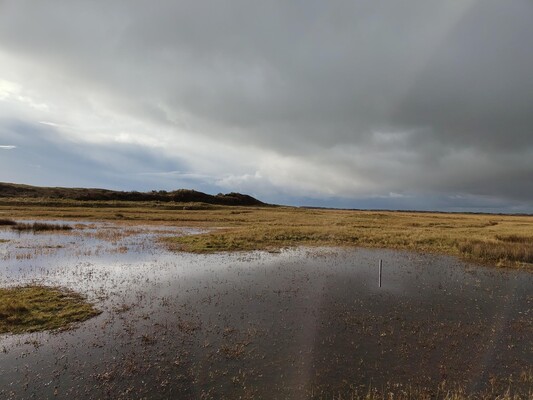
Sedimentation-erosion measurements in Slufter
References
IPCC, 2023: Summary for Policymakers.In: Climate Change 2023: Synthesis Report.Contribution of Working Groups I, II and III to the Sixth Assessment Report of the Intergovernmental Panel on Climate Change[Core Writing Team, H. Lee and J. Romero (eds.)].IPCC,Geneva,Switzerland,pp. 1-34,doi: 10.59327/IPCC/AR6-9789291691647.001
Eggert, A.L., Arnbjerg-Nielsen, K., & Löwe, R.(2024).Evaluating the feasibility of coastal protection scenarios on a city scale across plausible pathways scenarios for both sea level rise and urban development.Ocean & Coastal Management, 261, 107507.doi:10.1016/j.ocecoaman.2024.107507
Glueck, D., Feußner, N., Herbst, A., & Schubert, H.(2024).Ecological Consequences of Breakwater and Revetment Structures on the Baltic Sea Coast in Germany.Aquatic Botany, 103864.doi:10.1016/j.aquabot.2024.103864
