
J. Guo1*, Zeger Sierens1 , D. Bonte2, P. Rauwoens1
1Hydraulics and Geotechnics, Department of Civil Engineering, Bruges Campus, KU Leuven, Spoorwegstraat 12, 8200 Bruges, Belgium; 2Terrestrial Ecology Unit, Department of Biology, Ghent University, K.L. Ledeganckstraat 35, 9000 Gent, Belgium
*Corresponding author: jianghua.guo@kuleuven.be
Introduction
As the sea levels rise, coastal areas face increasing pressures. In Belgium, the Flemish Coastal Vision – a long-term coastal protection strategy – addresses sea – level rise (SLR) and storm impacts over a 100-year horizon (MDK 2023). Nature-based Solutions (NbS) are grounded in the strategy to enhance coastal protection and ecosystem services. In Oostende, two pilot sites – Raversijde and Oosteroever – have been established to evaluate vegetated dunes as a flood risk mitigation measure.
The dune system consists of sand interspersed with marram grass, contributing to dune accretion and storm erosion mitigation. However, safety assessments often treat dunes as homogeneous sand bodies, neglecting biomass effects. While above-ground vegetation modifies the hydrodynamic field, below-ground roots enhance soil mechanical properties. Improving erosion prediction by including the effect of biomass is therefore essential for more accurate storm impact assessments and effective coastal defense.
The Wu–Waldron model (Waldron 1977; Wu, et al. 1979) represents the shear strength of rooted soil as the sum of the inherent soil strength and an apparent cohesion. In this study, we quantified the shear strength of sand with and without marram roots and subsequently incorporated the derived parameters in the XBeach model to investigate their impact on dune .
Objective and Methods
The primary substrate was selected based on availability, relevance for coastal applications, and potential reuse of otherwise surplus material. The chosen substrate is a dune sand obtained from dunes in Zeebrugge. The sediment is a fine to medium sand (D50≈267μm) with negligible organic content.
The mechanical stability of the sand-root samples was assessed using direct shear tests, with the objective of determining effective cohesion c' and internal friction angle Φ'. Tests were performed using a Matest S278 Shearmec direct shear apparatus according to standard ISO-17892-10 (2018).
Samples were consolidated for 12 hours prior to testing. All tests were conducted under drained conditions, with shear rates selected to allow pore pressure dissipation, ensuring that shear strength was governed by effective stresses.
The numerical model XBeach was applied to simulate the dune evolution during storm events. Root reinforcement was implemented following Schweiger and Schuettrumpf (2021), with laboratory test results used to modify the critical sediment transport velocity to account for the additional shear resistance provided by roots. Storm Corrie (January 2022) was selected as the case study in Oosteroever, Belgium with model parameters adopted from WTI2017. Model performance was evaluated using the Brier Skill Score (BSS) based on bed elevation changes.
Results
Preliminary tests indicated that root reinforcement has negligible influence on sand shear strength under high normal stress; therefore, normal stresses of 25, 50, and 100 kPa were adopted. Due to the irregular distribution of roots, the shear stress–strain curves exhibited considerable variability, and specimens lacking roots within the shear plane were excluded from the analysis. The Mohr–Coulomb failure envelope passed through the origin, yielding tan(ϕ) = 0.70 (ϕ = 35°). Root reinforcement was assumed to vary linearly with normal stress, cr(σ) = k σ + c0. The corresponding failure criterion is
τ = σ tan(ϕ) + cr(σ) (1)
where cr(σ) = −0.0913 σ + 5.25, σ denotes the normal stress, and ϕ represents the friction angle.
The model was validated against post-storm bathymetry measurement from Storm Corrie using six representative cross-shore profiles. The resulting were 0.63, 0.61, 0.80, 0.42, 0.35 and 0.77, indicating overall good agreement between simulations and observations.
Root-induced cohesion (up to 5.25 kPa near the surface) was incorporated into the XBeach, resulting in indicate an approximately 23% reduction in simulated dune erosion. Figure 1(c) shows the simulation results at a representative dune profile.
(Acknowledgments: This work was supported by the SUSANA and DUNEFRONT project)
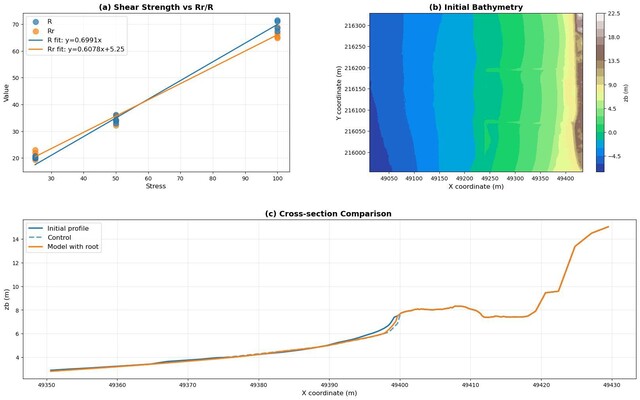
Figure 1 Effects of root reinforcement on dune morphodynamics: (a) shear strength enhancement, (b) initial topography, and (c) simulation result.
References
MDK. 2023. Kustvisie: Strategisch Beleidsplan Voor de Vlaamse Kust. Departement Mobiliteit en Openbare Werken.
Schweiger, C., and H. Schuettrumpf. 2021. “Considering the Effect of Belowground Biomass on Dune Erosion Volumes in Coastal Numerical Modelling.” Coastal Engineering 168. doi:10.1016/j.coastaleng.2021.103927.
Waldron, L. J. 1977. “The Shear Resistance of Root-Permeated Homogeneous and Stratified Soil.” Soil Science Society of America Journal 41(5):843–49. doi:10.2136/sssaj1977.03615995004100050005x.
Wu, T. H., W. P. McKinnell, and D. N. Swanston. 1979. “Strength of Tree Roots and Landslides on Prince of Wales Island, Alaska.” Canadian Geotechnical Journal 16(1):19–33. doi:10.1139/t79-003.
