
B.J.A. Huisman1*, E. Brand2, J-W Mol2, Q. Lodder2, M.A. de Schipper3, K.H. de Bruijn3, T.D. Price4, J.S. Lohr4, J. Wijsman5, J. Limpens5, J. Nauta5, M. Hulsenboom5, J.H. Damveld6, E. Poursoleymanzadeh6, E.M. Horstman6, S. Shah6, T. Duong6, G.H.P. Campmans6, J.J. Van der Werf6
1 Deltares; 2 Rijkswaterstaat; 3 Delft University of Technology; 4 Utrecht University; 5 Wageningen University; 6 Twente University
* Corresponding author: bas.huisman@deltares.nl
Introduction
The Dutch coastal maintenance policy aims at preserving the natural sandy coastline and associated ecological values preferably with sand nourishments. The most common method is to place the sediment directly seaward of the first sub-tidal bar (referred to as a ‘shoreface nourishment’) where the sand mitigates further erosion and supports growth of the beach and dunes through natural transport processes (Van der Werf et al., 2025). However, despite being effective for regional coastal management, our knowledge on the precise transport processes and ecological effects of the shoreface nourishments is limited. An important question is to what extent the composition of the nourishment sediment matters for the efficiency and ecological footprint of these measures. Currently, we can be very selective in using nourishment sediment from offshore borrow sites, but enhanced sea-level-rise and questions on the sailing distance of the dredging vessels require us to investigate this further. A large-scale field experiment with six nourishment segments has therefore been implemented at the coast of Ameland by Rijkswaterstaat in collaboration with the SOURCE research program.
Setup of the field experiment
A setup was chosen with six shoreface nourishment elements with a length of 1.2km each, with a total volume of 3 million cubic meters. The elements differ in their cross-shore position (connected to the bar or 1 meter deeper), type of nourished sediment (either 180 or 350 mm) and width/height (see Figure). Seven dedicated bathymetric surveys are carried out between 2025 and 2027 to map the morphological response (underwater and beach/dune), while detailed sediment sampling at 120 locations takes place at seven moments in these two years. A field campaign is currently underway which measures local hydrodynamics in the first 3 months of the two central nourishment elements, using an array of pressure sensors, wave buoys and ADCP’s. Benthic species are sampled in 2024 and 2026, and analysed at in-between moments using both conventional and dna methods. Furthermore, vegetation mapping will be carried out four times with a drone in 2026 and 2027.
Expectations and first findings
The a-priori expectation is that the nourishment elements that are placed nearest to the coast will quickly merge with the inner bar, while the offshore located elements are more stable, of which first indications are already present in the data (see top-right panel). Also, sediment accumulation can be seen at the updrift side of the scheme due to the alongshore supply of sediment by the wave-driven current. Elements with coarser sediment are expected to be more stable than the regular elements with fine sand, but this needs to be verified. Furthermore, strong currents are expected in-between the nourishment elements and wave attenuation in the nearshore, of which actual magnitudes are going to provide relevant validation to models (Huisman et al., 2019). Especially the vertical structure of the currents will be of interest. What effects can be expected on benthic species is especially difficult to grasp, and therefore these data are going to be extremely valuable. It is, for example, unclear yet if the patches with coarser sediment would provide a habitat to particular species and/or what the impact of the shoreface nourishments is on the regional benthos species. We are expecting a lot of relevant insights from these experiments!
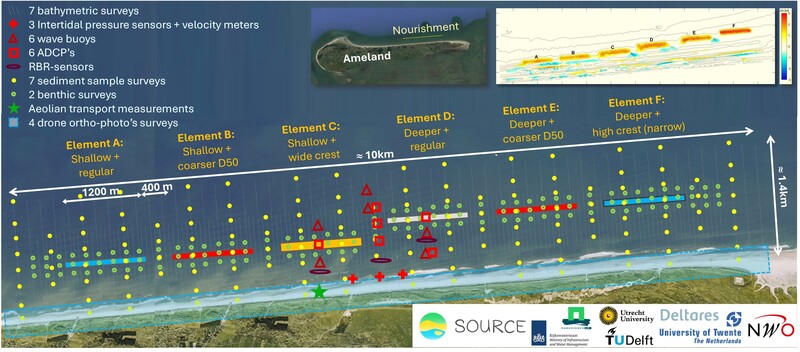
Nourishment configuration for Ameland-Oost and field measurement layout
References
Van der Werf J.J., Huisman B.J.A., Price T.D., Larsen B.E., De Schipper M.A., McFall B.C., Krafft D.R., Lodder Q.J., Ruessink B.G. (2025). Shoreface nourishments: Research advances and future perspectives. Earth-Science Reviews, Vol. 267, 2025, 105138.
Huisman B.J.A., Walstra D.J.R., Radermacher M., de Schipper M.A., Ruessink B.G. (2019). Observations and Modelling of Shoreface Nourishment Behaviour. Journal of Marine Science and Engineering, Vol. 7(3):59.
