
J.G.W. Beemster1*, S.A. Talke2, I.D. Haigh3,4, B.S. Hague5,6, G.C. Levins5, D.S. Van Maren7,8, A.J.F. Hoitink1
1 Wageningen University & Research, The Netherlands; 2 California Polytechnic State University, The United States of America; 3 University of Central Florida, The United States of America; 4 University of Southampton, United Kingdom; 5 Australian Bureau of Meteorology, Australia; 6 Monash University, Australia; 7 Deltares, The Netherlands; 8 Delft University of Technology, The Netherlands
* Corresponding author: joris.beemster@wur.nl
Introduction
Flood impacts depend not only on how often and how high water levels rise, but also on when flooding occurs within the day. Events that coincide with commuting hours or business operations can produce substantial societal disruption, while nighttime flooding may heighten risks to life. Yet the intraday timing of coastal floods remains largely unexamined. In tidal environments, this timing can be strongly constrained because tidal constituents—particularly the solar semidiurnal S₂ tide—impose a fixed daily signal on extreme high waters. As sea levels rise and calm‑weather “sunny‑day” floods become more common, understanding these temporal patterns becomes increasingly relevant.
Objective and Methods
We aim to quantify how coastal flood events are distributed within the solar day year and to determine the physical mechanisms that govern this timing. We investigate the extent to which floods occur at predictable hours across diverse tidal regimes in the United States and the United Kingdom, and how this temporal regularity varies with tidal dominance, diurnal inequality, and meteorological forcing.
We analyzed long‑term tide‑gauge records to identify threshold‑exceeding water levels and documented flood events. For each site, we extracted the intraday timing of events, identified dominant timing modes using a sliding 3‑hour window, and quantified their prominence. These timing patterns were compared against local tidal characteristics—including the phase of the S₂ constituent, tidal range, diurnal inequality, and the relative magnitude of surge residuals—to evaluate how tidal wave propagation and non‑tidal variability shape temporal clustering of floods.
Results
Across many semidiurnal and mixed‑tide settings, exceedances show strong clustering at specific hours of the day, revealing a highly regular daily structure. In Boston, for example, more than 70% of minor flood events occur within roughly ±1.5 hours of two dominant peak times. Similar patterns appear along the U.S. West Coast and much of the U.K. coastline, where timing aligns closely with the phase of the S₂ tide. Locations with substantial meteorological forcing or predominantly diurnal tides display weaker or more diffuse timing signals. Importantly, this temporal regularity is not limited to nuisance flooding: larger, disruptive coastal flood events frequently follow the same predictable schedule. These findings demonstrate that the daily timing of coastal floods is often strongly constrained by tidal dynamics, offering opportunities to incorporate hour‑specific predictability into risk communication, adaptation planning, and coastal infrastructure management.
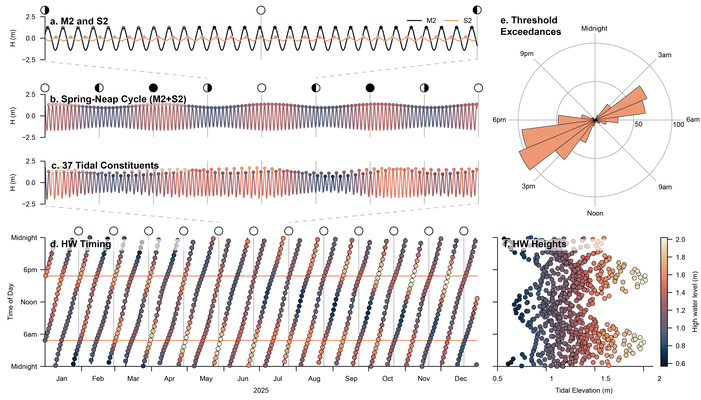
Tidal dynamics explain the intraday timing of flood peaks at Boston: (a.) heights of the principal lunar (M2, black) and solar (S2, orange) tidal constituents at Boston, MA (NOAA ID: 8443970) over half a lunar cycle; (b) combined M2 and S2 signal over two lunar cycles, illustrating spring–neap modulation; (c) full tidal prediction using all 37 NOAA tidal constituents (relative to NAVD88, the standard North American vertical datum); (d) timing (in UTC) and height of predicted high waters in the year 2025 (relative to NAVD88); black and orange lines indicate the timing of M2 and S2 peaks, respectively; (e) timing of threshold exceedances above NOAA’s minor flood level (2.078 m+NAVD88); (f) predicted high water heights (relative to NAVD88) and their intraday timing are largely controlled by the tidal elevation
