
Floris F. van Rees1,2,3, Amber D. Dsouza2, Sierd de Vries4, Laura L. Govers1,5, Glenn Strypsteen6, Cornelis J. Camphuysen1, Gerben Ruessink2, Valérie C. Reijers2
1 Department of Coastal Systems, Royal Netherlands Institute for Sea Research (NIOZ), the Netherlands;
2 Utrecht University,, the Netherlands
3 Deltares, the Netherlands
4 Delft University of Technology, The Netherlands
5 University of Groningen, the Netherlands
6 KU Leuven, Belgium
* Corresponding author: floris.van.rees@nioz.nl
Introduction
Dune-engineering grasses trap sand and thereby steer dune formation and coastal resilience. Coastal dunes are also widely used as roosting and breeding habitats by seabirds, which deposit nutrient-rich excrements (guano). Although guano represents a substantial nutrient subsidy to these systems, its influence on plant trait expression—and the extent to which this translates into changes in dune morphology, remains poorly understood. We therefore examined how guano-mediated nutrient inputs affect the growth and functional traits of key dune-building grasses and assessed the implications for embryonic dune development under both controlled and field conditions.
Objective and Methods
In a greenhouse experiment, we exposed three common European dune-building grasses (Elytrigia juncea, Ammophila arenaria, and Leymus arenarius) to a gradient of seabird guano (0–1000 g m⁻²). These species differ in nitrogen demand, allowing us to test for species-specific responses. To assess whether local nitrogen acclimation influences intraspecific trait responses, we included transplants originating from both guano-rich and guano-poor dune systems. To translate observed trait responses into geomorphological consequences, we parameterized the process-based AeoLiS dune model with experimentally derived trait data and simulated embryonic dune development across guano scenarios. Finally, we conducted a field experiment on embryonic dunes using a moderate guano addition (250 g m⁻²) to evaluate guano effects on plant traits, sand trapping, and short-term morphological change under natural abiotic conditions.
Results
Contrary to expectations, plant trait responses to guano were consistent across species and origins. Moderate enrichment (50–250 g m⁻²) enhanced above- and below-ground biomass and root surface area, whereas excessive inputs reduced growth and survival, likely due to nitrogen toxicity. Model simulations suggested that guano-driven increases in vertical growth rates could, on average, result in a 30% increase in embryonic dune height. However, field results revealed that morphological change was primarily governed by abiotic context, indicating that favourable wind and sediment supply conditions can outweigh guano-mediated trait effects at short timescales. Moreover, several strongly guano-responsive traits, such as shoot density and root cohesion, are not yet represented in current dune models. Together, our findings show that while guano consistently alters plant trait expression and dune-building potential, its geomorphological impact is strongly modulated by abiotic conditions. Incorporating ecological trait-based processes into morphological dune models will therefore be essential for improving predictions of vegetation–sedimentation feedbacks, dune evolution, and coastal ecosystem functioning.
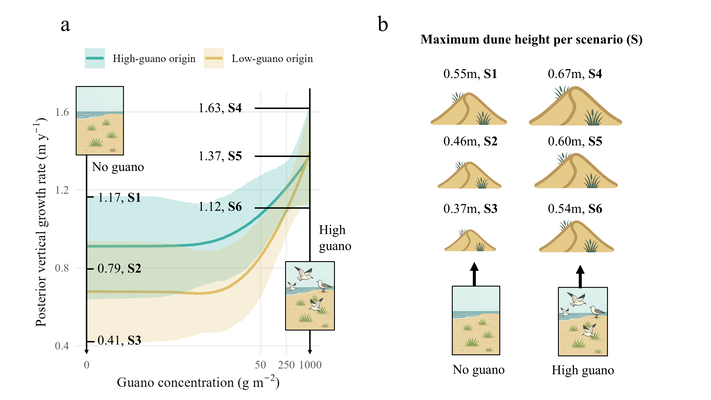
Panel (a) shows the marginal posterior predictions of the vertical growth rate of A. arenaria, calculated by dividing the predicted change in stem length from the greenhouse experiment by the experiment duration (in years). Median values and 95% confidence intervals of vertical growth were extracted for two guano treatments (no guano and maximum concentration), resulting in six model scenarios. Panel (b) presents the corresponding emergent embryonic dune crest elevations simulated by AeoLiS for these six scenarios. Different scenarios are indicated with S.
