
J. Mi1,2*, P. W.J.M. Willemsen3,4, T. J. Bouma1,2 , M. van der Wegen4,5, J. van de Koppel1,6, J. van der Molen1, T. Gerkema1
1Royal Netherlands Institute for Sea Research (NIOZ), the Netherlands. 2Utrecht University, the Netherlands. 3Wageningen University and Research, the Netherlands. 4Deltares, the Netherlands.5UNESCO-IHE, Netherlands. 6University of Groningen, The Netherlands
* Corresponding author: jie.mi@nioz.nl
Introduction
Changes in estuarine basin geometry, e.g., depth, width, and plan form convergence, alter tidal wave propagation, and consequently influence sediment transport and coastal flood risk (Guo et al., 2019; van Maren et al., 2025), particularly in estuaries subject to intense human intervention.
Objective and Methods
To quantify how tidal dynamics respond to long-term morphological evolution, we reconstruct eight centuries of changes in landscape and tidal propagation in the Western and Eastern Scheldt estuary by applying a numerical model (General Estuary Transportation Model, GETM, 2002) from 1200 AD to the present, supported by well-documented historical maps and dike records. Building on these reconstructions, we develop a novel approach that identifies the phase and dominant flow direction from tidal current ellipses to distinguish standing and progressive tidal components. Applying this method to eight centuries of bathymetric development of the Scheldt reveals substantial changes in the amplitude and phase of the principal (M₂) and overtide (M₄) constituents. Consequences for sediment transport are derived.
Results
Our results show that the estuary evolved from a largely progressive system to a more standing-wave regime, indicating a qualitative shift in tidal-wave propagation. This transition led to amplified tidal ranges and was accompanied by increased tidal asymmetry. The analysis of tidal current asymmetry further reveals patterns of sediment redistribution. The results show that, due to the strengthening of flood-dominant tidal current asymmetry, the sediment flux transported landward into the Scheldt has increased by an order of magnitude over the past 800 years. At the same time, the location of peak sediment deposition has shifted from the estuary mouth toward the upstream region. These findings demonstrate how historical management decisions have shaped present-day hydrodynamic processes, thereby influencing sediment redistribution and long-term morphological evolution. The novel method of tidal analysis and sediment transport offers a generic tool to link morphological change with tidal evolution, providing new insights for how morphological change reshapes tides and sediment transport over centuries.
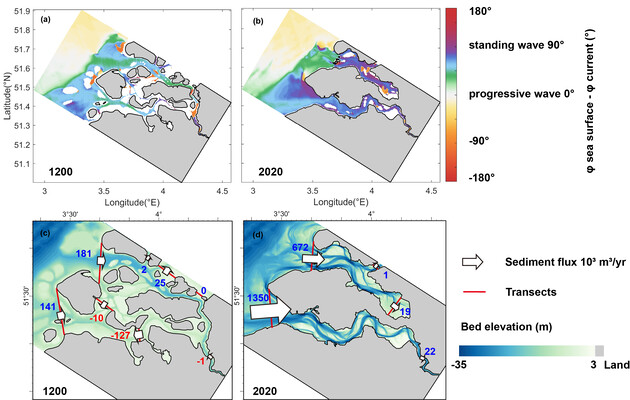
Fig 1. (a-b) The phase difference between the vertical tide (sea level) and the horizontal tide (tidal current), illustrating progressive waves (green and light blue) and standing waves (dark bule and purple). In the past, the Scheldt Estuary behaved more like a progressive wave, whereas it has now evolved into a predominantly standing-wave regime. (c-d) Sediment flux across channel transects driven by tidal flow, with arrows indicating the direction of transport. We define positive transport as landward import from the North Sea into the estuary or transport from the Western Scheldt toward the Eastern Scheldt.
References
Burchard, H., and Bolding, K., (2002). GETM – a General Estuarine Transport Model. Scientific Documentation. Brussels: European Commission. Tech. Rep. EUR 20253 EN.
Guo, L., et al., (2019), Quantification of Tidal Asymmetry and Its Nonstationary Variations. Journal of Geophysical Research: Oceans 124, 773–787.
van Maren, D. S., et al., (2025), Land Reclamation Impacts on Tidal Landscape Evolution. Reviews of Geophysics 63, e2024RG000860 .
