
L. Portos-Amill1*, P.C. Roos1 , H.M. Schuttelaars2 , S.J.M.H. Hulscher1
1 Water Engineering and Management, University of Twente; 2 Delft Institute of Applied Mathematics, Delft University of Technology
* Corresponding author: l.portosamill@utwente.nl
Introduction
Sand banks are large-scale rhythmic features observed in shelf seas, characterised by wavelengths of ~10 km and heights of ~10 m. They evolve over centuries to millennia (de Swart and Yuan, 2018). Sand banks often co-exist with tidal sand waves (see Figure 1), smaller features characterised by wavelengths of ~100 m, heights of 1-10 m, and migration rates of 1-10 m/yr (van Dijk & Kleinhans, 2005).
Sand wave characteristics are observed to depend on their local position across the underlying sand bank (e.g., on trough, on flank, or on crest), migrating anti-cyclonically around the sand bank and veering with respect to the sand bank crest (Caston & Stride, 1970). Portos-Amill et al. (submitted) showed that these local sand wave characteristics can be inferred from a linear stability analysis describing sand wave formation on a non-uniform background topography.
It is known that sand waves affect the flow similarly to an added roughness on a uniform seabed, termed form roughness. Portos-Amill et al. (2024) showed that sand wave-induced form roughness depends on sand wave characteristics (e.g., wavelength and height). Yet, modelling studies focusing on long-term sand bank evolution often disregard the co-existing sand waves and their non-uniform characteristics across the sand bank (e.g., Roos et al. 2004).
Objective and Methods
Here we aim to understand how the non-uniform sand wave characteristics affect the temporal evolution of a sand bank.
Given the distinct timescales of sand bank and sand wave evolution, both processes can be decoupled. Therefore, we treat sand waves as parametrised additions to the local roughness and sediment transport over the sand bank.
We combine the findings of Portos-Amill et al. (2024), in which the sand wave-induced form roughness was derived for different sand wave characteristics, and those of Portos-Amill et al. (submitted), in which the non-uniform local characteristics of sand waves across an underlying sand banks were investigated.
We use the non-linear sand bank model of Geerts et al. (submitted) to model the long-term sand bank evolution under the influence of locally growing and evolving sand waves. Note that sand waves are not explicitly resolved in the model, but are implicitly taken into account through parametrisations of form roughness and sediment transport. Therefore, the sand bank model is coupled with the sand wave and form roughness models. As the sand bank changes in shape over time, the local characteristics of sand waves also change and so does the local added form roughness.
Results
We expect to obtain a different sand bank evolution when considering the effects of time-varying sand waves over the sand bank. These results would be useful to achieve a more realistic and physics-based sand bank evolution model. This could be used to model, for example, sand extraction in the North Sea.
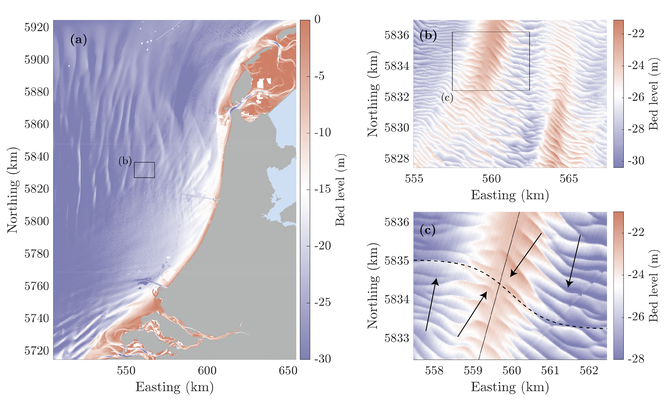
Figure 1. Panel (a): Bathymetric chart of the Netherlands Continental Shelf. Panels (b,c) show details of sand waves on a sand bank. The dashed line in panel (c) highlights how the sand wave crest orientation changes across a sand bank; the solid line indicates the bank crest. The arrows in panel (c) denote the direction of sand wave migration, showing veering towards the sand bank crest. Note the different spatial scales. Data from the Netherlands Hydrographic Service. From Portos-Amill et al. (submitted).
References
Caston, V. N. D., & Stride, A. H. (1970). Tidal sand movement between some linear sand banks in the North Sea off northeast Norfolk. Marine Geology, 9(5), M38-M42.
de Swart, H. E., & Yuan, B. (2019). Dynamics of offshore tidal sand ridges, a review. Environmental Fluid Mechanics, 19(5), 1047-1071.
Geerts, S.J., Roos, P.C., Hulscher, S.J.M.H. (Submitted). Semi-implicit time integration of the Exner equation for bedload transport over a non-erodible layer: Application to a tidal sandbank model.
Portos‐Amill, L., Roos, P. C., Damveld, J. H., & Hulscher, S. J. (2024). Modeling form roughness induced by tidal sand waves. Journal of Geophysical Research: Earth Surface, 129(5), e2023JF007610.
Portos-Amill, L., Roos, P.C., Schuttelaars, H.M., Hulscher S.J.M.H. (Submitted). Local characteristics of sand wave patterns are governed by underlying sand bank: A linear stability analysis approach.
Roos, P. C., Hulscher, S. J., Knaapen, M. A., & Van Damme, R. M. (2004). The cross‐sectional shape of tidal sandbanks: Modeling and observations. Journal of Geophysical Research: Earth Surface, 109(F2).
Van Dijk, T. A., & Kleinhans, M. G. (2005). Processes controlling the dynamics of compound sand waves in the North Sea, Netherlands. Journal of Geophysical Research: Earth Surface, 110(F4).
