
N. Geleynse1*, L.C. van Rijn2, A. Ton3, K.L. van der Laan1, M. Traas1, R. de Swart1, M. Boechat-Albernaz3, B. van Maren3
1WaterProof Marine Consultancy & Services B.V., The Netherlands; 2LVRS-Consultancy, The Netherlands, 3Deltares, The Netherlands
*Corresponding author: nathanael.geleynse@waterproofbv.nl
Introduction
The sea bed of estuaries and tidal basins generally consists of both mud and sand. A large variety of compositions is typically encountered, both in the vertical sense (mixed versus distinct layering of sand and mud beds) and in plan view (mixed versus spatially-segregated sand and mud zones).
The TKI-based MUSA-II program targets sand-mud dynamics, aiming to develop best-practices for measurements as well as to develop model tools for predictive studies.
Objective and Methods
As part of the execution of the first part of the MUSA-II program, the sediment mobility of mixed mud-sand beds is investigated.
To this end, three flumes have been employed to study the initiation of motion of sea beds. Experiments were conducted in a mobile field flume, a laboratory short flume and a laboratory long flume. Both samples from the top surface of various intertidal flats along the Wadden Sea and Western Scheldt were studied as well as artificial samples, of which the sand/mud composition and bulk density were systematically varied. For each sediment sample, the bulk density, sand/mud ratio and critical shear stress for initiation of motion were measured.
Results
The study highlights the characterisation of the initiation of motion of sea beds, by introducing stages of initiation of motion, thereby extending the work of Breusers [1972] that underpinned the Shields curve for sandy beds.
From the analysis of the flume experiments, a relation was found between critical bed shear stresses, bulk density and sand/mud content.
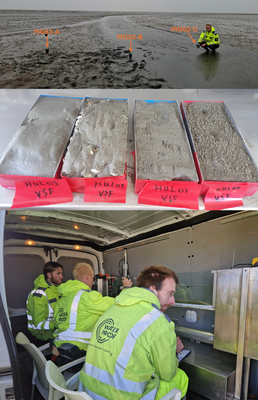
Field sampling (upper), Sampled beds (center), Field flume tests (lower)
