
B. Boekhorst1,2*, N. Geleynse2 , M.A. van der Lugt1,3, M.F.S. Tissier1, M.A. de Schipper1
1Delft University of Technology, The Netherlands; 2WaterProof Marine Consultancy & Services B.V., The Netherlands; 3Deltares, The Netherlands
* Corresponding author: bas.boekhorst@waterproofbv.nl
Introduction
Sandy nourishments are widely applied along wave-dominated coasts, yet their functioning in mixed-energy systems where waves interact with strong tidal currents remains poorly understood. The Prins Hendrikzanddijk (PHZD), southeast Texel, exemplifies such a system: a sandy retrofit with dunes, salt marshes, and sheltered beaches constructed seaward of the existing dike as part of a Building with Nature strategy that provides a soft, adaptive alternative to traditional hard defences.
Objective and Methods
This study applied a one-way coupled Delft3D–SWAN model to quantify wave transformation at the PHZD, validated with measurements data from the SEDMEX field campaign (Sep–Oct 2021) on nearshore waves and currents.
Offshore conditions at the Eierlandse Gat wave buoy were mild, with significant wave heights of 2–4 m and peak periods of 6–9 s. Wind directions in the area varied during the study period and included stormy periods up to Bft-7. Tide-controlled and surge-influenced nearshore water levels varied between –0.5 and +1.0 m NAP.
Results
Analysis of observed and simulated storms showed that southwesterly North Sea waves penetrated the inlet through the Schulpengat and reached the PHZD, contrasting stormy northwesterly waves blocked by the Noorderhaaks and neighboring shallow Molengat. Three regimes were found to govern the nearshore PHZD wave climate: (i) offshore southwesterly wind-sea penetrating the Marsdiep and reinforced by basin winds, (ii) purely locally-generated waves under southeasterly winds, and (iii) a mixed case combining offshore southwesterly wind-sea penetration with local southerly wind growth in the basin.
Tidal currents strongly modulated these dynamics: ebb-enhanced wave penetration through negative current gradients that focused energy into the tidal channel, while flood currents redirected energy toward the ebb-tidal delta and adjacent coasts through positive gradients and ray divergence. Although nearshore wave height peaks typically coincided with ebb currents, a substantial share of wave energy was retained within the channel, whereas during flood more energy dissipated in the outer delta before reaching the shoal.
These findings provide the first quantitative assessment of wind–wave–current interactions at the PHZD, emphasising the combined role of tidal water levels, offshore penetration, local growth, and tidal current modulation under mild conditions. Further work should assess these governing processes under severe storm scenarios.
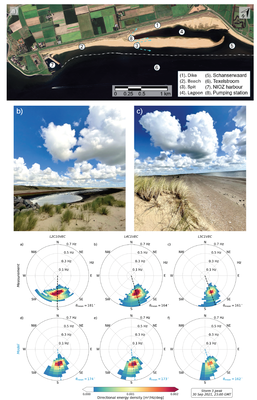
The Prins Hendrikzanddijk. Measured and computed wave roses.
