
C.J.C. Hunter1,2*, J.C. de Smit3, G.S. Fivash4, J. van Belzen1,5, T.J. Bouma1,2,3
1 Department of Estuarine and Delta Systems, Royal Netherlands Institute for Sea Research, Yerseke, The Netherlands;
2 Earth Surface Processes, Coastal Dynamics, Fluvial Systems & Global Change, University of Utrecht, Utrecht, The Netherlands;
3 Department of Water, Technology & Environment, Building with Nature Research Group, HZ University of Applied Sciences, Middelburg, The Netherlands;
4 Ecosphere Research Group, Department of Biology, University of Antwerp, Antwerp, Belgium;
5 Wageningen Marine Research, Wageningen University and Research, Yerseke, The Netherlands
* Corresponding author: conor.hunter@nioz.nl
Introduction
Cohesive sediment erosion resistance is influenced by interactions between physical, geochemical and biological properties and processes (Grabowski et al., 2011). Physical processes such as (over-)consolidation and evaporation are known to have a significant effect on shear strength in cohesive sediments by reducing water content. Various studies have presented the effect of these processes, linking them to periods of aerial exposure and low ambient water tables.
Colosimo et al. (2023) explain that successful over-consolidation occurs during these windows, as the prolonged drying creates under-pressures in the bed which raises the bed strength significantly. This far outperforms the strength gained during consolidation when the bed is submerged. Meanwhile, Fagherazzi et al. (2017), Nguyen et al. (2020) and van Rees et al. (2024) present how longer periods of exposure allow for more pore water evaporation, strengthening the bed. This effect lasted till following inundations, indicating a hysteresis of the bed strength which can potentially sum over time (Fagherazzi et al., 2017; Nguyen et al., 2020). The effect of aerial exposures has also been documented in ridge-runnel patterns, where bed strength increased with exposure time for raised ridges. Neighboring runnels failed to build up strength due to the thin layer of water keeping it inundated (Fivash et al., 2024).
Objective and Methods
Problem Definition
These findings highlight the importance of drainage and aerial exposure on tidal flats in relation to bed strength development. However, greater detail can be captured as to how bed strength evolves across consecutive tidal cycles. It is currently unclear whether the gained strength during aerial exposure is always maintained over time, or if it can at times compound. Both the timescale and magnitude of this process remain vague, requiring further assessment. This is relevant when considering storm events or bed liquefaction, as it can indicate the recovery timescales to (re)establish a strong bed.
Furthermore, the shape of tidal flats has not yet been considered in this context. Profile shape will determine the cross-shore distribution of inundation periods as well as drainage, influencing where and when on the tidal flat profile sediment deposits can strengthen. Despite advancements by Colosimo et al. (2023), it is not yet fully understood what processes drive sediment erodibility in which zones of the tidal flat.
Finally, estuarine gradients in salinity and tidal range will influence the cohesion of fine sediments as well as inundation frequency respectively. Therefore it is crucial to evaluate sediment erodibility along cross shore transects as well as across the estuary itself.
Results
Objectives and Approach
In response to these conceptual gaps, the objective of this proposed research is threefold:
- Couple observed daily dynamics of bed strength to long term developments. Quantify the timescale, magnitude and trend of these changes for various sediment compositions, inundation frequencies and water contents.
- Understand how the profile shape and elevation of cross-shore transects interrelates to bed strength along the cross-shore.
- Map the developments of bed strength across salinity and tidal range gradients in the Western Scheldt. Also accounting for distance to anthropogenic interventions such as shipping channels and groynes.
To achieve the intended research objective, mesocosm experiments and field work will be conducted to develop conceptual models of tidal flat bed strength, as well as build upon those which have already been proposed (Colosimo et al., 2023; Fivash et al., 2024).
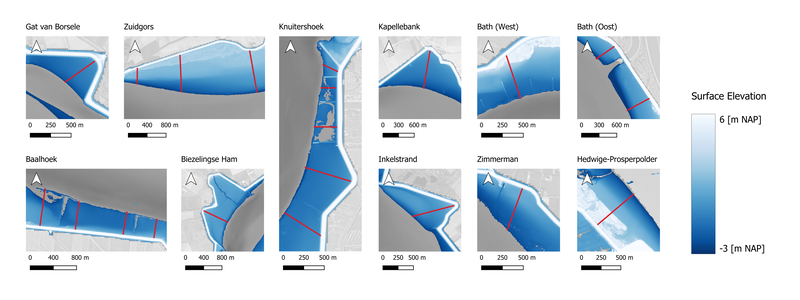
Selected cross-shore transects throughout the Western Scheldt estuary to assess sediment errodibility (2025 vaklodingen taken from https://downloads.rijkswaterstaatdata.nl/).
References
Colosimo, I., Van Maren, D. S., De Vet, P. L. M., Winterwerp, J. C., & Van Prooijen, B. C. (2023). Winds of opportunity: The effects of wind on intertidal flat accretion. Geomorphology, 439, 108840. https://doi.org/10.1016/j.geomorph.2023.108840
Fagherazzi, S., Viggato, T., Vieillard, A. M., Mariotti, G., & Fulweiler, R. W. (2017). The effect of evaporation on the erodibility of mudflats in a mesotidal estuary. Estuarine, Coastal and Shelf Science, 194, 118–127. https://doi.org/10.1016/j.ecss.2017.06.011
Fivash, G. S., Stoorvogel, M. M., De Smit, J. C., Van Rees, F., Van Dalen, J., Grandjean, T. J., Van De Vijsel, R. C., Bouma, T. J., Temmerman, S., & Van Belzen, J. (2024). Abiotic origins of self‐organized ridge‐runnel patterns on tidal flats. Limnology and Oceanography, 69(6), 1378–1389. https://doi.org/10.1002/lno.12581
Grabowski, R. C., Droppo, I. G., & Wharton, G. (2011). Erodibility of cohesive sediment: The importance of sediment properties. Earth-Science Reviews, 105(3–4), 101–120. https://doi.org/10.1016/j.earscirev.2011.01.008
Nguyen, H. M., Bryan, K. R., & Pilditch, C. A. (2020). The effect of long‐term aerial exposure on intertidal mudflat erodibility. Earth Surface Processes and Landforms, 45(14), 3623–3638. https://doi.org/10.1002/esp.4990
Van Rees, F. F., Hanssen, J., Gamberoni, S., Talmon, A. M., & Van Kessel, T. (2024). Effect of air exposure time on erodibility of intertidal mud flats. Frontiers in Marine Science, 11, 1393262. https://doi.org/10.3389/fmars.2024.1393262
