
Julia Löhr1*, Gerben Ruessink1 , Timothy Price1
1 Department of Physical Geography, Faculty of Geosciences, Utrecht University, The Netherlands
* Corresponding author: j.s.lohr@uu.nl
Introduction
Shoreface nourishments are nowadays the preferred strategy to prevent coastal erosion in the Netherlands (Brand et al., 2022). However, the cumulative effect and the spreading of repeated shoreface nourishments through the coastal zone is still poorly understood. Sedimentation in the nearshore zone following a shoreface nourishment is often ascribed to the lee and feeder effects (Van Duin et al., 2004; Van der Werf et al., 2025). The feeder effect can lead to a direct supply of nourished sand to the beach through onshore transport by, among other processes, wave non-linearity. The lee effect can be observed when the zone landward of a shoreface nourishment evinces a larger volumetric response than would be expected based on the change in the nourishment body alone (Van der Werf et al., 2025), indicating the deposition of sand originating from alongshore.
Objective and Methods
This study aims to quantify the long-term volumetric changes in the coastal zone in response to the repeated nourishments placed off the coast of Egmond and Bergen in the Netherlands. To this end, we analysed a set of JarKus (‘Jaarlijkse Kustmetingen’ in Dutch) transects available between 1965-2025 within a 14 km stretch of coast. The JarKus data consist of annual topographic and bathymetric measurements surveyed every 200-250 m along the coast. After preprocessing the JarKus transects, a division of the profiles into several elevation ranges was made from the dunes until a depth of NAP-9 m. Subsequently, for each elevation range the volumetric changes could be calculated relative to the average volume present in 1965-1969, a reference period without any nourishments.
Results
Since the first shoreface nourishment was constructed in 1999 at Egmond, cumulatively increasing volumes become apparent in all elevation ranges (Figure 1). The box between -5 and -7 m NAP, containing the largest share of the nourished sand, indicates rapid volumetric increases concurrent with the placement of the shoreface nourishments. Each shallower elevation (and hence more landward located) range (e.g. -3 to -5 m NAP) exhibits a delayed and dampened volumetric response to the nourishments, indicating the presence of the feeder effect. The total volume contained between +0.8 m and -9 m NAP in the coastal section shown in the figure (km 37-39) increases by approximately 2.2 Mm3 between 1970-2025. Analysis of this volume over time revealed a small lee effect following a few shoreface nourishments. During the same time period, the volume of the dry beach and dunes (above +0.8 m NAP) exhibits a total increase of 0.8 Mm3. Of the approximately 7.6 Mm³ nourished between km 37-39 (beach and shoreface), about 3 Mm³ is thus reflected as a cumulative increase in the entire profile. The volumetric changes for the entire study site further suggest limited alongshore dispersal of nourished sand to the adjacent coastal sections.
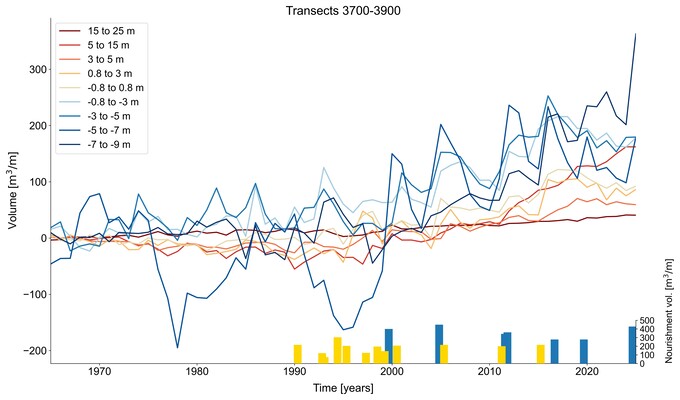
Figure 1: Alongshore-averaged evolution of the volumes contained in the different elevation ranges (m NAP) for JarKus transects 3700-3900 (km 37-39) at Egmond. The timing and volume of the beach (yellow) and shoreface (blue) nourishments are also indicated.
References
Brand, E., Ramaekers, G., & Lodder, Q. (2022). Dutch experience with sand nourishments for dynamic coastline conservation – An operational overview. Ocean & Coastal Management, 217, 106008. https://doi.org/10.1016/j.ocecoaman.2021.106008
Van Der Werf, J. J., Huisman, B. J. A., Price, T. D., Larsen, B. E., De Schipper, M. A., McFall, B. C., Krafft, D. R., Lodder, Q. J., & Ruessink, B. G. (2025). Shoreface nourishments: Research advances and future perspectives. Earth-Science Reviews, 267, 105138. https://doi.org/10.1016/j.earscirev.2025.105138
Van Duin, M. J. P., Wiersma, N. R., Walstra, D. J. R., Van Rijn, L. C., & Stive, M. J. F. (2004). Nourishing the shoreface: Observations and hindcasting of the Egmond case, The Netherlands. Coastal Engineering, 51(8–9), 813–837. https://doi.org/10.1016/j.coastaleng.2004.07.011
