
L. Coumou1*, M. klein Obbink2, S. Moons2, N. Gebraad1
1 Arcadis Nederland B.V..; 2 Rijkswaterstaat Water, Verkeer en Leefomgeving
* Corresponding author: laura.coumou@arcadis.com
Introduction
Since the introduction of the dynamic coastal management policy in the Netherlands in 1990, the North Sea beach of the Wadden Island Vlieland has been nourished six times. Beach nourishments can influence the aeolian sediment transport to the dunes, for example due to changes the grain size distribution and the beach profile shape. A coarse sediment fraction may cause the formation of a beach armour layer that inhibits aeolian sediment transport to the dunes. Natura 2000 management plans of the coastal zone require that the grain size of the nourished sand matches the native beach sand as closely as possible, to prevent potential negative ecological impact of changes in grain size and aeolian sand transport to the dunes. However, the sand of the last beach nourishment in 2023 at Vlieland was relatively coarse (D50 313 µm). In the future, it will occur more often that only relatively coarse sand is available for beach nourishments. Therefore, we investigated how effective lowering the crest height of the nourishment at Vlieland is in limiting the formation of beach armouring if relatively coarse sand is nourished. The lessons learned from this monitoring campaign will be used for the design of future nourishments.
Objective and Methods
To examine beach armouring in relation to the crest height of the nourishment, the top 1 cm of the beach was sampled every two months during the year after the nourishment (T1-T6). The weight percentage of the coarse fraction (> 1 mm) was analysed as an indicator of the degree of beach armouring. The beach was sampled at four heights along 10 cross-sections: three transects at the west side of the nourishment with a crest height of +3m NAP, three transects at the east side with the crest at +2.5m NAP and two reference transects at each side of the nourishment. The spatial and temporal variation in the degree of armouring was analysed. The physical conditions during the monitoring period (water level, waves, wind, rain) and morphological changes along the cross-sections were used to interpret the results. Most events with elevated water levels and waves - and strong wind - occurred in the first period (T1-T3). The sea reached the top of the lower part (+2.5m NAP) of the nourishment more frequently than the higher part (+3m NAP), resulting in variation in beach armouring over space and time.
Results
The measurements showed that lowering the crest height of a beach nourishment can be effective in limiting beach armouring if the crest of the nourishment is occasionally inundated and the top layer is reworked. For Vlieland, the tipping point for the formation of significant beach armouring appeared to be just above +2.5m NAP: at +3m NAP significantly more persistent beach armouring was observed than at +2.5m NAP and +2m NAP. This tipping point seems to depend strongly on the local wave run-up level, and therefore on the local water levels, wave heights and the profile shape. Hence, the optimal elevation of the nourishment crest varies between beaches. Furthermore, the results suggest that the slope of the beach nourishment is also relevant for the degree of beach armouring. Beach armouring was most persistent on the high, flat part of the nourishment. A narrower - but relatively high - crest under a slope could potentially lead to less beach armouring than a flat, high and wide nourishment.
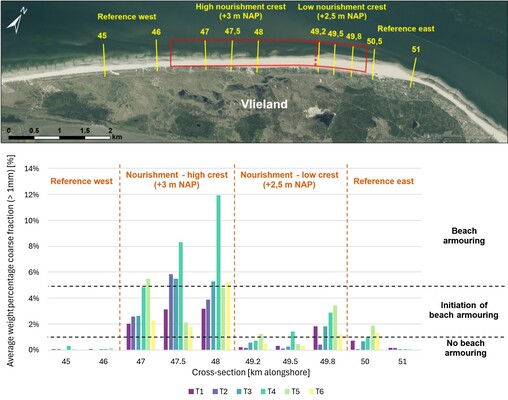
Top: Overview of the location of the beach nourishment (red box) and cross-sections at Vlieland. Bottom: Average weight percentage of the course fraction (>1 mm) in the top 1 cm at the beach averaged over each cross-section per timestep in the first year after nourishment. In general, initiation of beach armouring was observed if the course fraction was > 1% and beach armouring was observed if the course fraction was > 5%.
References
Arcadis (2025). Korrelgrootte en beach armouring strandsuppletie Vlieland 2023. Commissioned by Rijkswaterstaat. Final report.
