
R. Gijsman1*, D. Roelvink1,2,3 , M. van der Wegen1,2
1 IHE Delft, Netherlands; 2 Deltares, Netherlands; 3 Delft University of Technology, Netherlands
* Corresponding author: r.gijsman@un-ihe.org
Introduction
The stabilising effect of mangroves on shorelines is an important regulating ecosystem service, particularly considering the ongoing erosion of muddy mangrove-vegetated coasts (Hulskamp et al., 2023). Shoreline stabilisation means that mangroves can reduce erosion, or increase accretion, and as such contribute to the protection of land, and the persistence of their own ecosystem services. Waves are an important driver of erosion along mangrove-vegetated muddy coastlines. However, while waves are being held responsible for coastal erosion along mangrove coasts (Winterwerp et al., 2013), waves can also stimulate sediment transport towards mangroves (Gijsman et al., 2024). In addition to the potential effects of waves, it also remains unknown how substantial the contribution of mangroves to enhanced accretion, or reduced erosion is, and how it depends on mangrove characteristics and environmental conditions. This lack of knowledge hampers (1) quantitative assessments about the persistence of mangrove ecosystem services, (2) the development of policy guidelines for mangrove greenbelt widths, and (3) the establishment of quantitative design guidance for nature-based or hybrid engineering solutions with mangroves.
Objective and Methods
The objective of this study is to quantify the short-term response of mangrove-vegetated upper intertidal flats under varying intertidal flat slopes, tidal ranges, and wave heights. A set of process-based numerical model simulations was performed with the 1D wave-driven morphological model MFlat (Van der Wegen et al., 2019). MFlat solves the wave-energy balance, including wave attenuation by mangroves, sediment advection and diffusion, and bed level change. Mangrove characteristics were inspired by a mangrove forest of Avicennia marina var. australasica in the Firth of Thames estuary in New Zealand (stem density of 0.04 m, stem height of 3 m, drag coefficient of 3, following Gijsman er al., 2024). We use three linear profiles with different slope (1:250; 1:500 and 1:1000), five different tidal ranges (0.25 m; 0.5 m; 1 m; 2 m; 4 m) and four different wave heights at the boundary (0.05 m; 0.1 m; 0.2 m; 0.4 m). The profile response during 1 full tidal cycle was analysed, with the tide starting at low tide. We compared the cumulative eroded/accreted sediment at the upper intertidal flat (z > MSL) of the simulations with mangroves (N = 10 stems/m2) to those without mangroves (N = 0 stems/m2).
Results
The model simulations show that the general profile response depends on profile slope, tidal range, and wave height (Figure 1a-c). The profile slope was found to be paramount. At gentler-sloped profiles, sediment accreted in the upper intertidal flat primarily due to the combination of increasing tidal range and increasing wave heights (Figure 1a). At steeper-sloped profiles, increased tidal ranges and wave heights caused erosion of the upper intertidal flat (Figure 1c).
Mangroves generally increased sediment accretion at the upper intertidal flat in case tidal ranges exceeded about 2 m, and wave heights about 0.1 m (Figure 1d-f). The contribution of the mangroves increased with the profile steepness. Depending on the exact conditions, the mangroves mildly increased sediment accretion at milder slopes, could reverse the mild erosion at intermediate slopes, and mitigated the severe erosion at steeper slopes. The results show that the mangrove-induced response of the upper intertidal flat may increase with the increasing erosion pressure on muddy mangrove-vegetated coastlines. However, importantly, on the lower intertidal flat, mangroves did not reduce, or even enhanced, erosion. Future work will increase the tested parameters, parameter ranges, and the longer-term response of mangrove-vegetated intertidal flats.
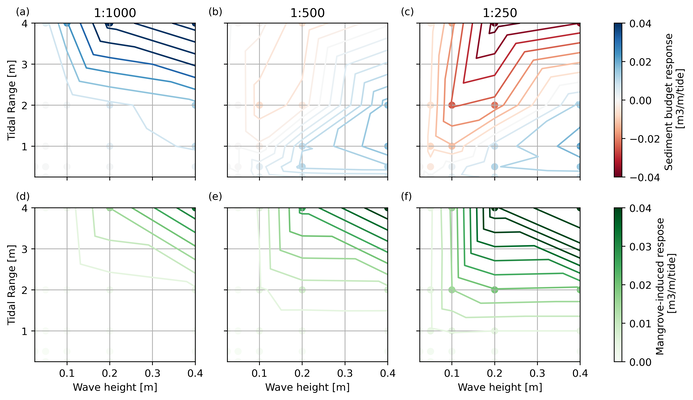
Figure 1: Upper intertidal flat response of different linear slopes. (a-c) Sediment budget without mangroves and (d-f) Contribution of mangroves to sediment budget.
References
Gijsman, R., Horstman, E.M., Swales, A., et al. (2024). Mangrove forest drag and bed stabilisation effects on intertidal flat morphology. Earth Surface Processes and Landforms, 49(3), 1117–1134. Available from: https://doi.org/10.1002/esp.5758
Hulskamp, R., Luijendijk, A., van Maren, B., et al. (2023). Global distribution and dynamics of muddy coasts. Nat Commun 14, 8259. https://doi.org/10.1038/s41467-023-43819-6
Van der Wegen, M., Roelvink, J. A., & Jaffe, B. E. (2019). Morphodynamic resilience of intertidal mudflats on a seasonal time scale. Journal of Geophysical Research: Oceans, 124, 8290–8308. https://doi.org/10.1029/2019JC015492
Winterwerp, J. C., Erftemeijer, P., Suryadiputra, N., et al. (2013). Defining eco-morphodynamic requirements for rehabilitating eroding mangrove-mud coasts. Wetlands, 33(3), 515-526. https://doi.org/10.1007/s13157-013-0409-x
