
K.H. de Bruijn1*, S.G. Pearson1 , M.A. de Schipper1
1 Delft University of Technology, The Netherlands
* K.H.deBruijn-1@tudelft.nl
Introduction
Coastal erosion poses a significant global challenge, affecting shorelines through increased storm-driven inundation risk, coastal squeeze, and the loss of recreational space. Among the strategies developed to counter shoreline retreat, shoreface nourishment—also known as the construction of nearshore berms—has seen widespread application. In the Netherlands, it represents roughly 50% of the total annual nourishment volume, and it is also frequently implemented along the coasts of the United States. By placing sediment in the nearshore zone, shoreface nourishments aim to enhance coastal resilience while working with natural processes to redistribute sediment toward the beach. Despite their growing popularity, important questions remain regarding the physical mechanisms through which these interventions influence shoreline evolution and beach morphology.
Objective and Methods
Shoreline advance is commonly observed in the lee of shoreface nourishments and is generally explained by a combination of feeder and leeside effects. However, quantification of the relative importance of these mechanisms is limited, and the conditions under which one process dominates over the other remain poorly understood.
To address this knowledge gap, a unique shoreface nourishment experiment has been initiated along the Dutch coast within the SOURCE project. The intervention comprises six nourishment bodies that differ in a single design parameter, such as crest elevation or position within the subtidal bar system. This configuration provides a rare opportunity for controlled a field experiment to compare nourishment designs under comparable hydrodynamic forcing. Dedicated alongshore and cross-shore measurement arrays are deployed to quantify hydrodynamic responses during both calm and high-energy wave conditions. We supplement these measurements with conceptual modelling for a range of conditions and nourishment designs.
Results
We present initial outcomes from the monitoring programme and associated conceptual modelling. Our analysis focuses on the mechanisms governing beach response to shoreface nourishments under varying hydrodynamic conditions and design characteristics. Early results indicate that, over short time scales, the feeder effect is difficult to distinguish in the field data. In contrast, the leeside effect appears more pronounced, although its signal is partially masked by the alignment between dominant littoral drift and net tidal flow. Importantly, the hydrodynamic conditions required for a clear leeside effect occur less frequently than those activating the feeder effect. Consequently, the overall balance between feeder and leeside contributions is largely controlled by the frequency of energetic events.
These findings are discussed in the context of existing literature on nearshore processes. The SOURCE experiments offer a valuable opportunity to evaluate long-standing hypotheses regarding shoreface nourishment dynamics, supporting more effective coastal management strategies in the future.
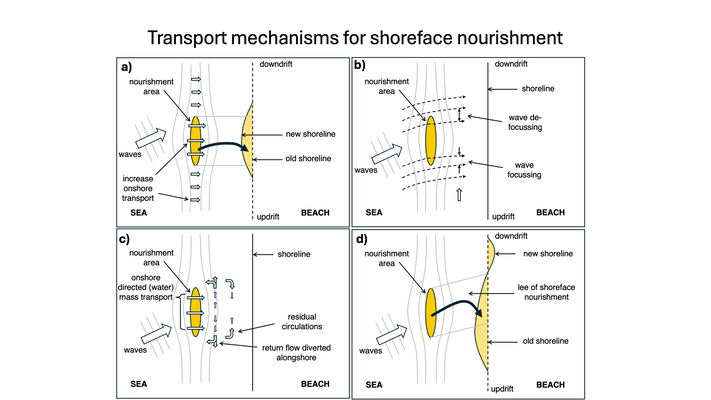
Transport mechanisms for shoreface nourishment, dominated by (a) onshore transport / feeder effect, (b) wave focussing, (c) circulation currents, and (d) full saturation / leeside effect. Adapted from van Duin et al. (2004).
References
van Duin, M.J.P., Wiersma, N.R., Walstra, D.J.R., van Rijn, L.C., Stive, M.J.F., (2004), Nourishing the shoreface: observations and hindcasting of the Egmond case, Coastal Engineering, Volume 51, Issues 8-9, Pages 813-837.
