
C.O. van IJzendoorn1*, J. Hamilton2, B. van Westen2,3, M. Wengrove2
1Utrecht University, the Netherlands, 2Oregon State University, USA, 3Deltares, the Netherlands
* Corresponding author: c.o.vanijzendoorn@uu.nl
Introduction
Coastal dunes provide vital ecological, recreational and flood protective functions. To conserve biodiversity and allow dunes to grow with sea level rise, managers increasingly implement dynamic dune management. Coastal dune models such as AeoLiS can evaluate management practices (van Westen et al. 2024), but oversimplify sediment trapping by vegetation and dune shape. Current models produce immediate deposition when sand is transported into vegetation or when abrupt slope changes occur. In reality, sand can be deposited 10s-100s of meters downwind of these features due to skimming and flow separation.
Skimming occurs when strong winds cause dense dune grass to bend over, making the grass act like a conveyor belt and elevating the main airflow and sand transport above the bed level. For example, Rotnicka et al. (2023) measured a case of transport across a coastal dune where 70% of transport occurred above the grass canopy. Flow separation occurs when abrupt slope changes cause airflow to detach from the bed, creating a low-velocity wake zone (shaded orange in Figure 1C) where erosion is reduced. However, transport driven by flow across the slope break can still carry sand beyond the wake zone.
Objective and Methods
Quantitatively representing downwind transport in the presence of skimming and flow separation is essential for reliably simulating deposition patterns in coastal dunes and evaluating dune management strategies. Therefore, this project quantifies the effect of skimming and flow separation on vertical aeolian sand transport patterns and creates a conceptual representation to enable inclusion of these processes in process-based numerical models like AeoLiS.
To quantify the vertical sand transport patterns, wind and sand transport patterns measurements were collected on a small dune (20 m long x 10 m wide x 3 m high) in Nehalem, Oregon, USA (see Figure 1). Measurements were collected using wind sensors, sand traps, grain impact sensors and vegetation surveys. Additionally, topography measurements were collected using a laser scanner. Sand traps consisted of vertically stacked sand catchers, enabling measurements of transport at multiple heights above the surface (Figure 1C). Measurements were collected during two consecutive 3-week periods. First, the dune was fully vegetated (Figure 1A), then all vegetation was removed (“The Big Haircut”) and the measurements were repeated on the bare dune (Figure 1B). This setup allowed for the isolation of the effects of vegetation and topography on the vertical sand transport patterns.
Results
The results show that three different types of behavior (example locations indicated with flags in Figure 1A and B) occur in the measured vertical sand transport patterns:
- No abrupt slope change, no vegetation: a logarithmic profile is present with largest transport rates near the bed
- Abrupt slope change, no vegetation: the largest transport rates occur several decimeters above the bed, where the distance between the peak in transport and the bed depends on the relative placement of the sand trap compared to the slope break.
- No abrupt slope change, vegetated: the largest transport rates occur approximately 0.4 m above the bed surface, at the height of the vegetation
Our presentation will show the measurements on which we base this distinction in behavior. We will collect additional measurements in the Netherlands in fall of 2026 to determine whether a vegetated surface with an abrupt slope change also shows distinct behavior. Together, the two field studies will result in a paper that further quantifies vertical sand transport patterns and investigates the conditions under which they occur.
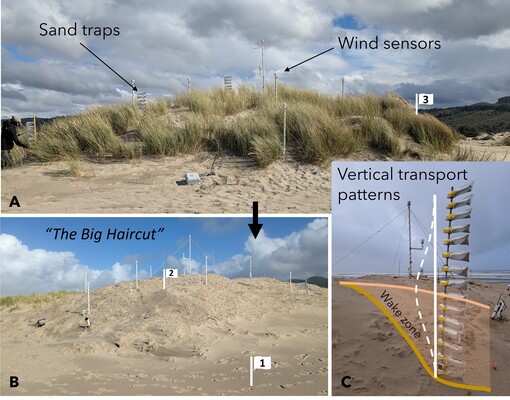
Figure 1: Field setup in Nehalem, OR, USA. A) Instruments on the vegetated dune. B) Vegetation removal resulted in a bare dune. C) Sand transport measurement (white dashed line) in the wake zone (shaded orange) behind the dune showing a peak in transport several decimeters above the bed. The white flags in panel A and B relate to the behavior types described in the results.
References
Rotnicka, J. (2023), Skimming Flow and Sand Transport Within and Above Ammophila (Marram) Grass on a Foredune. JGR: Earth Surface, 128.
Van Westen, B. (2024), AeoLiS: Numerical modelling of coastal dunes and aeolian landform development for real-world applications. Environmental Modelling & Software, 179.
