
S.A. Shah1*, J.J. Van der Werf1,2, T.M. Duong1, S. J. M. H. Hulscher1
1 University of Twente, Netherlands; 2 Deltares, Netherlands
* Syeda Arooba Shah: syeda.shah@utwente.nl
Introduction
Shoreface nourishments are increasingly applied worldwide to protect sandy coasts from erosion and flooding. They are generally placed in water depths of 4 to 10 m within the nearshore zone. Predicting nearshore zone morphodynamics remains challenging due to complex dynamics, making it particularly difficult to assess how sand nourishments in nearshore zone evolve. Numerical modeling is an essential tool for studying how nourishment bodies evolve and predicting sediment distribution. However, existing numerical modeling studies are unable to fully capture the alongshore and cross-shore distribution of nourished sediment. Shoreface nourishment's lifetime or recurrence interval is about 5 years, while current numerical modeling studies are limited to short time scales of 1 to 3 years and lack representation of aeolian sediment transport processes that drive sediment exchange between the wet and dry parts of the beach. The roles of individual wave and tidal forcing, and their combined effects on nourished sediment spreading, remain poorly understood for barrier islands like Ameland. In addition, the influence of nourishment grain size, placement depth, and crest width is still largely unquantified. Moreover, current numerical modeling frameworks have not yet quantified the cumulative effects of repeated shoreface nourishments on the coastal state for longer decadal time scales.
Objective and Methods
This study aims to model shoreface nourishment along the Ameland Coast by using a Delft3D-FM model. First, the Ameland 2019 shoreface nourishment will be modeled in Delft3D-FM. It will then be calibrated and validated using JARKUS bathymetric and topographic data to quantify the nourishment’s evolution in the nearshore zone over five years. Second, controlled numerical simulations (5-years) with or without waves, tides, and wind will be conducted to investigate how nourished sediment spreads throughout the coastal zone to identify the dominant hydrodynamic forcing. Third, the effects of key nourishment design parameters, including grain size, placement depth, and crest width, will be evaluated using a combination of numerical modeling over five years and one year of monitoring data from the innovative Ameland 2025 Living Lab shoreface nourishment. Finally, Delft3D-FM will be coupled with AeoLiS to incorporate aeolian sediment transport processes. The validated modeling framework will then be upscaled from five years to 10-20 years to assess different shoreface nourishment strategies using relevant coastal morphological state indicators, such as shoreline position, beach width, and dune volume, to quantify the long-term coastal impact of shoreface nourishment.
Results
The expected results include the development of a calibrated and validated process-based morphodynamic model for the Ameland shoreface nourishment using Delft3D-FM, capable of predicting cross-shore and alongshore volume changes, and sediment redistribution patterns over five years. The preliminary results will include modeling results from the Ameland 2019 shoreface nourishment model, incorporating hydrodynamics and morphodynamics. In the further phase of the project, detailed numerical modeling will identify the dominant physical processes controlling sediment spreading, clarifying the relative influence of waves, tides, and their combined effects on sediment redistribution. Modeling different nourishment design parameters will help identify the most suitable and effective shoreface nourishment design for the Ameland coast. Finally, for the first time, the coupled Delft3D-FM-AeoLiS model will allow assessment of long-term impacts of shoreface nourishment on shoreline position, beach width, and dune volume. This contribution will provide stakeholders with practical insights into nourishment efficiency, coastal resilience, and sustainable shoreface nourishment design.
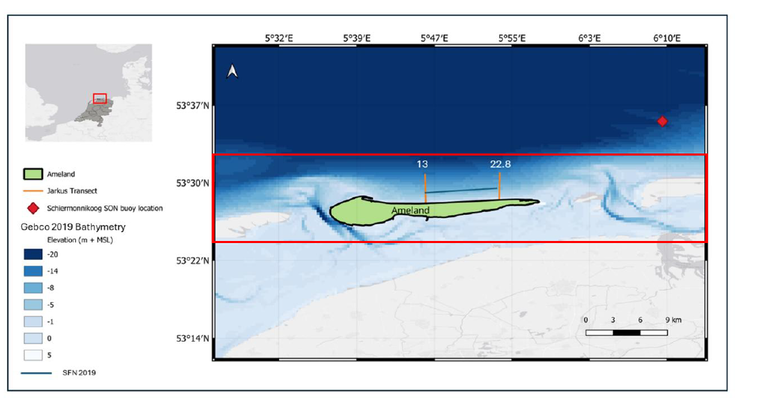
Shoreface Nourishment (SFN) location placed in Ameland in 2019 between JARKUS Transects 13 and 22.8. The proposed model domain for the Delft3D-FM (D-Flow Model) is shown within a red boundary
References
Brand, E., Ramaekers, G., & Lodder, Q. (2022). Dutch experience with sand nourishments for dynamic coastline conservation–An operational overview. Ocean & Coastal Management, 217, 106008. https://doi.org/10.1016/j.ocecoaman.2021.106008.
Grunnet, N. M., Walstra, D. J. R., & Ruessink, B. G. (2004). Process-based modelling of a shoreface nourishment. Coastal engineering, 51(7), 581-607. https://doi.org/10.1016/j.coastaleng.2004.07.016.
Johnson, C. L., McFall, B. C., Krafft, D. R., & Brown, M. E. (2021). Sediment transport and morphological response to nearshore nourishment projects on wave-dominated coasts. Journal of Marine Science and Engineering, 9(11), 1182. https://doi.org/10.3390/jmse9111182.
van der Werf, J. J., Huisman, B. J. A., Price, T. D., Larsen, B. E., de Schipper, M. A., McFall, B. C., ... & Ruessink, B. G. (2025). Shoreface nourishments: Research advances and future perspectives. Earth-Science Reviews, 105138. https://doi.org/10.1016/j.earscirev.2025.105138.
Van Duin, M. J. P., Wiersma, N. R., Walstra, D. J. R., Van Rijn, L. C., & Stive, M. J. F. (2004). Nourishing the shoreface: observations and hindcasting of the Egmond case, The Netherlands. Coastal engineering, 51(8-9), 813-837. https://doi.org/10.1016/j.coastaleng.2004.07.011.
Acknowledgement
This work is part of the research program SOURCE (Sand nOURisment strategies for sustainable Coastal Ecosystems), funded by the Dutch Research Council (NWO), project number NWA.1518.22.133.
