
T.P. van Oudenallen1*, T.S. van den Bremer1, M. Zijlema1, W.S.J. Uijttewaal1, P.M. Bayle1, J. Mol1
1 Delft University of Technology, The Netherlands
* Corresponding author: t.p.vanoudenallen@gmail.com
Introduction
Surface gravity waves are one of the hydrodynamic processes that play a key role in the transport of plastic, plankton, sediment and other particles in the coastal region. This in turn affects local marine ecosystems and nearshore morphology. Understanding the driving physical phenomena is therefore of great relevance. Offshore of the surf zone, the largest contribution to wave-driven flow is Stokes drift, a net motion in the direction of wave propagation. Combined with the Eulerian-mean background flow, this resembles the Lagrangian-mean velocity with which water parcels are convected (e.g., van den Bremer & Breivik, 2017). Noticeably, observations of vertical flow profiles show a Eulerian-mean current exactly opposite to the regular Stokes drift velocity at each vertical position (Lentz et al., 2008) (Figure 1b). A possible explanation is based on the theory of Hasselmann (1970), which states that on a rotating Earth, the Coriolis force drives a Eulerian flow that counteracts this Stokes drift. However, the result was obtained by assuming inviscid flow (i.e., no viscosity or turbulence). In an inertial frame of reference, the Stokes drift must also be compensated by a Eulerian-mean return flow, due to the presence of a coastal boundary. This is shown as a depth-uniform return current in Figure 1a.
Objective and Methods
Previous research has studied the combined effect of the Earth’s rotation and turbulent mixing on the wave-driven cross-shore velocity profile in both the surf zone and on the inner continental shelf. However, these studies either used eddy viscosity profiles typical for wind-driven currents or determined the turbulence characteristics based on the amount of energy dissipated by wave breaking. The current research aims to unravel the connection between the Coriolis force and momentum diffusion in the absence of wave breaking by using a turbulence model that is based exclusively on wave-driven flow dynamics. To this end, the existing one-dimensional wave-averaged model of Lentz et al. (2008) was improved by incorporating a low-Re one-equation turbulence model to determine the eddy viscosity distribution generated by the Eulerian-mean flow. In more detail, Prandtl’s one-equation turbulent kinetic energy model is combined with a damping function to account for the effects of molecular viscosity at low Reynolds numbers. The resulting wave-averaged cross-shore velocity profiles are compared with measurements obtained during experiments performed at the Delta Transport Processes Laboratory (Bayle et al., 2025), which serves as a method of validation.
Results
In an inertial frame of reference, the model predicts velocity profiles that are similar to the theoretical inviscid solution based on a depth-uniform return flow in the inner part of the water column (see Figure 1c). Deviations are observed closer to the bed, caused by vertical radiation shear stresses and bed friction. These results are in line with the laboratory measurements. In a rotating frame of reference, the results approach the anti-Stokes drift profile (see Figure 1d) based on the theory of Hasselmann (1970). Near the surface, the effects of turbulence result in a deviation from this piecewise Stokes drift compensation. This is not reflected in the experimental data, hypothesized to be related to the limited width of the flume and additional circulations. The inverse wave Ekman number (not presented here) is shown to be a key indicator of the relative importance of the Coriolis force with respect to turbulent mixing. The obtained results emphasize the importance of including the Coriolis force in nearshore wave-driven flow models. Compared with laboratory measurements, the theoretical model accurately predicts the near-bed velocity profile, indicating that a turbulence model based on wave-driven flow dynamics is essential to properly model wave-induced currents close to the bed.
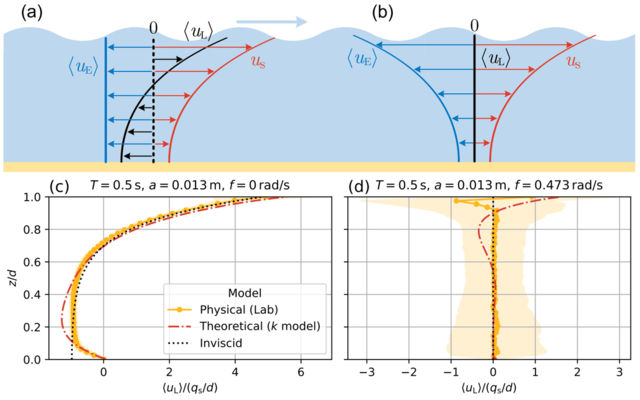
Figure 1: Stokes drift (u_s), Eulerian-mean (⟨u_E⟩) and Lagrangian-mean (⟨u_L⟩) flow profiles driven by progressive surface gravity waves for inviscid flow in (a) an inertial frame of reference and (b) a rotating frame of reference (Hasselmann, 1970). The brackets indicate averaging over the wave and inertial periods. (c, d) Model outputs of the Lagrangian-mean velocity normalized by the theoretical depth-averaged return flow (⟨u_L⟩/(q_s/d)) as a function of the normalized distance from the bed (z/d) for a depth of 0.18 m. Here, q_s indicates the depth-integrated Stokes transport. The shaded area denotes the standard deviation of the laboratory measurements. Inviscid refers to a depth-uniform return flow in an inertial reference frame or to the anti-Stokes drift solution based on the theory of Hasselmann (1970) in a rotating frame of reference. T denotes the wave period, a the wave amplitude and f the Coriolis parameter.
References
Bayle, P.M., Middelplaats, L., Weststeijn, C., van der Gaag, P., de Gans, D., Mol, J., van’t Hof, S., Leenheer, L., van Meurs, J., Haine, M., Mills-Williams, R., Willems, C., Hofland, B., & van den Bremer, T.S., (2025), The Delta Transport Processes Laboratory: A novel laboratory for surface wave-induced currents under rotation. Journal of Coastal and Hydraulic Structures, 5. https://doi.org/10.59490/jchs.2025.0047
Hasselmann, K., (1970), Wave-driven inertial oscillations. Geophysical Fluid Dynamics, 1(3), 463–502. https://doi.org/10.1080/03091927009365783
Lentz, S.J., Fewings, M.R., Howd, P., Fredericks, J., & Hathaway, K., (2008), Observations and a model of undertow over the inner continental shelf. Journal of Physical Oceanography, 38(11), 2341–2357. https://doi.org/10.1175/2008JPO3986.1
van den Bremer, T.S., & Breivik, Ø., (2017), Stokes drift. Philosophical Transactions of the Royal Society A: Mathematical, Physical and Engineering Sciences, 376(2111). https://doi.org/10.1098/rsta.2017.0104
