
M.A. van der Lugt12*, M.A. de Schipper1 , A.J.H.M. Reniers1
1 TU Delft, The Netherlands; 2 Deltares, The Netherlands
* Corresponding author: m.a.vanderlugt@tudelft.nl
Introduction
Low-energy, fetch limited sites typically have a cross shore profiles that differ significantly from open coast profiles. Observations at a nourished sandy back-barrier beach in the Netherlands confirm this, showing three persistent sections in the profile: a nearly horizontal submerged platform, a distinct beach step and a steep beach face . At this low-energy site, sediment mobility is intermittent, and the dominant transport regime is the vortex ripple regime, possibly even during storm. This presence of ripples complicates the estimates of cross-shore sediment transport under energetic conditions where we commonly assume the bed to be flat.
Our aim is to examine cross-shore transport across the profile, and understand how it varies in direction and magnitude as conditions change. We built upon detailed field observations and expand with the numerical model XBeach.
XBeach Surfbeat is commonly used at open ocean sandy coastal systems for storm response. Understanding the skill of this modelling approach on low-energy sites is desired but not evident, as the current XBeach transport equations do not account for transport in this vortex-ripple regime.
Objective and Methods
Our research uses observed ripple migration rates during and in the aftermath of storm Ciaràn (November 2023, Van der Lugt et al. 2025) as validation data for the XBeach model at one location in the cross-shore profile. These observations entailed tracking of ripple migration, both onshore as well as offshore directed, with a rate up to approximately 6 cm/hr and wave- and current information. The comparison of our observations to sediment transport predictors using the intrawave velocity signal quantitatively confirms that cross-shore ripple migration, and therefore bedload, responds strongly to the wave nonlinearity, and that the contribution of infragravity waves proved particularly essential.
Results
We’ve used the hydrodynamic observations to validate the forcing of an XBeach SurfBeat model. Erosion volumes above the storm peak water level were reasonably predicted using XBeach (1.1m3/m observed, 1.7m3/m predicted). We then used the observed ripple migration to compare model predictions of bedload transport to. sediment transport to. The default vanThiel-deVries transport model underestimates bedload at the location of our measurement frame, as the effective velocity for the sediment transport formulation mostly did not exceed the threshold of motion. With expressions by van Rijn’93 that give more weight to in the low mobility regime, the bedload predictions improve. We then discuss how the distribution varies across the profile in the week of observed bed load transport rates.
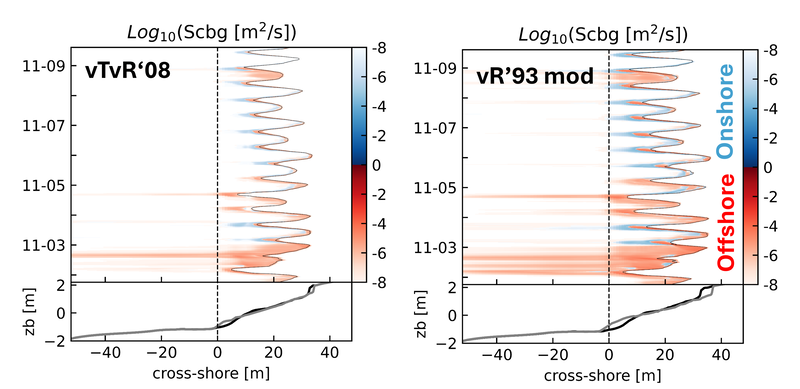
Modelled cross-shore distribution bedload sediment transport over time. Left: predicted bedload by the default vanThiel-vanRijn formulation, right: predicted bedload by the modified vanRijn’93 model. Bottom plots indicate a zoom of the beach profile with initial (black) and post-storm (grey) position. Vertical dashed line indicates position of our field-measurements.
References
van der Lugt, M. A. (Creator), de Schipper, M. A. (Creator), Reniers, A. (Creator), Fritsch, N. (Creator), Wengrove, M. (Creator) (2025). Data underlying the publication: Observations of intermittent cross-shore bed load transport on a low-energy beach. TU Delft - 4TU.ResearchData. 10.4121/AD1AD426-3C19-43A1-A4B6-C726426BC53A
