
Jilu Chea, b, Minyi China, Mingsheng Nga, Shiwen Fooa, Keegan Leea, Ying Changa
a Department of Biological Sciences, Faculty of Science, National University of Singapore; b College of Forestry and Grassland, College of Soil and Water Conservation, Nanjing Forestry University, Nanjing, China
jlche@njfu.edu.cn, minyi.chin@yale.edu, mingsheng_ng@u.nus.edu, shiwen_f@nus.edu.sg, keegan_leeng25@u.nus.edu, y.chang@nus.edu.sg
Introduction
Microorganisms play an essential role in maintaining plant health and driving global biogeochemical cycles. As carbon sinks, mangroves offer critical ecological services in addressing global climate change. The microorganisms inhabiting mangroves, which thrive in nutrient-poor, high-salinity, and low-oxygen environments, are key in promoting nutrient cycling and boosting mangrove productivity. However, a comprehensive understanding of the microbiome in the coastal mangroves remains elusive.
This multi-kingdom analysis elucidates compartment-specific microbial dynamics in mangrove root zones and informs strategies for leveraging microbes to bolster productivity and resilience in these critical coastal ecosystems.
Objective and Methods
In this study, we explored the diversity and composition of archaeal, bacterial, and fungal communities across three mangrove sites in the coastal regions of Singapore. Consistent with root microbiome described in other ecosystems, microbial diversity decreased from bulk soil to the rhizosphere and endosphere. Taxonomic analysis identified Bathyarchaeia, Nitrososphaeria, and Nanoarchaeia as dominant archaeal classes, while Proteobacteria, Desulfobacterota, and Chloroflexi were the main bacterial phyla. Sordariomycetes, Dothideomycetes, and Agaricomycetes were the most common fungal classes. Total carbon influenced archaeal and bacterial composition, while salinity and nitrogen shaped fungal communities. Co-occurrence network analysis revealed that interactions between archaea and bacteria were highest in the bulk soil, gradually decreasing towards the endosphere, where interactions between fungi and bacteria became more prominent. Along the soil–root continuum, prokaryotic niche breadth progressively narrows with exclusion of generalists, whereas fungi rebound in niche breadth and increase both generalist and specialist taxa within the endosphere.
Results
Our study characterized the diversity and composition of archaea, bacteria, and fungi in Singapore's coastal mangroves. The results revealed distinct dynamic ecological roles of these microbial groups across different compartment niches. These findings offer valuable insights for developing strategies that harness specific microbial taxa to improve mangrove productivity.
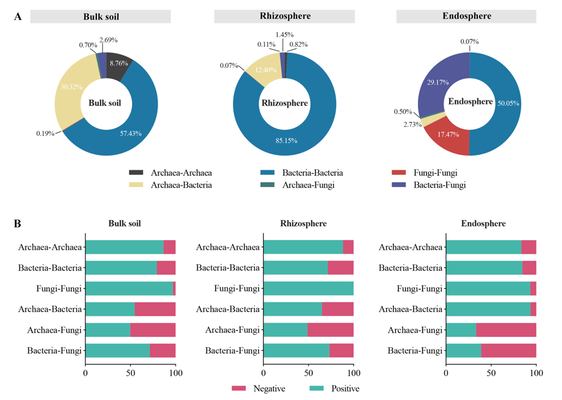
Figure 5 The proportion of correlations in the co-occurrence networks between archaea, bacteria, and fungi among the bulk soil, rhizosphere soil, and root endosphere (A), and proportion of the positive and negative interactions within each network (B).
References
Beckers, B., De Beeck, M.O., Weyens, N., Boerjan, W., and Vangronsveld, J. (2017) Structural variability and niche differentiation in the rhizosphere and endosphere bacterial microbiome of field-grown poplar trees. Microbiome 5: 1–17.
Li, X., Su, L., Jing, M., Wang, K., Song, C., and Song, Y. (2025) Nitrogen addition restricts key soil ecological enzymes and nutrients by reducing microbial abundance and diversity. Sci Rep 1–16.
Du, H., Pan, J., Zou, D., Huang, Y., Liu, Y., and Li, M. (2022) Microbial active functional modules derived from network analysis and metabolic interactions decipher the complex microbiome assembly in mangrove sediments. Microbiome 10: 1–17.
Cao, P., Zhang, L.M., Shen, J.P., Zheng, Y.M., Di, H.J., and He, J.Z. (2012) Distribution and diversity of archaeal communities in selected Chinese soils. FEMS Microbiol Ecol 80: 146–158.
