
A. Petridis1*, B.E. Larsen2
1 Technical University of Denmark (DTU), Denmark; 2 Technical University of Denmark (DTU), Denmark
* Corresponding author: athpe@dtu.dk
Introduction
As waves enter shallow water, they become non-linear and change their shape. The waves can be skewed (raised crests and troughs) and asymmetric (forward-leaning). The wave shape has been shown to have an impact on cross-shore sediment transport (e.g. Ruessink et al. (2011)). Existing parametrizations for predicting skewness (Sk) and asymmetry (As) typically depend solely on local water depth and wave conditions through the Ursell number (Ur) (e.g. Elfrink et al. (2006), Ruessink et al. (2012)). However, it has been shown by Rocha et al. (2017) that bed slope (among other quantities) can be important for the prediction of both skewness and asymmetry. Their work was based on constant slopes, however, most real beach profiles comprise of non-constant slopes and may even contain breaker bars. For such profiles, the choice of slope in the parametrizations becomes nontrivial. In addition, these parametrization models do not consider any shape-altering effects the wave has previously experienced. These effects could be important in areas before and after a bar crest, where local Ur remains the same, but the wave has experienced shoaling (from offshore to bar crest) and de-shoaling (from bar crest to bar trough) that potentially lead to different wave shapes before and after the bar.
Objective and Methods
The present study uses Computational Fluid Dynamic (CFD) simulations to assess the evolution of skewness and asymmetry of both the surface elevation (η) and nearbed velocities (u) for irregular waves. The simulations include both constant and non-constant (e.g. barred) coastal profiles for a wide range of offshore wave conditions. In the current abstract one barred case is shown.
CFD modelling is conducted using a Reynolds-Averaged Navier-Stokes model in OpenFOAM, with the Volume of Fluid method and the stabilized k-ω. This model has been validated previously by Larsen & Fuhrman (2018) and Larsen et al. (2020). Here, the validation is extended with experiments by Scott et al. (2005). The experiments involved irregular waves with Hm0=0.544 m, Tp=4 s over a barred profile. The simulation duration is 210Tp, with the first 60Tp used as warm-up to ensure quasi static conditions in the flume and the remaining 150Tp for averaging to ensure stable statistics.
The skewness and asymmetry are calculated using the definitions from Ruessink et al. (2012). The lower-frequency part of the spectrum, associated with non-zero mean values and infragravity waves, is removed. This is done by using a butterworth filter, with a high-pass cutoff frequency of fcutoff=1/2.5Tp
Results
Cross-shore evolution of significant wave height (Hs) and Sk and As is shown in Figure 1a and 1b respectively. Figure 1c and 1d show the mean velocity, Sku and Asu along the water column and across the profile.
The model shows a good comparison with measured Hs.
Sk and As increase in absolute values with wave shoaling, until the bar (x≈54 m). Sk is positive, indicating raised and sharp-crested waves, while As is negative, indicating forward-leaning waves. Furthermore, Sku and Asu show some variability along the water column, with the highest being near the bed.
Sku reaches a maximum and remains constant before the bar, which contradicts parametrizations based solely on local depth and wave conditions. Additionally, before the bar and at the bar trough the depth is identical, but Hs is not. This indicates smaller Ur at the bar trough, which, based on the parametrizations, is associated with smaller Asu. However, model results contradict this, indicating that there are some processes that are not captured or misrepresented with such parametrizations.
Financial support is acknowledged from the European Research Council, Horizon 2020 Research and Innovation Program (Grant Agreement No. 101163534).
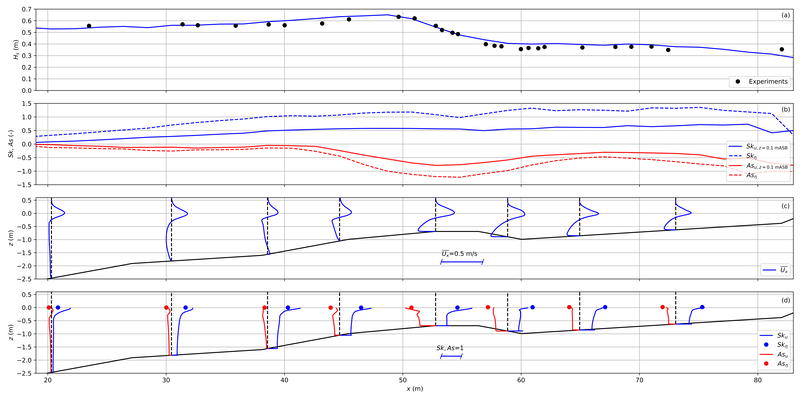
Figure 1 – (a) Hs validation of CFD model against Scott et al. (2005) experiments. (b) Sk and As evolution of the surface elevation and nearbed velocity. (c) Mean velocity vertical profiles (water column) across the domain. (d) Sku and Asu vertical profiles (water column) across the domain, in conjunction with the free surface Skη and Asη for comparison.
References
Elfrink B., Hanes D.M. & Ruessink G.B. (2006) – Parametrization and simulation of near bed orbital velocities under irregular waves in shallow water. Coastal Engineering, vol. 53, pp. 915-927.
Larsen B.E. & Fuhrman D.R. (2018) – On the over-production of turbulence beneath surface waves in Reynolds-averaged Navier–Stokes models, Journal of Fluid Mechanics, vol. 853, pp 419-460.
Larsen B.E., van der A D.A., van der Zanden J., Ruessink G.B. and Fuhrman D.R. (2020) – Stabilized RANS simulation of surf zone kinematics and boundary layer processes beneath large-scale plunging waves over a breaker bar, Ocean modelling, vol. 155.
Rocha M.V.L., Michallet H. & Silva P.A. (2017) – Improving the parametrization of wave nonlinearities – The importance of wave steepness, spectral bandwidth and beach slope. Coastal Engineering, vol. 121, pp. 77-89.
Ruessink G.B., Michallet H., Abreu T., Sancho F., van der A D.A., van der Werf J.J. and Silva P.A. (2011) – Observations of velocities, sand concentrations, fluxes under velocity-asymmetric oscillatory flows. Journal of Geophysical Research, vol. 116.
Ruessink G.B., Ramaekers G. & van Rijn L.C. (2012) – On the parametrization of the free-stream non-linear wave orbital motion in nearshore morphodynamic models. Coastal Engineering, vol. 65, pp. 56-63.
Scott C., Cox D., Maddux T. & Long J. (2005) – Large-scale laboratory observations of turbulence on a fixed barred beach. Measurement Science and Technology, vol. 16, pp. 1903-1912.
