
Roelvink1,2*, F. Masselink1, G. Rose3, S. Tissier4, M. McCall2, R.
1 University of Plymouth, United Kingdom; 2 Deltares, The Netherlands; 3 University of Bath, United Kingdom; 4 TU Delft, The Netherlands
* Corresponding author: floortje.roelvink@deltares.nl
Introduction
Atoll islands are tropical, wave‑built accumulations of carbonate sediment produced by the breakdown of calcium‑carbonate–secreting organisms living on the surrounding reef. Their very low elevation—typically less than 1–2 m above high tide—makes them highly susceptible to coastal flooding and island‑scale inundation during extreme wave events.
Many studies suggest that sea‑level rise and coral degradation will increase wave‑driven flooding to the extent that numerous atoll islands may become uninhabitable later this century (Storlazzi et al., 2018). However, the assumption that these islands are morphologically static has been challenged by observations and modelling showing that overwash and sediment deposition can raise island crests and help maintain freeboard under rising sea levels (Masselink et al., 2020).
To improve our understanding of atoll‑island morphodynamics under energetic waves and rising sea levels, we conducted a large‑scale physical experiment in the Delta Flume at Deltares. Continuous measurements were collected of crest discharge, flood depths, and bed‑level change, together with detailed wave and water‑level records across the reef platform. These observations provide a high‑resolution dataset for advancing process understanding and evaluating model performance. Initial XBeach validation results highlight its potential to reproduce key atoll‑island dynamics.
Objective and Methods
The objective of this study is to improve predictions of cross‑shore atoll island morphodynamics—and thereby future flood‑risk assessments—by calibrating and validating XBeach against the hydrodynamic and morphological data from the Delta Flume experiment.
The Delta Flume experiments featured a 1:3 scale sandy atoll island constructed on a concrete reef platform, heavily instrumented with pressure and velocity sensors, water‑level gauges, and LiDAR. The experimental programme comprised: (i) hydrodynamic tests (HYD) with an extended island berm to isolate reef‑specific processes such as infragravity and very‑low‑frequency wave generation, bore transformation, and runup; (ii) morphodynamic tests (MOR) with a representative island profile to characterise morphodynamic tipping points; and (iii) long‑term morphological tests (LTM) in which water levels were progressively increased to explore sea‑level‑rise effects on atoll islands under two contrasting wave climates. HYD and MOR tests were repeated with and without artificial reef structures to assess their influence on nearshore hydrodynamics and island response.
A 1D non‑hydrostatic, morphostatic XBeach model was calibrated against the flume observations using Manning roughness as the primary tuning parameter, to demonstrate its ability to reproduce reef‑flat hydrodynamics and associated sediment‑transport patterns, runup and crest-discharge characteristics.
Results
Observations from the HYD series (see Figure) show that offshore water levels strongly modulate reef‑flat hydrodynamics. Low water levels increase wave setup, infragravity (IG) and very‑low frequency (VLF) energy, while reducing short‑wave (SS) energy across the reef flat. In the MOR series, a clear morphodynamic tipping point was identified: a 17cm water‑level increase combined with energetic waves triggered progressive inundation and island rollover. The long‑term morphological tests (LTM1–4), spanning 86 runs under two contrasting wave climates, reveal location-specific island responses to sea‑level rise (SLR). Under the more energetic “Pacific” climate, accelerated SLR resulted in more rapid island rollover, whereas under the calmer “Maldives” climate, accelerated SLR led to enhanced crest building. All tests showed notable island retreat, partially caused by the absence of sediment supply.
XBeach simulations reproduced reef‑flat hydrodynamics and runup with high skill. Biases in wave setup, IG, and VLF components were <0.007 m (SCI < 0.05). Errors were slightly larger for SS waves, partly due to limitations of the pressure‑based measurements: linear depth‑attenuation corrections cannot resolve short‑wave undulations or steep borefronts. LiDAR‑derived free‑surface data will be used to address this. Ongoing work focuses on crest‑discharge and morphodynamic modelling.
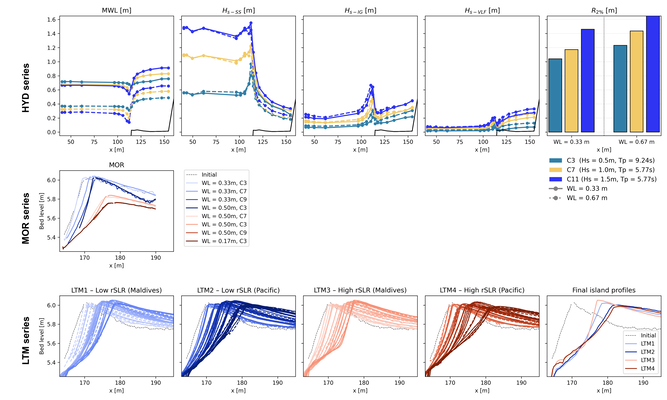
Overview of key data collected during the ARISE Delta Flume experiments, including reef hydrodynamics and runup from the HYD test series, morphodynamic tipping points from the MOR test series, and the long-term response of an atoll island to slowly increasing water levels (LTM series), including the individual runs and final island profiles for the four scenarios.
References
Masselink, G., Beetham, E., & Kench, P. (2020). Coral reef islands can accrete vertically in response to sea level rise. Science Advances, 6(24), eaay3656.
Storlazzi, C. D., Gingerich, S. B., Van Dongeren, A. P., Cheriton, O. M., Swarzenski, P. W., Quataert, E., ... & McCall, R. (2018). Most atolls will be uninhabitable by the mid-21st century because of sea-level rise exacerbating wave-driven flooding. Science advances, 4(4), eaap9741.
