
Y.B. Steenman1*, T. Stolp2
1 Svasek Hydraulics, The Netherlands; 2 HKV Lijn in Water, The Netherlands
* Corresponding author: steenman@svasek.com
Introduction
Effective management of salt intrusion in the Haringvliet estuary is essential for safeguarding freshwater availability and maintaining ecological balance during the Kier operation of the Haringvliet sluices. A key indicator for operational decision-making is the salinity in the Haringvliet Outer Delta. Accurate short-term forecasting of salinity at this location is therefore critical to support adaptive discharge strategies.
Conventional prediction methods rely on numerical hydrodynamic models, such as the currently applied Operationeel Stromingsmodel Rotterdam (OSR). Although physically robust, these models are computationally demanding and less flexible in operational contexts. Previous work demonstrated that relatively simple machine learning (ML) models can reproduce instantaneous salinity values with promising accuracy. However, operational water management requires forward-looking forecasts rather than retrospective estimations.
This study advances earlier research by developing a forecasting-oriented ML framework based on a Long Short-Term Memory (LSTM) neural network. The focus is on generating reliable 48-hour salinity forecasts at the measurement station Stellendam-buiten (-5 m+NAP) using readily available operational input data. The aim is to assess the performance of the ML model relative to the existing numerical model regarding the daily operational management of the Kier.
Objective and Methods
The primary objective of this study was to develop and validate a machine learning model capable of forecasting salinity in the Haringvliet Outer Delta 48 hours ahead and to assess its added value for operational Kier management. A secondary objective was to evaluate whether the model framework can be extended towards probabilistic forecasting in a computationally efficient manner.
An LSTM neural network architecture was selected due to its capability to capture temporal dependencies. The model was trained using historical datasets of salinity and relevant forcing variables, including sluice discharge, water levels, wind speed, and wind direction. The model was trained relying solely on measurement data, whereas operational forecast datasets were used as input to test the model performance. Model performance was benchmarked against the OSR numerical model using standard performance indicators.
To incorporate forecast uncertainty, a simplified probabilistic approach was implemented. Ensemble-like variability was emulated by perturbing key input parameters, specifically water level and wind speed, thereby generating multiple input configurations. Due to the computational efficiency of the LSTM model, these scenarios can be evaluated rapidly, producing a probabilistic bandwidth of salinity forecasts without the need for full hydrodynamic ensemble simulations.
Results
The LSTM-based forecasting model demonstrates a significant improvement in predictive performance compared to the currently applied OSR numerical model. Mean absolute errors for a forecast point 6 hours ahead decreased from 2360 mg/L for OSR to 620 mg/L for the ML model. In particular, the ML model more accurately captures the lower salinity levels caused by freshwater discharging through the sluice, as well as the temporal evolution of salinity under varying discharge regimes. The improvement is most pronounced during transitional hydrodynamic conditions caused by increases or decreases of sluice discharge.
The model shows a decreasing accuracy with longer forecast horizons, with a maximum mean absolute error of 840 mg/L at a forecast point 48 hours ahead. The simplified probabilistic extension provides additional insight into forecast uncertainty by delivering a bandwidth of potential salinity outcomes. This information could assist in risk-based decision making regarding the inlet protocol.
Furthermore, predicted salinity values in the Voordelta were translated into required inlet discharge settings using an analytical model developed within the research program. This step directly links salinity forecasts to operational measures. Overall, the results demonstrate that the ML-based forecasting tool constitutes a robust, flexible, and cost-efficient decision-support instrument for adaptive management of the Kier operation.
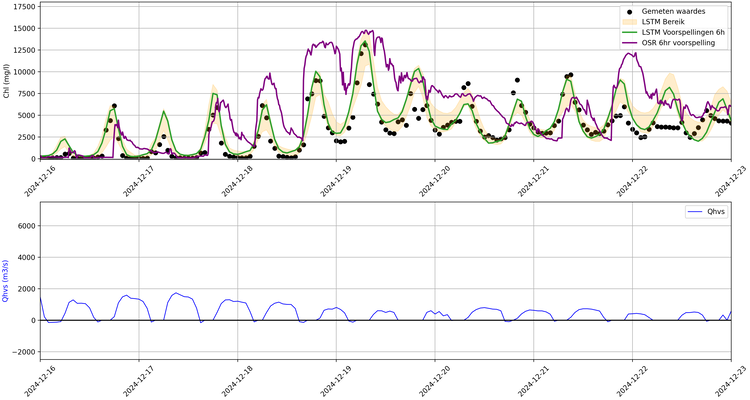
Upper figure: salinity predictions of the ML model 6 hours ahead (green line) versus predictions from the OSR numerical model 6 hours ahaed (purple line) and measurement data (black dots). The orange bandwidth shows the range of values predicted by the ML model at this timestep. Lower figure: discharge through the Haringvliet sluices.
