
M.H.V.Meijer1*, E.M. Horstman1, D.R. Fuhrman2, K.M.Wijnberg1
1 University of Twente, Netherlands; 2 Technical University of Denmark
* Corresponding author: martin.meijer@utwente.nl
Introduction
Salt marshes are widely recognized as potential Nature-based Solutions for coastal stability and flood protection under climate change. However, there’s a great contrast between managed salt marshes dominated by a few species and more biodiverse and dynamic salt marshes. In the Wadden Sea, many mainland salt marshes are under pressure from the triple ecological crisis of climate change, biodiversity loss and pollution. The differences between managed, monocultural salt marshes and more natural, biodiverse marshes under these pressures are not well understood. In most existing models, especially those simulating the dynamics of entire salt marshes, all vegetation is often characterized as cylinders for the purpose of calculating hydrodynamics. This parametrization assists in making these models work at scale, and for modelling a monoculture marsh, this may even be appropriate. However, salt marsh vegetation can vary widely in shape and structure. Understanding the impact of the assumptions made, and seeing what differences exist between species, can increase our understanding of the role biodiversity plays in salt marsh dynamics, and unlock more accurate parametrizations for larger scale models.
Objective and Methods
To gain more understanding on the effects of different salt marsh vegetation species on hydrodynamics, CFD modelling is applied. Different plant species are schematized in a single plant CFD model to analyse the hydrodynamics around the plant structure. Contrasting plant structures are selected, representing the most common salt marsh species: succulents (e.g., Salicornia), grasses (e.g., Spartina) and shrubs (e.g., Atriplex portulacoides). For model optimization purposes, modelling the free water surface and flexibility of vegetation are excluded. Not modelling the free surface allows for much more testing, since single-phase models are computationally much more efficient and stable than two-phase models that resolve the free surface. Flexibility is expected to have a limited impact on the reliability of the results, as most species tested are relatively rigid compared to e.g., seagrasses. The plants are subjected to a current and oscillating flow to analyse the differences in hydrodynamic wakes, vorticity patterns, velocity profiles and representative drag coefficients under currents and a combination of waves and currents.
Results
Early results indicate large differences in the vorticity patterns and velocity profiles between schematizations of the common pioneer species Salicornia europaea, and the more commonly used cylindrical vegetation representation (Figure 1). Both the scale and shape of the vorticity wake under waves and currents change drastically. These simulation results will be validated with flume measurements at LUFI Hannover with 3D prints of the plant structure schematizations.
Further analysis will focus on the velocity profiles introduced by the different plant structures, with a focus on near-bed dynamics and quantifying drag forces. Additionally, different topologies of the aforementioned species can be tested. This could take the form of adding more branches or changing stem dimensions. Differences in the observed drag for the varying plant structures will be translated into drag parametrizations that can be integrated into landscape-scale salt marsh models combining vegetation development and morphodynamics. These models will increase our understanding of the differences in development of managed monocultures compared to biodiverse salt marshes.
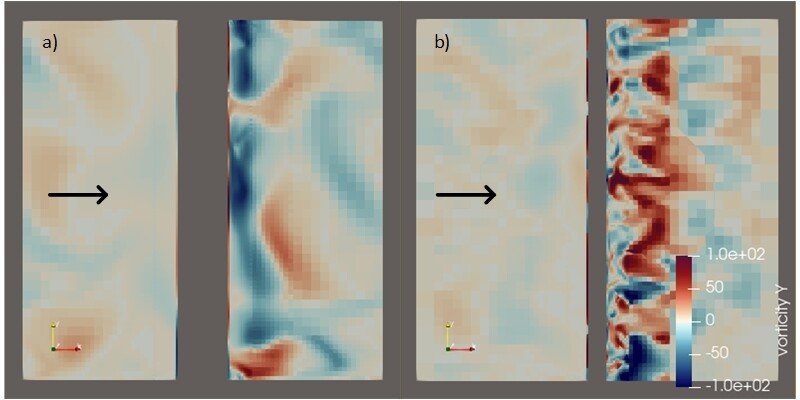
Figure 1 – Side views of vorticity wakes in cross-sections of simulations of a single cylinder (a) and a Salicornia schematization (b) at peak orbital velocity. Total computational domain is a cube with sides of 0.1m. Direction of flow is in the positive x-direction, as indicated by the black arrows.
