
Y. Attema1*, A. Kroon1 , B. van Leeuwen1
1 Svašek Hydraulics, The Netherlands
* Corresponding author: Attema@svasek.com
Introduction
The Eastern Scheldt has experienced a structural sediment deficit since construction of the storm surge barrier in 1986. The barrier reduced the tidal prism and flow velocities, and largely blocked sediment import into the basin (De Vet et al., 2024). As a result, the system is no longer in morphological equilibrium, and tidal channels are oversized relative to the reduced prism. The intertidal flats are the primary sediment source for channel adjustment and show significant erosion, as wave-driven erosion has remained largely unchanged while sediment supply and vertical accretion have been substantially reduced due to decreased flow velocities (Eelkema et al., 2013). This imbalance drives a gradual decline in intertidal areas, with bed-level changes on the order of centimeters per year (De Vet et al., 2017).
The loss of intertidal area has negative ecological consequences, as these flats function as essential foraging habitat for birds (Van Wesenbeeck et al., 2014). Sand nourishments are applied to mitigate habitat loss, but their expected lifespan is typically estimated from historical trends, monitoring data, hydrodynamic modelling, and expert judgement. Applying process-based morphodynamic models in these low-energy remains challenging, yet may improve predictions of nourishment lifespan and support more robust design.
Objective and Methods
This study presents the calibration and validation of a numerical morphodynamic model to assess the capability of process-based models to simulate and predict the morphological development and expected lifespan of nourishments in the Eastern Scheldt.
A coupled 2D FINEL-SWAN model was applied, resolving hydrodynamics, wave action, and sediment transport on a 15 m grid. Water levels were prescribed using astronomical tidal boundary conditions combined with storm surge data from Europlatform, and wind forcing was based on observations from Stavenisse. Sediment transport was computed using the Van Rijn (2007) formulation, accounting for both sand and silt fractions to represent the mixed sediment composition.
The 2008 Galgeplaat pilot nourishment was used for calibration. Hydrodynamic validation was carried out using measurements obtained at six locations on the tidal flat in 2008. Morphological calibration focused on reproducing observed suspended sediment concentrations.
Two-year morphological model simulations (2019–2021) were validated against LiDAR-derived bathymetry to assess the evolution of the pilot nourishment and general erosion and sedimentation patterns on the Galgeplaat. The role of wind was further investigated through additional simulations without and with increased wind influence (by adjusting the wind drag coefficient) on the hydrodynamics.
Results
The hydrodynamic calibration indicates that inclusion of wind forcing is essential to reproduce current velocities during windy conditions. However, the results show limited sensitivity to increased wind influence beyond the default setting. Furthermore, reproducing the observed suspended sediment concentrations requires inclusion of both silt and sand fractions.
Morphological validation demonstrates that the model accurately reproduces the evolution of the pilot nourishment and the larger-scale morphological patterns on the Galgeplaat. The sedimentation patterns are strongly influenced by wind forcing and require increased wind influence to reproduce the observed redistribution. Sediment transport frequently occurs near the threshold of motion, a regime typical for low-energy tidal flats and associated with increased parameter uncertainty. Default transport settings overestimate bed-level changes and require reduction by approximately a factor of 0.1.
Despite small morphological change rates, the morphological simulation captures the dominant trends and provides realistic estimates of nourishment erosion. These results demonstrate that process-based morphodynamic modelling can support more reliable prediction of nourishment lifespan and provide a quantitative basis for design.
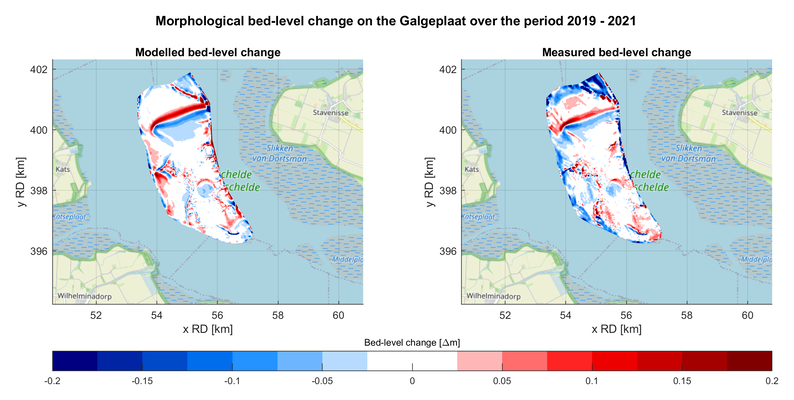
Comparison of modelled (left) and LiDAR-derived measured (right) bed-level changes on the Galgeplaat for the period 2019–2021.
References
Eelkema, Menno & Wang, Zheng Bing & Hibma, Anneke & Stive, Marcel. (2013). Morphological effects of the eastern scheldt storm surge barrier on the ebb-tidal delta. Coastal Engineering Journal. 55. 10.1142/S0578563413500101.
P.L.M. de Vet, B.C. van Prooijen, P.M.J. Herman, T.J. Bouma, D.S. van Maren, B. Walles, J.J. van der Werf, T. Ysebaert, E. van Zanten, Z.B. Wang, Response of estuarine morphology to storm surge barriers, closure dams and sea level rise, Geomorphology, Volume 467, 2024, 109462, ISSN 0169-555X, https://doi.org/10.1016/j.geomorph.2024.109462.
P.L.M. de Vet, B.C. van Prooijen, Z.B. Wang, The differences in morphological development between the intertidal flats of the Eastern and Western Scheldt, Geomorphology, Volume 281, 2017, Pages 31-42, ISSN 0169-555X, https://doi.org/10.1016/j.geomorph.2016.12.031.
Bregje K. van Wesenbeeck, Jan P.M. Mulder, Marcel Marchand, Denise J. Reed, Mindert B. de Vries, Huib J. de Vriend, Peter M.J. Herman, Damming deltas: A practice of the past? Towards nature-based flood defenses, Estuarine, Coastal and Shelf Science, Volume 140, 2014, Pages 1-6, ISSN 0272-7714, https://doi.org/10.1016/j.ecss.2013.12.031.
L. C. van Rijn. Unified View of Sediment Transport by Currents and Waves: part I and II. Journal of Hydraulic Engineering, pages 649–667, 2007
