
Pim. W.J.M. Willemsen1,2*, Victoria G. Mason3,4, Vincent van Zelst2,5, Vera M. van Bergeijk2, Mark Klein Breteler2, Jos. R.M. Muller6, Dimitrios Dermentzoglou5, Akis Vouziouris5, Thomas J. van Veelen6, S. Dzimballa6, Kathelijne M. Wijnberg6, Ton A.J.F. Hoitink1, Paul Buring7, Maike Paul8, Alessandro Antonini5, Tjeerd J. Bouma3,4, Bas W. Borsje6
1 Wageningen University & Research, Wageningen, the Netherlands; 2 Deltares, Delft, the Netherlands; 3 Royal Netherlands Institute for Sea Research (NIOZ), Yerseke, the Netherlands; 4 Utrecht University, Utrecht, the Netherlands; 5 Delft University of Technology, Delft, the Netherlands; 6 University of Twente, Enschede, the Netherlands; 7 Wetterskip Fryslân, Leeuwarden, the Netherlands; 8 Leibniz University Hannover, Hannover, Germany
* Corresponding author: pim.willemsen@wur.nl
Introduction
Salt marshes are well-known for their ability to attenuate wind waves. Consequently, salt marshes can reduce flood risk in green-grey flood protection. Field observations and large-scale lab experiments prove a significant attenuation of wave height and energy due to the elevated bed and vegetation roughness of the marsh (Caldera et al., 2025; Leonardi et al., 2018; Moller et al., 2014; Vuik et al., 2019). However, these results only include moderate conditions with waves up to approximately 1.0 m, with water levels of 2.0 m (Moller et al., 2014; Vuik et al., 2016). In the Netherlands, the UK, but also in Asia, Oceania and North-America more extremes are expected with surge induced water levels exceeding 2.0 m over the marsh (Dullaart et al., 2021; Pannozzo et al., 2021; Vuik et al., 2016) and, wind waves potentially exceeding 1.0 m. In particular, the efficacy of marsh vegetation to reduce waves exceeding 1.0 m, is largely uncertain as vegetation is progressively damaged during a storm.
Objective and Methods
In this study, we aim to assess the contribution of progressively damaged marsh vegetation to wave attenuation at the peak of storm surges on salt marshes worldwide. We consider storms with a statistical return period of 100 and 1000 years, and determine impact by parameterizing the results of a field-scale Delta Flume experiment (Deltares, Delft; Figure) that quantified the decreasing wave attenuation and progressive vegetation damage under extreme wave heights from 0.7 m up to 2.0 m and water depths over the marsh from 1.5 m up to 4.0 m. From the experiments, a statistical model (generalized linear model) was developed to parameterize vegetation damage and wave attenuation in response to exposure duration and incoming significant wave height (pseudo-R2 = 0.97; measured versus predicted R2 = 0.93). Subsequently, global datasets of storm surge hydrographs, coastal elevation and salt marsh presence were used to derive potential maximum significant wave heights at the seaward edge of the salt marsh (Dullaart et al., 2023; Pronk et al., 2024; van Zelst et al., 2021; Worthington et al., 2024). Stem damage and wave attenuation by vegetation was calculated at the peak of the storm surge by deploying the generalized linear model.
Results
The global statistical model emphasizes that salt marsh vegetation further contributes to the wave attenuating capacity of the marsh, in addition to depth-induced wave attenuation. Particularly at low-energy salt marsh coasts where the incoming significant wave heights remains below 1.0 m (total of 50% and 34% of all global coastlines for storm surge events with return periods of 100 and 1000 years, respectively), a large contribution is observed as vegetation damage is limited. At low energetic marsh coasts (Hs < 1.0 m), with a return period of 100 years, marsh vegetation reduces incoming waves by 10% to 50%. When incoming wave heights exceed 1.0 m (high energetic marsh coasts), wave attenuation by vegetation generally remains below 10%.
The Delta Flume experiment showed minor to negligible erosion of the elevated marsh platform under extreme wave conditions. This indicates that, both low (Hs < 1.0 m) and high (Hs > 1.0 m) energetic marsh coasts profit from the flood protection service the stable marsh provides. In addition, especially for low-energy marsh coasts, our results provide evidence for substantial wave attenuation by marsh vegetation, despite progressive vegetation damage.
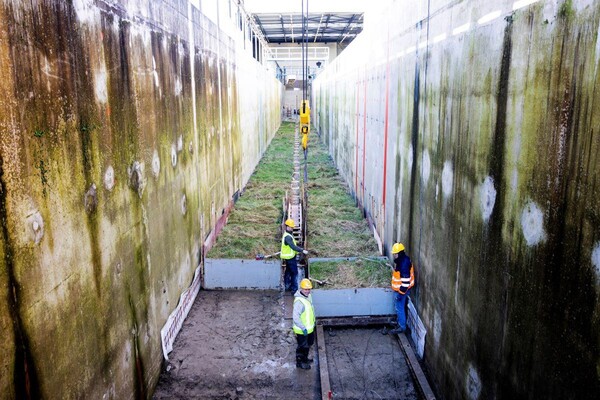
Figure. Construction and transplantation of the salt marsh in the Delta Flume (Deltares, Delft).
References
Caldera et al. (2025). Seasonal and inter-annual changes in wave attenuation by a constructed salt marsh on a sloping bed. Ecological Engineering.
Dullaart et al. (2021). Accounting for tropical cyclones more than doubles the global population exposed to low-probability coastal flooding. Communications Earth & Environment.
Dullaart et al. (2023). Enabling dynamic modelling of coastal flooding by defining storm tide hydrographs. Nat. Hazards Earth Syst. Sci.
Leonardi et al. (2018). Dynamic interactions between coastal storms and salt marshes: A review. Geomorphology.
Moller et al. (2014). Wave attenuation over coastal salt marshes under storm surge conditions. Nature Geosci.
Pannozzo et al. (2021). Salt marsh resilience to sea-level rise and increased storm intensity. Geomorphology.
Pronk et al. (2024). DeltaDTM: A global coastal digital terrain model. Scientific Data.
van Zelst et al. (2021). Cutting the costs of coastal protection by integrating vegetation in flood defences. Nature Communications.
Vuik et al. (2019). Salt marshes for flood risk reduction: Quantifying long-term effectiveness and life-cycle costs. Ocean & Coastal Management.
Vuik et al. (2016). Nature-based flood protection: The efficiency of vegetated foreshores for reducing wave loads on coastal dikes. Coastal Engineering.
Worthington, et al. (2024). The distribution of global tidal marshes from Earth observation data. Global Ecology and Biogeography.
