

W. Ploeg1*, P.C. Roos1, B.W. Borsje1, S.J.M.H. Hulscher1
1 University of Twente, the Netherlands
* Corresponding author: w.ploeg@utwente.nl
Introduction
Sustainable management of the projected increased sand extraction volumes from the Netherlands Continental Shelf requires detailed understanding of the interactions among the extraction pit, bed forms and the local sediment composition. Tidal sand waves are of particular relevance, as their spatial scale (hundreds of meters) and evolution timescale (decades) are of similar order as those of extraction pits. Additionally, the impact on the sediment composition might be profound, as extraction pits have shown to accumulate cohesive sediment. However, the exact interactions among cohesive sediment, sand wave dynamics and extraction pits are still poorly understood. This study, carried out within the OR ELSE project, therefore aims to develop an idealised numerical model to investigate these interactions. This idealised approach permits exploring the key physical processes governing the evolution, and (due to shorter computation times) exploring large parameter variations.
Objective and Methods
Two numerical tools are developed: a linearised model to quickly explore the small-amplitude dynamics (e.g. Campmans et al., 2017), and a (slower) nonlinear model also valid in the finite-amplitude domain (e.g. Campmans et al., 2018). The linear model is used for exploring the impact of cohesive sediment on sand wave formation, sorting and wavelength in the formation stage, and for exploring the impact of many pit design parameters on the temporal evolution. The nonlinear model is applied to investigate the temporal evolution of the system towards a finite amplitude equilibrium, and how cohesive sediment and sand extraction impact the evolution and equilibrium state.
Both models apply the shallow water equations to model the hydrodynamics, with spatially periodic boundary conditions in the horizontal direction, and a partial slip bed boundary condition. Sediment transport occurs due to bedload (using a general transport predictor) and suspended load (modelled by an advection-diffusion equation), where the cohesive fraction is only transported in suspension. The Exner equation governs the bed elevation, and the sediment composition is modelled using the Hirano (1971) active layer approach (assuming only the instantaneously mixed top layer is available for transport), extended with various sublayers to schematize the sediment stratigraphy.
Results
The results indicate that the preferred sand wave length generally increases for an increasing mud content for the conditions present on the Netherlands Continental Shelf. Additionally, cohesive sediment slows the evolution of the topography (comparing the top row, without mud, and middle row, with mud, of Fig. 1), which is caused by the lower transport rates due to the increased shear stress following the cohesive sediment presence. Application of our model to an extraction pit confirms that the pit attracts cohesive sediment (Fig. 1, bottom row), aligning with field observations by, for example, Witbaard & Craymaersch (2023). Furthermore, the extraction pit is shown to evolve more slowly in a muddier environment. However, the relation between the morphodynamic evolution and the pit design parameters (e.g. orientation w.r.t. principal flow direction, pit dimensions and slope angle) are barely affected by cohesive sediment presence.
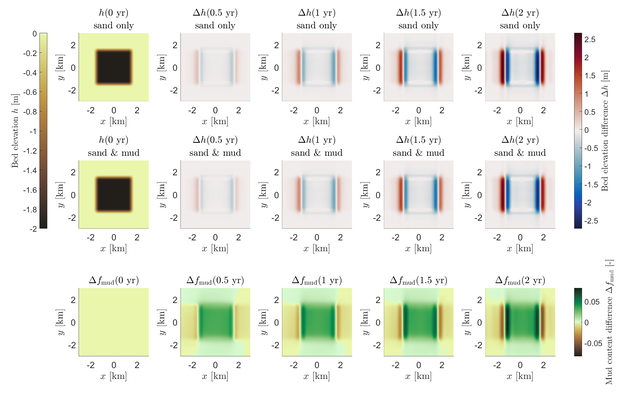
Evolution of sand extraction pits for two cases: without cohesive sediment (top row), and with 10% cohesive sediment in the bed (middle row). For the latter, the associated changes in the cohesive sediment content are shown in the bottom row. Δh and Δf_mud denote difference in bed elevation and mud content with respect to the initial state (t=0 yr).
References
Campmans, G. H. P., Roos, P. C., de Vriend, H. J., & Hulscher, S. J. M. H. (2017). Modeling the influence of storms on sand wave formation: A linear stability approach. Continental Shelf Research, 137, 103–116. https://doi.org/10.1016/j.csr.2017.02.002
Campmans, G. H. P., Roos, P. C., de Vriend, H. J., & Hulscher, S. J. M. H. (2018). The Influence of Storms on Sand Wave Evolution: A Nonlinear Idealized Modeling Approach. Journal of Geophysical Research: Earth Surface, 123(9), 2070–2086. https://doi.org/10.1029/2018JF004616
Hirano, M. (1971). River bed degradation with armouring. Japan Society of Civil Engineers, 3, 194–195.
Witbaard, R., & Craeymeersch, J. (2023). Littekens op de zeebodem. Een onderzoek naar de faunistische effecten op lange termijn van diepe zandwinning voor de Nederlandse kust (Nos. 2023–01; pp. 1–42). Netherlands Institute for Sea Research (NIOZ). https://doi.org/10.25850/nioz/7b.b.8d
