
Pauline Overes1,2*, Marcel Taal2 , Maaike Maarse2, Laura Brakenhoff3, Suzanne Hulscher1, Jebbe van der Werf1,2
1 University of Twente, The Netherlands; 2 Deltares, The Netherlands; 3 Rijkswaterstaat, The Netherlands
* Corresponding author: p.h.p.overes@utwente.nl
Introduction
Sand nourishments are a cornerstone of Dutch coastal management. They offer a flexible, nature‑based approach to maintaining the coastline. The policy objective to maintain the coastline serves both long term flood protection and ecological, recreational, and economic values. After more than 30 years of successful implementation, this approach is widely regarded as robust and adaptive (Brand et al., 2022). However, rising sea levels, increasing demands for space, environmental ambitions and the need to reduce emissions require both technical and organisational innovations. As a result, there is a growing recognition that the Netherlands could benefit from a strategy that goes beyond “hold‑the‑line”. Projects like the Sand Motor and the Hondsbossche Dunes have already demonstrated the potential of larger-scale sandy interventions. Building on these insights, the SOURCE-project aims to deliver knowledge to facilitate decisions on further adoption of such concepts.
Objective and Methods
This study aims to improve the science-policy interface for decisions on future nourishments. Necessary insights relate to physical as well as governance aspects and both extend across spatial and temporal scales (see Figure 1).
As coastal development must anticipate accelerating sea‑level rise and shifting landscape dynamics, new questions arise, e.g. on how dune systems evolve or whether different types of nourishments could offer additional values and how this intersects with governance challenges. This study will therefore also focus on how system knowledge is shared across policy arenas, how stakeholder involvement is organised and how path dependency and existing institutional arrangements play a role.
To address these issues, the study applies a system‑based planning approach combining physical and governance perspectives. Conceptual models are used to translate complex coastal processes into accessible information for practitioners and decision‑makers. The morphological scale cascade provides a structured way to link short‑term nourishment behaviour with long‑term coastal evolution. Complementary governance analysis examines institutional roles, mandates, and decision processes to identify how system knowledge can more effectively support coastal planning.
Results
The study will support the development of a coherent evaluation framework. It will help to clarify how key morphological indicators (e.g. beach width, dune development) can guide nourishment design and long‑term planning. The governance perspective will contribute to identify where stakeholder involvement can be strengthened and how system knowledge can be better used in coastal decision‑making.
Regular interaction with experts, practitioners, and stakeholders, such as Rijkswaterstaat, municipalities, waterboards and NGO’s, is essential as this helps to determine which knowledge gaps are crucial and to identify largest opportunities for innovation. In addition, reflecting on experiences abroad (e.g. Belgium, Portugal) will provide useful contrasts and potential inspiration.
Acknowledgments
This work is part of the research program SOURCE (Sand nOURisment strategies for sustainable Coastal Ecosystems), funded by the Dutch Research Council (NWO), project number NWA.1518.22.133.
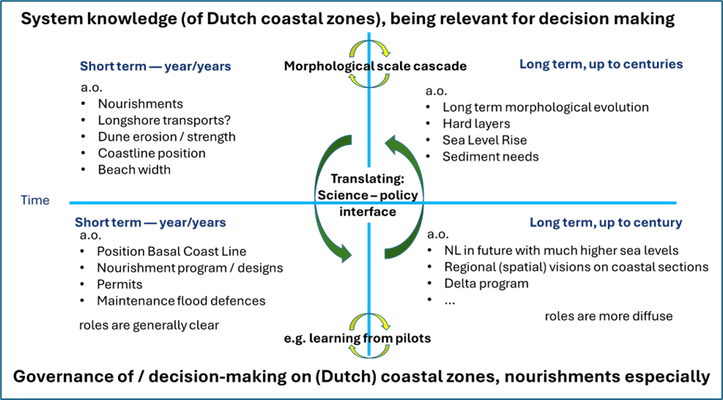
Timescales and the science-policy interface (diagram developed for SOURCE) (Taal and Maarse, 2026.)
References
Brand, E., Ramaekers, G., & Lodder, Q. (2022). Dutch experience with sand nourishments for dynamic coastline conservation–An operational overview. Ocean & Coastal Management, 217, 106008. DOI: 10.1016/j.ocecoaman.2021.106008
Taal, M. & Maarse, M. (2026) SOURCE WP 4 Strategies - Inception Report [in preparation]
