
J. Jorritsma1*, W. Van de Lageweg2
1 HZ University of Applied Sciences, The Netherlands; 2 HZ University of Applied Sciences, The Netherlands
* Corresponding author: jorr0003@hz.nl
Introduction
The adoption of sand as a building block to facilitate coastal functions marked a fundamental shift in Dutch coastal management: from treating water as a threat to embracing its role as an ally. This shift towards soft measures has not only challenged existing concepts of coastal protection, but also challenges the acceptance for and trust in coastal protection amongst coastal populations. The local population plays a unique role in coastal protection, and coastal protection measures can only be truly sustainable if supported and valued by coastal communities (Philipp 2024). Given the acceleration of sea level rise, nourishments across the Dutch coast will only increase in the upcoming future. However, studies examining the interactions between nature-based measures and the coastal communities’ appreciation or valuation of the coast are still rare (Bakhshianlamouki 2025; Bax et al. 2025), and the human dimension of technical interventions is often overlooked. This paper, therefore, aims to map out the key requests that the coastal population of Walcheren (Zeeland, The Netherlands) has for coastal protection, and asks what the underlying images and experiences are that shape and define these requests.
Objective and Methods
We perceive the coast not as a passive landscape, but as a dynamic space that is actively shaped by the human imagination. Exploring the coast through such a ‘coastal imaginary’ lens helps to understand the regional identities, beliefs, myths and anxieties in different contexts (Beaven 2025). In policy, the cultural, emotional and historical dimensions of coastal planning are incorporated in the concept of ‘spatial quality’ (SQ), which is recorded in the Environment and Planning Act of the Netherlands. SQ, however, is an ambiguous concept that defines quality in rather vague terms such as ‘cultural history’, ‘specificity’, ‘character’ and ‘recognizability’. Due to the ambiguity of SQ, the concept can be misused to justify particular top-down interests, create unmet expectations and lead to miscommunication (Bakx et al. 2023; Porter & Davoudi 2012; Soubry & Sherren 2022). By engaging with the imaginaries of coastal communities, it is our objective to concretize the requests that shape local views on SQ in order to produce an explicit view of what constitutes desired outcomes (Geukes et al. 2024). We will map out the key societal requests of the coastal population of Walcheren through field visits and qualitative, in-depth interviews with local inhabitants and stakeholders.
Results
Our interviews display a tool to assess the needs and values of a society that could be the basis for any coastal protection measure during different project phases. Furthermore, our case study will offer categories to place, evaluate and compare measures in less ambiguous terms, openly communicating the societal needs and requests towards coastal protection. This will lead to a better understanding of the interactions between NbS measures and the coastal communities’ appreciation or valuation of the coast, and provides a more realistic assessment of the potential influence of management decisions, not only on flood safety but also on other, societal functions of which the coast forms a part. In turn, our paper will contribute to the ambition that is laid down in the Environment and Planning Act of the Netherlands, which states that it is the people themselves who should be responsible for environmental quality by actively participating in policymaking and project development.
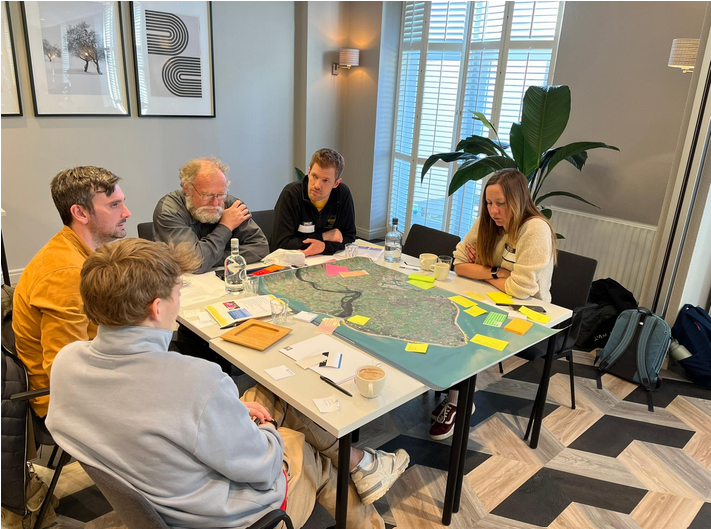
SOURCE LivingLab Zeeland: https://storymaps.arcgis.com/stories/c214d2c8d7014ff485f122c26a5106aa
References
Bakhshianlamouki, Elham. 2025. Towards Integrated Management of Sandy Anthropogenic Shores: Developing Tools for the Exploration of Human-Natural Interactions. Dissertation: University of Twente.
Bakx, Michiel., Sven Stemke and Sanda Lenzholzer. 2023. “Beyond Landscape Experience: A Systematic Literature Review on the Concept of Spatial Quality in Flood-Risk Management”. WIREs Water 10, no. 5.
Bax, Vincent, Teun Terpstra, Wietse van de Lageweg, Jean-Marie Buijs and Tatiana Filatova. 2025. “Emotions, Trust, and Expectations: Comparing Determinants of Public Support for Managed Realignment Across Cases”. Journal of Environmental Management 380.
Beaven, Brad. 2025. “Introduction to Coastal Imaginaries: Anxiety, Liminality, Power and Cultural Construction”. Coastal Studies 4, no. 2-3.
Davoudi, S. and L. Porter (eds.). 2012. “Resilience: A Bridging Concept or a Dead End?” Special Issue. Planning Theory & Practice 13.
Döring, Martin, and Beate M.W. Ratter. 2021. “‘I show you my coast…’ – A Relational Study of Coastscapes in the North Frisian Wadden Sea”. Maritime Studies 20, no. 3.
Geukes, Haye H., Peter M. van Bodegom, Alexander P.E. van Oudenhoven. 2024. “Setting the Stage for Decision-Making on Nature-Based Solutions for Climate Adaptation”. Ocean & Coastal Management 247.
Holzhausen, Jessica, and Kevin Grecksch. 2021. “Historic Narratives, Myths and Human Behavior in Times of Climate Change: A Review from Northern Europe’s Coastlands”. WIREs Climate Change 12, no. 5.
