
A. Zorndt1*, E. Botero-Campabadal1 , V. Sort, H. Jansch1
1 Bundesanstalt für Wasserbau, Germany
* Corresponding author: anna.zorndt@baw.de
Introduction
The Jade is a meso-tidal bay located in the German Bight, just west of the Weser estuary, in Germany. In the deep-water harbor JadeWeserPort located in the inner Jade, dredging amounts have been rising due to the construction of new berths and approach basins, among others infrastructure for liquefied gas terminals. The disposal sites used by the waterways and shipping administration and private port operators are beginning to fill up. Therefore, the administration is aiming to approve new sediment disposal sites. Nine new disposal sites have been identified to replace the four current sites, based on morphological development and investigations of sediment and benthic macroinvertebrates.
We have been tasked with investigating the impact of the fine sediment disposal on the new disposal sites, compared to those currently in use (see figure, right).
Objective and Methods
The study’s objective is to investigate the changes in disposal-related impacts resulting from shifting disposal activities from the current sites to the future ones. It focusses on changes in disposal-related increases in suspended sediment concentrations and the fate of the disposed fine sediments < 63 µm.
A numerical model of the North Sea based on Lepper et al. (2025) is used, with a refined Jade-Weser area. The base run is a hindcast of the year 2018 with a two-months spin-off time for sediment initialization. Additionally, the model is rerun with two future dredging volume projection scenarios amounting to 18,9 Mio. m3 dredged material, containing 18 % of fine sediments. In the two scenarios, the current and the new disposal sites are used, respectively. Both scenarios are compared to the base run and to each other.
Results
Preliminary results point out the impacts of the disposals in general and the differences between the investigated scenarios in particular. In the figure, long-term averaged suspended sediment concentrations (ssc) in the area of interest are shown for the sum of all modeled fine sediment fractions, thus including both natural sediment transport and scenario disposals. First analyses show that the impact of the disposals is approximately one order of magnitude smaller than the natural suspended sediment transport. In the following steps, the differences between the scenarios will be evaluated further. We will also focus on specific sites such as tidal flats and seagrass sites.
To get a better understanding of the processes during the sediment disposal and to further improve the model parameters, a measurement campaign investigating the disposal of fine sediment in the Jade is planned. It will include ship- and mooring-based measurements of current velocity, suspended sediment concentration and particle size distributions in the vicinity of the hopper dredger. Using the results of the field campaign, we will further improve our model to better fit to observational data.
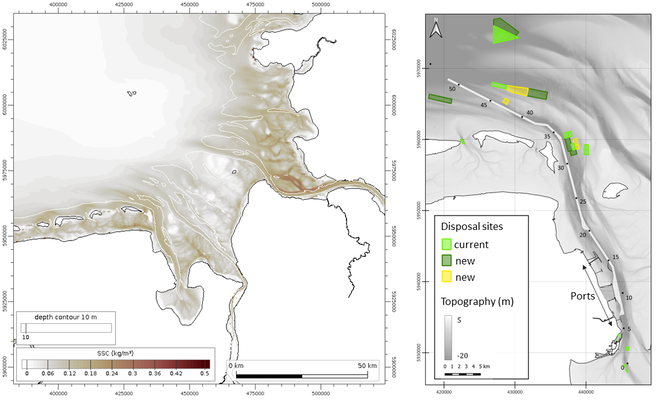
Long-term averaged suspended sediment concentrations (ssc) including both natural sediment transport and scenario disposals in the German Bight (left) and the inner and outer Jade showing the locations of the ports and the new disposal sites (right).
References
Lepper, R.; Reinert, M.; Gundlach, J.; Weber, J.; Kösters, F. (2025): A hydrographic dataset of the Wadden Sea as a foundation for a digital twin of the coastal ocean. In: Scientific data 12 (1), S. 1746. DOI: 10.1038/s41597-025-06211-1
