
Roelvink, Dano1,2,3
1 IHE Delft Instiutute for Water Education, the Netherlands
2 Deltares, the Netherlands
3 Delft University of Technology
* Corresponding author: d.roelvink@un-ihe.org
Introduction
ShorelineS (Roelvink et al., 2020 is a free-form coastal planform model that simulates the coastline evolution based on longshore transports driven by waves and tides, for sandy coasts that may be subject to human interventions such as groynes, offshore breakwaters, revetments and nourishments. Due to its flexible grid it can represent complex shapes such as spits, islands and migrating river mouths.
The numerical scheme is explicit, which allows an easy implementation of additional processes but constrains the time step applied. For small grid sizes, this can become restrictive as the allowed timestep reduces by the cell size squared.
In some coastline models, e.g. Cosmos-Coast (Vitousek et al., 2017), an implicit scheme is used, which greatly reduces the computation time and renders the simulations insensitive to grid size changes. However, such models do not deal with high-angle waves generating unstable behaviour, and can only move coastline points 'on rails', i.e. in a fixed direction.
In this paper we present a way towards a fully implicit method for ShorelineS, while retaining the flexibility and ability to deal with high-angle waves.
Objective and Methods
Our objective is to develop a numerical scheme that is fully implicit in time and that can handle both the diffusive coastline behaviour fro small angles of incidence and the high-angle behaviour leading to the growth of spits.
For the diffusive behaviour, we develop a linearised, tridiagonal set of equations for the coastline change at the new time level, starting from the coastline state at a given moment. The set of equations can be solved using the Thomas algorithm, and the cross-shore changes can be applied to predict new positions of the coastline. This method is extremely robust and can be shown to reproduce the typical behaviour around groynes as produced by the Pelnard-Considère equations.
For the high-angle case, the discretisation of the coastline change for points at an angle higher than 45 degrees is performed using an upwind scheme; here, we use a sweeping technique to solve the coastline change at the new time level directly using the solution for the adjacent upwind point.
Both methods can be combined by first applying the sweeping in both directions for the high-angle sections and then applying the tridiagonal solver for the remainder.
Results
We show an example of the evolution of a circular island under constant wave forcing. The western part is eroded in a diffusive way, and on the northern and southern side spits develop at roughly 45 degrees to the incident wave direction. In the figure, the initial shape is drawn in red dots, the blue lines are coastline shapes drawn every tenth time step and the green dots are the final coastline after 10 years. This simulation produces converging results for time steps from as large as 1 month to days or less.
Similar results can be shown for spit evolution after a coastline angle discontinuity and for the case of fullt blocking groynes. We conclude that we can show the proof of concept for an implicit method for ShorelineS. However, much work needs to be done before we have implemented and validated the same range of functionalities covered by the current version of ShorelineS.
We are grateful for the suggestion by Guus Stelling to try a sweeping method for the upwind part. This work was carried out under the ShorelineS TKI 2.0 project.
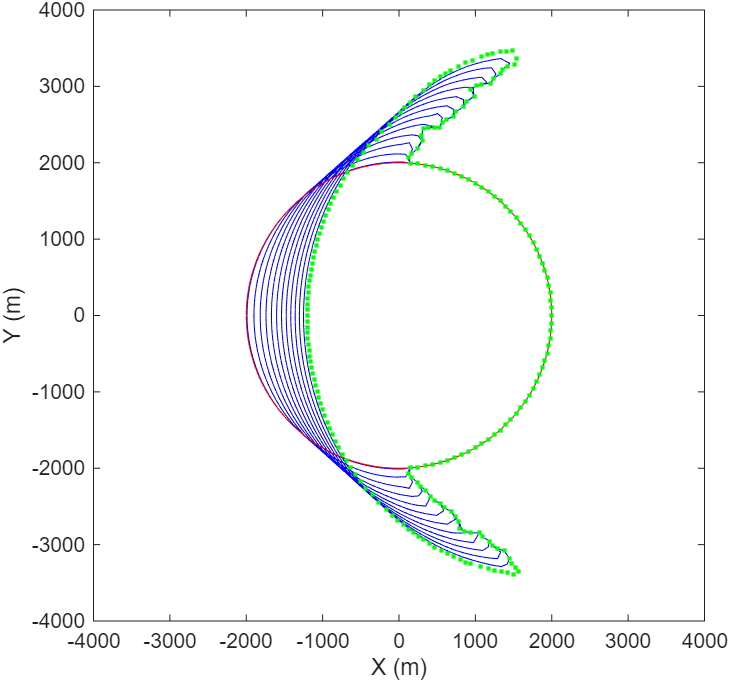
Evolution of a circular island over a 10-year period under constant wave forcing from the West.
References
Roelvink D, Huisman B, Elghandour A, Ghonim M and Reyns J (2020) Efficient Modeling of Complex Sandy Coastal Evolution at Monthly to Century Time Scales. Front. Mar. Sci. 7:535. doi: 10.3389/fmars.2020.00535
Vitousek, S., Barnard, P. L., Limber, P., Erikson, L., & Cole, B. (2017). A model integrating longshore and cross-shore processes for predicting long-term shoreline response to climate change. Journal of Geophysical Research: Earth Surface, 122(4), 782-806. https://doi.org/10.1002/2016JF004065
