
H.Shafiei1*, S.G. Pearson1, J.A.H. Reyns1,2,3, A.J.H.M. Reniers1
1 Delft University of Technology, Department of Hydraulic Engineering, Delft, 2600GA, The Netherlands;
2 Coastal and Urban Risk and Resilience Dept., IHE Delft, Delft, Netherlands;
3 Dept. of Applied Morphology, Deltares, Delft, Netherlands
* Corresponding author: h.shafiei@tudelft.nl
Introduction
Understanding sediment pathways is crucial for the sustainable management of coasts. These pathways act as conveyor belts whose strength and source diversity determines morphological changes and sediment mixing throughout the system. By aggregating individual pathways into a unified dynamic system and examining their local- and regional-scale behaviors together with morphological changes, the most influential pathways and their contributions to the beach can be identified. For example, a relatively small, highly erosive area (e.g., a rip channel) may be fed by an extensive region of the beach. Under such conditions, even small changes in that area may rewire the whole system and drive it toward a new morphological state. This hypothesis is investigated in this work by implementing the framework of coastal sediment connectivity [1] into a rip-channeled beach.
Objective and Methods
First, a Delft3D morphodynamic model is used to simulate the development of rip channels and shoals from an initially alongshore-uniform sandbar [2]. The resultant velocity field as well as the bathymetric updates are then fed into the SedTRAILS Lagrangian model to simulate the sediment pathways [3,4]. Since SedTRAILS uses morphostatic bed, multiple models are set up and sequentially run with updated bathymetries. The simulated pathways are then aggregated and complied into a complex network. The network nodes and links represent, respectively, initial position of the seeded particles and the connection between the initial and new positions. Then, versatile, widely used toolboxes developed by network scientists can be adapted and implemented to analyse the sediment dynamics. In this work, the nodal network metric in-degree is used to quantify the spatial distribution of sand source diversity. Then, a combination of global network properties (e.g., heterogeneity, centralization, and assortativity) is computed and analysed to understand the effects of highly connected areas (also known as hub in network sciences) on the system-wide dynamics.
Results
The results show that the sediment dynamics experiences difference stages. In the first stage, morphological instabilities lead to slow excavation of the rip channels. The respective sediment connectivity indicates that sediment pathways grow in a self-similar manner (i.e., the standard deviation of In-degree increases proportional to its mean). In the second stage, the positive feedback loop between the bed and hydrodynamic forcing triggers rapid development of the rip channels and shoals; coherent pathways seem to promote a metastable condition. In the third stage, despite structural similarities in morphology, the network is segregated into two parts and the connectivity metrics experience sharp changes. In the final stage, both morphology and connectivity seem to have reached a dynamic equilibrium state, resulting in persistent rip-shoal structure and constant global connectivity metrics. Consequently, the morphology of a rip-shoal system seems to be tied to the emergence and persistence of a sand source hub. Eventually, these findings can be applied to real-world sandy coasts to examine the interactions of local and system-wide dynamics and changes.
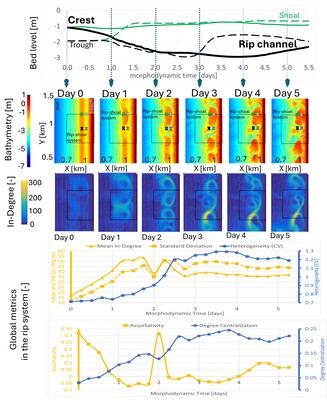
Spatio-temporal variations of the morphology and connectivity of the rip-shoal system
References
[1] Pearson, S. G., van Prooijen, B. C., Elias, E. P., Vitousek, S., & Wang, Z. B. (2020). Sediment connectivity: A framework for analyzing coastal sediment transport pathways. Journal of Geophysical Research: Earth Surface, 125(10), e2020JF005595.
[2] Reniers, A. J., Roelvink, J. A., & Thornton, E. B. (2004). Morphodynamic modeling of an embayed beach under wave group forcing. Journal of Geophysical Research: Oceans, 109(C1).
[3] Pearson, S. G., Elias, E. P. L., Van Ormondt, M., Roelvink, F. E., Lambregts, P. M., Wang, Z., & van Prooijen, B. (2021). Lagrangian sediment transport modelling as a tool for investigating coastal connectivity. In Coastal Dynamics Conf. Proc.
[4] Soulsby, R. L., Mead, C. T., Wild, B. R., & Wood, M. J. (2011). Lagrangian model for simulating the dispersal of sand-sized particles in coastal waters. Journal of waterway, port, coastal, and ocean engineering, 137(3), 123-131.
