
D.W. Poppema1*, S. de Vries1 , A. Antonini1
1 Delft University of Technology, The Netherlands.
* Corresponding author: d.w.poppema@tudelft.nl
Introduction
Hybrid flood defenses that combine sandy dunes with hard structures are increasingly applied in coastal flood protection. These systems integrate the ecological, recreational, and adaptive potential of dunes with the predictable safety and erosion resistance of traditional hard structures. While the stability of classical fully hard or soft flood defenses under wave attack is a well-established topic, the response of hybrid dunes additionally depends on complex feedback processes between wave action, hard elements, and dune morphology. Proper understanding of these interactions is essential to assess the safety of existing hybrid dunes and to effectively design new ones. The Hybrid Dune field experiment was conducted to quantify hydrodynamics and storm-driven dune erosion for several hybrid flood defense configurations. This contribution examines how storm conditions and hybrid dune configuration control erosion processes during energetic storm events.
Objective and Methods
The Hybrid Dune experiment investigates storm-driven erosion of hybrid dunes, with a focus on the interaction between hard structures and sandy dune morphology. A large-scale field experiment was conducted at the Sand Motor, where a hybrid test dune was constructed above the high-water line. Four cross-shore configurations were tested: (1) a classical sand dune (baseline), (2) a dike with a concrete revetment, (3) a dike-in-dune with a sand-covered revetment, and (4) a dune with a buried vertical seawall.
Hydrodynamic conditions (water levels, waves, currents, and sediment concentrations), wave impacts on the hard structures, and morphological evolution of the dune and foreshore were continuously measured during storm events. This contribution focuses on the morphological response, specifically storm-induced dune erosion. Beach and dune topography were monitored at high temporal resolution using lidar, from which cross-shore profiles and time series of dune erosion were derived. Observed erosion rates are related to storm conditions and nearshore hydrodynamic forcing, enabling comparison between sandy and hybrid dune configurations and assessment of the role of dune typology in controlling storm erosion.
Results
The experiment resulted in a comprehensive dataset with concurrent observations of hydrodynamics, beach-dune morphology, and wave impacts on the hard structures during storms. The continuous, high-frequency measurements enabled analysis of dune erosion at near-continuous timescales. Overall, hybrid dune sections experienced substantially less dune erosion than the sandy dune. In contrast, beach-face evolution seaward of the defenses appeared similar across all cross sections, suggesting that beach response was primarily governed by large-scale sediment supply, beach elevation, and hydrodynamic forcing. Analysis indicates that dune erosion rates correlate well with water levels and nearshore 2% exceedance water levels, used here as a proxy for wave runup. Ongoing analysis extends this approach to additional hydrodynamic statistics and compares erosion drivers between sandy and hybrid dune configurations, thereby improving understanding of how storm conditions and hard elements together control hybrid dune erosion.
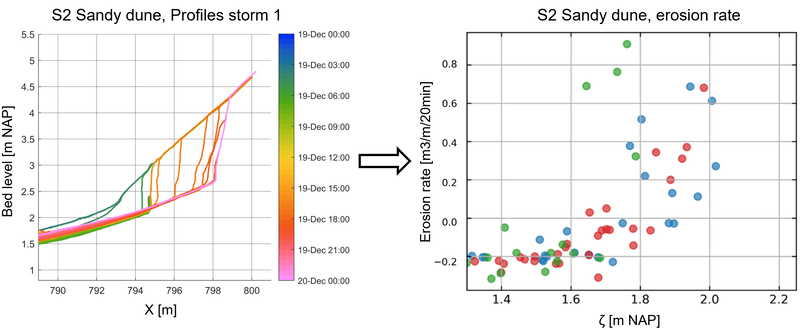
Beach-dune profiles obtained from the lidar scans (left) are used to determine the erosion rate (right) and link it to the hydrodynamic conditions
