
M.J.M. van Dijk1*, J.H. Nienhuis1 ,
1 Utrecht University, Netherlands
* Corresponding author: m.j.m.vandijk@uu.nl
Introduction
Over the past few centuries, the Rhine-Meuse channel network has become increasingly stabilized and actively managed through channel stabilization and dredging to regulate discharge, protect surrounding cities from flooding, and maintain navigation (Cox et al., 2022). Construction of the Maeslant Barrier (MB) on the Nieuwe Waterweg (NWW), the now main discharge channel to the North Sea, was finished in 1997 (Cox et al., 2021). This barrier protects the delta and upstream channels from storm surge flooding, maintains general accessibility for shipping, including to the port of Rotterdam, and fluvial discharge outflow from the Rhine and Meuse rivers.
Ongoing dredging of the NWW to maintain shipping depths, combined with rising sea levels and altered upstream discharges due to climate change, may alter hydrodynamics and flood risk conditions. These uncertain future conditions raise the question on how to manage the storm surge barrier effectively. Addressing this question requires understanding how the future long-term morphology of the deltaic channel network develops and how it influences barrier functionality.
Objective and Methods
In this study we use the 1D numerical model of Iwantoro et al., (2022). This model simulates long-term (decades to centuries) hydrodynamics and morpho-dynamics across a tidal channel network. Channels can function as either bifurcations or confluences depending on the tidal phase, and sediment redistribution at bifurcations is handled using a nodal point relation that allocates bedload according to the characteristics of the receiving channels.
Using the model we assess the long-term stability and morphology of the present-day configuration of the Rhine–Meuse channel network under future sea level and upstream discharge scenarios. We compare this to alternative channel configurations, modifying channel geometry (depth and width) to reflect flood risk measures or dredging activities. We will also evaluate future discharge distributions, sediment transport, and bed-level changes for a closed NWW. Even though the NWW is only closed during storm surges, we would like to investigate the deltaic structural sensitivity to a downstream restriction in tidal influence.
Identifying the morphological long-term system response if tidal influence were progressively reduced (increased closure frequency) is a next step in our research. Ultimately we will provide a baseline for future event-based analyses, defining the structural response before examining operational effects in more detailed morphological models.
Results
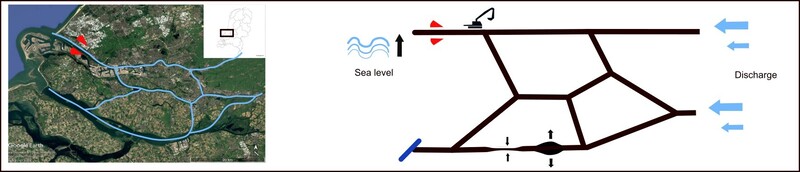
Figure 1: On the left, satellite image of study area, blue indicates main channels of the system and red indicates location of the Maeslant Barrier. On the right, conceptual figure of study area translated into model schematization. Choices in boundary conditions and schematization for different scenarios (sea level, discharge, channel deepening, widening or narrowing) indicated by illustrations.
References
Cox, J. R., Huismans, Y., Knaake, S. M., Leuven, J. R. F. W., Vellinga, N. E., van der Vegt, M., Hoitink, A. J. F., & Kleinhans, M. G. (2021). Anthropogenic Effects on the Contemporary Sediment Budget of the Lower Rhine-Meuse Delta Channel Network. Earth’s Future, 9(7), e2020EF001869. https://doi.org/10.1029/2020EF001869
Cox, J. R., Leuven, J. R. F. W., Pierik, H. J., van Egmond, M., & Kleinhans, M. G. (2022). Sediment deficit and morphological change of the Rhine–Meuse river mouth attributed to multi-millennial anthropogenic impacts. Continental Shelf Research, 244, 104766. https://doi.org/10.1016/j.csr.2022.104766
Iwantoro, A. P., van der Vegt, M., & Kleinhans, M. G. (2022). Stability and Asymmetry of Tide-Influenced River Bifurcations. Journal of Geophysical Research: Earth Surface, 127(6), e2021JF006282. https://doi.org/10.1029/2021JF006282
