

I. Noshin1*, Saiyara. Saha2 , Chamlei.
1 Yale University, USA; 2 Khulna University, Bangladesh
* Corresponding author: nsaiyara144@gmail.com
Introduction
Mangrove forests, which occupy enormous regions throughout the world, have suffered significant losses due to anthropogenic activity and environmental stresses such as heavy metal poisoning. Cadmium (Cd) is a major hazard among these contaminants, especially in mangroves, where it accumulates in plant tissues and can cause severe poisoning. The Sundarbans is under rising pressure from urbanization, industry, and climate change. This research focuses on Xylocarpus mekongensis Pierre, a vital mangrove species, and the influence of Cd in this particular tree. The study showed all plant parts' philological, anatomical, and chemical changes. There was a high accumulation of Cd in the roots and very few in the leaves. There was a distinct physiological effect of the Cd stress, which shows a decline in physiology, with increasing concentrations of Cd. There was also an effect on chemical and nutrient composition with Cd accumulation mostly in roots.
Objective and Methods
The specific objectives of this study are as follows-
• To evaluate the effect of Cd on Xylocarpus mekongensis seedling biomass
• Examine the influence of Cd on the chemical composition of Xylocarpus mekongensis leaves, such as chlorophyll
• To investigate the influence of Cd on nutrients (N, P, and K) and Cd accumulation in plant sections (Leaf, stem, and root) of Xylocarpus mekongensis.
• To analyze the variation in anatomical structures of Xylocarpus mekongensis plant sections (leaf and stem) under varied Cd concentrations.
Results
Cadmium (Cd) exposure progressively inhibited Xylocarpus mekongensis seedling growth across all measured parameters. Height increment declined sharply from 6.29 cm in control (T0) to 1.70 cm at 50 mg/L Cd (T6), collar diameter from 1.08 mm to 0.15 mm, and fresh biomass from 3.23 g to 0.85 g (Table 4). Two-way ANOVA confirmed highly significant treatment effects on height (p < 0.0001, R² = 0.24), with post-hoc LSD tests showing distinct groupings (A > B > C); T1 (5 mg/L) differed from control while T2–T6 formed separate clusters.
Potassium (0.30–0.43 mg/g) and phosphorus (0.04–0.05 mg/g) concentrations were highest in leaves, decreasing through stems to roots. Treatments significantly affected leaf P and K (p < 0.05) but not other tissues.
Leaf vein density exhibited highly significant variation (p < 0.0001), indicating Cd-induced anatomical remodeling. Chlorophyll concentration differed markedly across treatments (F = 179.44, p < 0.0001, R² = 0.99).
Cd bioaccumulation was strongly root-preferential (>55% total), rising from 0.03 mg/kg (T0) to 0.27 mg/kg (T6) in roots—highly significant (F = 1630.12, p < 0.0001). Stems showed significant accumulation (F = 45.88, p < 0.0001), while leaf levels trended upward (0.02–0.07 mg/kg) but remained non-significant (p = 0.079), confirming effective root barrier function.
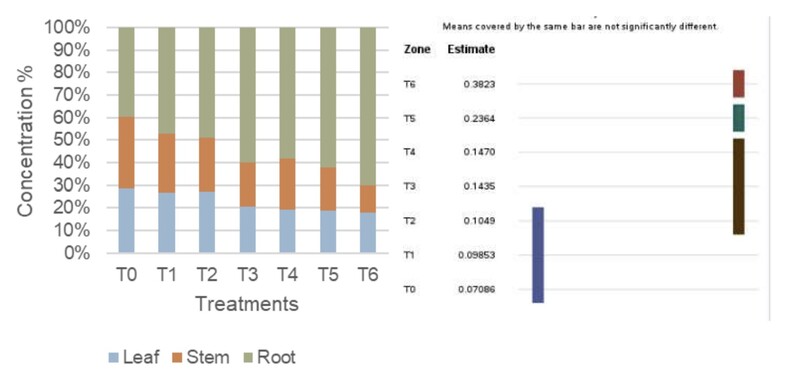
Effect of Cd concentration level on the seedlings of Xylocarpus Mekongensis's Accumulation percetage
